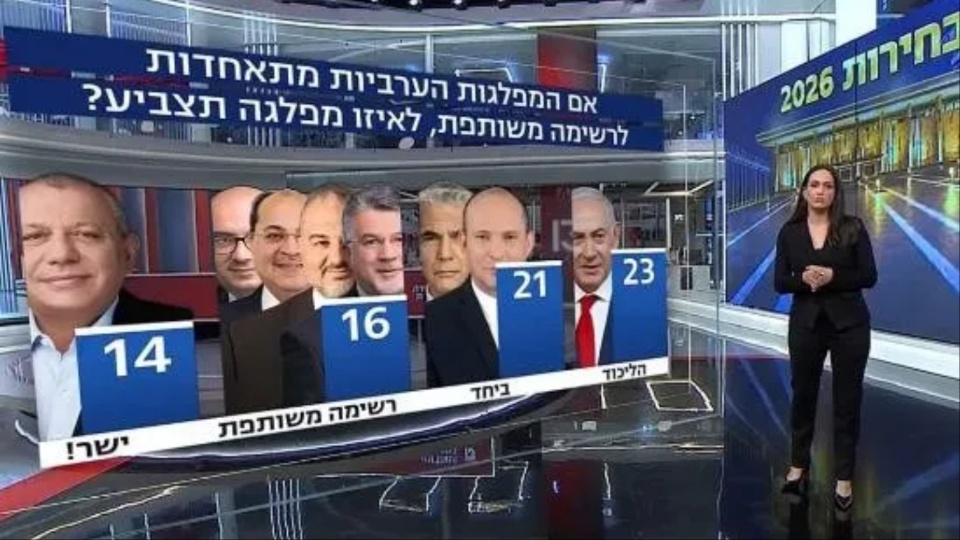
TEL AVIV—If the elections for the Israeli legislature, the Knesset, were held today, the “Joint List”—an alliance of Arab-majority political parties—would become the third largest party in, according to the results of a poll taken last week. Elections are due sometime before Oct. 27, 2026.
According to the poll, the Joint List would receive 16 seats, with Prime Minister Benjamin Netanyahu’s Likud Party dropping to 23 seats and center-right Opposition Leader and former Prime Minister Yair Lapid’s “Together” alliance dropping to 21 seats.
In this scenario, Netanyahu’s far-right bloc would drop to 53 seats, while the anti-Netanyahu bloc of Zionist parties would drop to 51 seats. In order to form an alternative government, the opposition parties would need to work out a coalition deal giving them a majority of 67 Knesset members.
The Joint List is composed of four member parties. Leading it is Hadash, the Democratic Front for Peace and Equality, a left-wing Arab-Jewish coalition with the Israeli Communist Party at its core. Joining Hadash is Ta’al (Arab Movement for Change), a secular nationalist party; Balad (National Democratic Assembly, another secular Palestinian nationalist party; and Ra’am (United Arab List), an Islamist social conservative party.
The Joint List was established in 2015 but dissolved in 2021. In January of this year, the four member parties agreed to revive their cooperation for the 2026 elections.
The chairman of the Hadash candidate slate, Dr. Yosef Jabarin, said that the Joint List “is the key to bringing down the government.” Jabarin participated in the weekly Hadash-Ta’al faction meeting at the Knesset building and added:
“Only the Joint List will bring down the government on the first day of the Knesset. I guarantee that [National Security Minister Itamar] Ben-Gvir and [Finance Minister Bezalel] Smotrich will not be in the government. We will bring about a strong Jewish-Arab partnership.”
The poll also examined the political map without the Joint List competing, and it shows that the Likud, led by Netanyahu, would increase to 25 seats. This is in light of a three-seat drop for the Together party led by Lapid and fellow former Prime Minster Naftali Bennett, which receives 23 seats compared to 26 in a previous poll. Gadi Eisenkot’s “Yashar” party, another Zionist ideological entity, would come third with 14 seats, an increase of two seats compared to the previous survey.
Itamar Ben-Gvir’s Otzma Yehudit and Aryeh Deri’s Shas receive 10 seats each in the poll, followed by Yair Golan’s Democrats with nine seats. Avigdor Lieberman’s Yisrael Beiteinu receives eight seats, an increase of one seat compared to the previous poll, and United Torah Judaism is stable with seven seats.
Hadash-Ta’al increases by one seat and receives six seats, while Mansur Abbas’s Ra’am decreases by one seat to four. Smotrich’s Religious Zionism party would stand on the verge of the electoral threshold with four seats.
Not passing the threshold: Balad (2.2%), the Reservists led by Yoaz Hendel (1.6%), and Blue and White led by Benny Gantz (1.2%).
Looking at the map of the blocs, Netanyahu’s coalition would have 56 seats, while the bloc of opponents of Netanyahu of the Zionist parties would total 54 seats, with Hadash-Ta’al and Ra’am at a combined 10 seats if they ran separately.
The poll also asked the question, “What kind of government would you like to see formed after the next elections?”, to which 27% said they prefer a government with the current composition, signalling support for Netanyahu to continue as PM. Some 24% want a government of the opposition parties without Hadash and the Arab parties, 23% want a government of the opposition parties including Hadash and the Arab parties, and 20% would like a unity government that includes parties from both blocs.
The survey also asked, “Who do you think won the war between the U.S./Israel and Iran?”, and only 27% responded that they think Israel and the U.S. won, compared to 40% who think Iran won and 33% who responded that they do not know.
Also, only 27% of the public believe that Israel’s security situation has improved following the war with Iran, compared to 34% who think that the security situation has worsened and 39% who responded that the situation has remained unchanged.
The polling results suggest that the political situation in Israel remains intensely divided but that maintaining the unity of the non-Zionist, joint Arab-Jewish opposition forces could create a political bloc in the Knesset with the bargaining power to push Israeli domestic and foreign policy in a different direction.
We hope you appreciated this article. At People’s World, we believe news and information should be free and accessible to all, but we need your help. Our journalism is free of corporate influence and paywalls because we are totally reader-supported. Only you, our readers and supporters, make this possible. If you enjoy reading People’s World and the stories we bring you, please support our work by donating or becoming a monthly sustainer today. Thank you!
CONTRIBUTOR