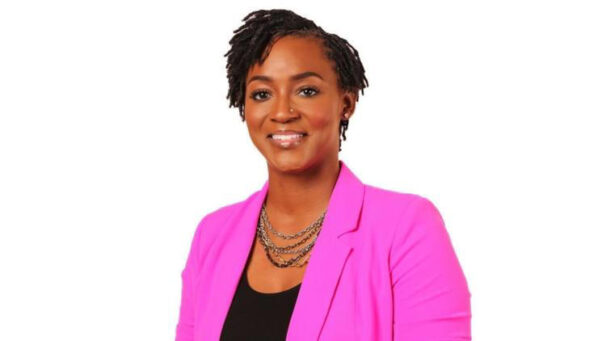
JACKSONVILLE, Fla.—Democratic Socialist Angie Nixon won an upset victory over Alexander Vindman in the Aug. 18 U.S. Senate Democratic primary in Florida. Vindman had a 16-to-1 funding advantage over Nixon and the backing of the Democratic Party’s national leadership but still lost by a wide margin, 56% to 44%.
Nixon, a state representative from Jacksonville who has openly declared her affiliation with the Democratic Socialists of America, faces what is expected to be a well-funded GOP campaign against her.
By contrast, Vindman—who rose to fame in Democratic circles after being fired by President Donald Trump from the National Security Council for being a whistleblower—was backed by party leaders who have been critical of DSA and allied groups and have explicitly expressed their support for capitalism over socialism.
Both Nixon and Vindman ran as progressives, with Vindman boasting that he’s “a true outsider” who never held elected office—he was a career military officer until Trump terminated him—and that he didn’t take corporate campaign cash, though he did receive extensive out-of-state contributions.
Nixon relied on volunteers, shoe leather, and a down-to-earth message about helping hurting people.
Tired of corporate-backed politics
“We have proved that everyday people are more powerful than corporations and billionaires,” Nixon said in her victory speech. “We went up against the political establishment, against millions of dollars of outside spending. We were outspent, and we won. This win was for the little guys and girls.”
And while Nixon is a Democratic Socialist, she also told Florida Politics in an Election Day interview that “I’m also a Democrat; I’m also a member of the Florida Public Services Union.”
“Floridians are tired of corporate-backed politics as usual. They want a proven working-class fighter who actually meets with them, listens to them, and understands the daily struggle of hardships like skyrocketing rent, medical debt, and property insurance,” Nixon said.
“Our campaign isn’t powered by Washington insiders or ultra-rich donors. It’s powered by teachers, nurses, union workers—everyday Floridians… A true, people-powered movement is the only way we can motivate working families and beat Ashley Moody in November.”
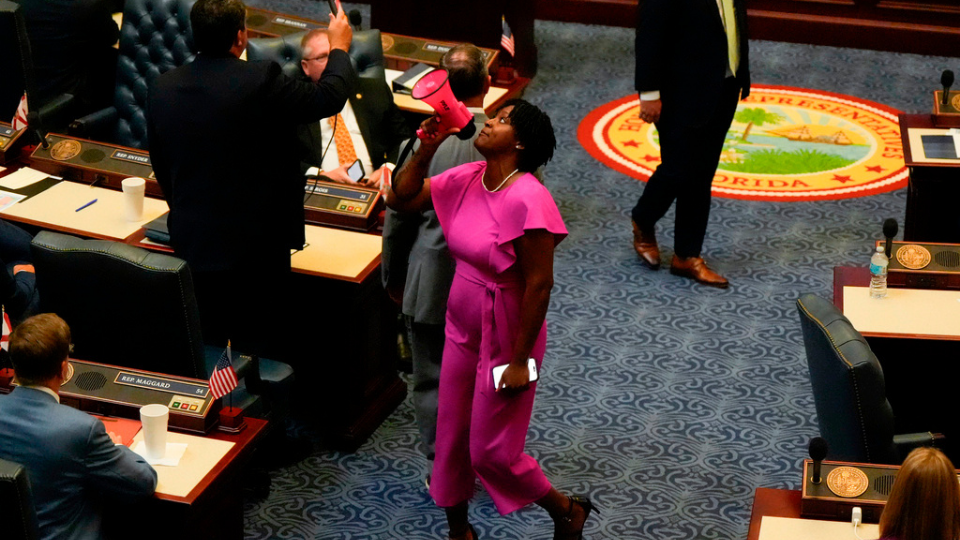
Nixon also showed a knack for garnering free publicity. When Trump and Florida Gov. Ron DeSantis pushed the Republican remap through, she loudly—literally—led the opposition on the state House floor, shouting through a pink bullhorn. Four years earlier, as a newly elected state representative, she conducted a sit-in against the prior redistricting and got arrested.
Nixon will go up against Ashley Moody, the incumbent Republican senator who won her primary with 79.6% of the vote Tuesday night. Moody was appointed a year and a half ago to fill the seat vacated by Marco Rubio when he was appointed Secretary of State.
The rightward tilt of the Florida electorate means that winning the race to replace the extremist DeSantis will be a major challenge for Nixon. One of the things she has going for her, however, is the fact that Republicans are afraid to campaign on the issues Americans are most concerned about—the high cost of living and the war on Iran which is fueling inflation.
The GOP is relying on a message of fear, warning voters that Democrats are allied with socialists and communists, groups they should not support. Primary election results thus far across the country, including Nixon’s victory, indicate that voters are looking for more than just resurrected McCarthyism from candidates.
Mixed story statewide
The Florida Democratic senatorial race was one of several in the Sunshine State pitting the favorite of party leadership insiders against an insurgent. And while members or backers of DSA have won mayoral contests in New York and Seattle and U.S. House Democratic nominations in New York, Colorado, Pennsylvania, and elsewhere, statewide races have been another story for both DSA hopefuls and, in Florida, other progressives.
State Rep. Dayna Marie Foster, who champions unions, fully funded schools, migrants’ rights—including legalization—and who wants to abolish ICE, lost in the Democratic gubernatorial primary to former Rep. David Jolly.
Jolly is a corporate-oriented former Republican congressman who migrated by fits and starts to the Democrats. He won 63% of the vote, with Foster at 14% and state Rep. Dotie Joseph at 10%. In November, Jolly will face Republican U.S. Rep. Byron Donalds, who is African-American.
The race for the GOP gubernatorial nomination was a test of strength between Trump, who backed Donalds, and the term-limited DeSantis, who covertly pushed his lieutenant governor, Jay Collins, into the race. Thanks to Trump, Donalds won a multi-candidate race by a two-to-one ratio over Collins but didn’t win a majority of the vote.
Establishment Democratic U.S. Rep. Debbie Wasserman Schultz and Jared Moskowitz, whom the heavily gerrymandered GOP legislature tried to defeat by erasing their districts, both won their primaries.
The new district map, drawn at Trump’s behest, eliminated four of the state’s Democratic-held House seats. Showing the white and “Christian” nationalist slant of the GOP majority in Tallahassee, two of Florida’s four Jewish lawmakers—Wasserman Schultz and Moskowitz—saw their districts axed, as did two of the four African-American Democrats. The state delegation, before the remap, is 20-7 Republican, with one vacancy. The remap could jack the GOP margin up to 24-4.
Lawmakers threw Moskowitz into an Atlantic Coast shoreline district stretching from Broward County to Miami Beach. It’s viewed as one of the few real tossup districts in Florida. He won his primary with 63% of the vote.
Wasserman Schultz became notorious in 2016. As chair of the Democratic National Committee, many progressives felt she tilted the party apparatus and the convention against Sen. Bernie Sanders, Ind-Vt., in favor of former Secretary of State Hillary Rodham Clinton. Wasserman Schultz is also a favorite of the politically toxic American Israel Public Affairs Committee, or AIPAC.
Wasserman Schultz’s former district was heavily Jewish, but when the lines were redrawn, her house was in a majority-Black district, and she refused to move. That angered many of the members of the Congressional Black Caucus.
Nationwide, analysts say the remaps could cost the CBC up to 19 of its 62 members. And the caucus members are the most-reliable and consistent supporters in the U.S. House of workers and their causes. One CBC member, veteran Rep. Bobby Scott, D-Va., would reclaim the chair of the House Education and the Workforce Committee should Democrats win the majority—and then change the panel’s name (again) to its original wording, Education and Labor.
Three African-Americans ran against Wasserman Schultz, and they split the vote. She won 45.4%. Her nearest competitor, businessman Dale V.C. Holness, got half of that.
Battlegrounds elsewhere
While Florida was a major battleground on Aug.18, it wasn’t the only one.
Wyoming and Alaska also held primaries, and California had a special runoff election for a vacant congressional seat in the San Francisco Bay area. That, too, turned into a brawl, with more than $3 million in AIPAC spending against the progressive Afghan-American Democrat, State Sen. Aisha Wahab, as a key feature.
Wahab finished first in the initial round of voting in early June, with 43% of the vote. Her Democratic foe, Bay Area Rapid Transit board member Melissa Hernandez, considered more moderate and endorsed by the state Democratic Party, was second, with 17%. She criticizes Israel’s continuing war on Gaza but won’t stop U.S. aid. Wahab calls the war genocide and would vote to stop the flow of U.S. funds to the Israeli military.
With 62% of the vote counted in the runoff, Wahab led 51% to 49%, but at least 40,000 votes remained to be counted. The winner will take the seat held by former Rep. Eric Swalwell, and there will be yet another rematch, for a full two-year term, between Wahab and Hernandez in November.
Alaska uses ranked-choice voting for its offices, and that produced a traffic jam of candidates in both the U.S. Senate and gubernatorial races. The top four, regardless of party, advance to the Nov.3 election.
The main focus in Alaska was on the U.S. Senate race. Former Rep. Mary Peltola (D) led the field with nearly half of the 80% of ballots counted so far, at least for first-choice votes.
The first Alaska Native American to represent the state in Congress, Peltola broke a 49-year GOP stranglehold on the state’s sole U.S. House seat by winning a special election several years ago before narrowly losing it in 2024.
In second place, with 43%, is incumbent GOP Sen. Daniel S. Sullivan, seeking a third term. A down-the-line Trump supporter, he’s been criticized for voting with the president even when the vote hurts his state.
Running third was another Republican named Daniel Sullivan, this time a Daniel J. Sullivan. He has 2.4% of the vote, enough right now to put him in the final four for November. Republicans worry that since he has the same name as their candidate who came in second, he will draw votes from him, increasing the chance of a Peltola victory in November and then a takeover of the U.S. Senate by Democrats.
Trump’s endorsement is no guarantee
When Trump famously rode the escalator at Trump Towers in New York to announce his first run for the presidency, he was unknown as a political candidate. By now, however, after having taken over the Republican Party completely, he has become the new GOP establishment.
Increasingly, as can be expected when someone is viewed as the “establishment” over a period of time, people have been coming forward to oppose his choices in primary elections.
Those candidates are, however, also MAGA supporters trying to gain office by claiming a measure of independence from Trump. They are, nevertheless, right-wingers offering little alternative.
Three such Trump-backed candidates were defeated in the GOP primaries on Tuesday. They were, in Florida, Rep. Cory Mills, who lost to TV anchor Ryan Elijah, and businesswoman and ex-Trump administration official Catalina Lauf, who lost to business executive Jim Schwartzel.
We hope you appreciated this article. At People’s World, we believe news and information should be free and accessible to all, but we need your help. Our journalism is free of corporate influence and paywalls because we are totally reader-supported. Only you, our readers and supporters, make this possible. If you enjoy reading People’s World and the stories we bring you, please support our work by donating or becoming a monthly sustainer today. Thank you!
CONTRIBUTOR