NEW YORK—A coalition of Muslims, Sikhs, Hindus, and Americans United for Separation of Church and State is suing the Trump regime in federal court in Manhattan over its White House Religious Advisory Commission. They say it’s illegally skewed to evangelical Christians, plus one Orthodox Jewish rabbi.
The suit comes as the commission continues to meet behind closed doors at the relatively new Museum of the Bible, in southwest D.C., several blocks from the U.S. Capitol. The museum, too, has an evangelical Christian origin.
Represented by lawyers for Democracy Forward and Americans United, the groups rest their case on the 1972 Federal Advisory Committee Act, which says all such panels throughout the U.S. government should reflect a variety of viewpoints and include competing ideas.
This commission, the coalition says, doesn’t have variety and competition. They want the judges to order its proceedings to be opened up, its minutes published—as the advisory committee law requires—and that its report, if there is one, to include the fact that the commission itself was illegally tilted.
Though the suit cites the advisory committee law, it includes the values embodied in the U.S. Constitution and in U.S. history, even before the American Revolution. A variety of religions were present in the colonies before the Declaration of Independence. There was no “established church,” unlike the Church of England in Great Britain alone.
Most New England pilgrims were Protestant dissenters. Roman Catholics founded and dominated Maryland. Quakers established Pennsylvania. Jews first arrived in Nieuw Amsterdam—now New York—in the 1600s, which was already inhabited by members of the Dutch Reformed Church. White Baptists, who at that time were persecuted in Europe, were prevalent in the deep South. And Roger Williams established freedom for all religions in Rhode Island.
The founders, too, were a varied lot, the suit notes, quoting George Washington’s letters about religious freedom to various denominations, Thomas Jefferson’s deism, and others. The most famous Washington letter was in 1790 to the elders of Touro Synagogue in Rhode Island, where he wrote the government “gives to bigotry no sanction, to persecution no assistance.”
And the Constitution’s 1st Amendment says “Congress shall make no law respecting an establishment of religion or prohibiting the free exercise thereof.”
“This case challenges the composition and secrecy of the Religious Liberty Commission,” the lawsuit opens. “While this body is ostensibly designed to defend religious liberty for all Americans,” and celebrate “religious pluralism,” it actually represents only a single “Judeo-Christian” viewpoint.
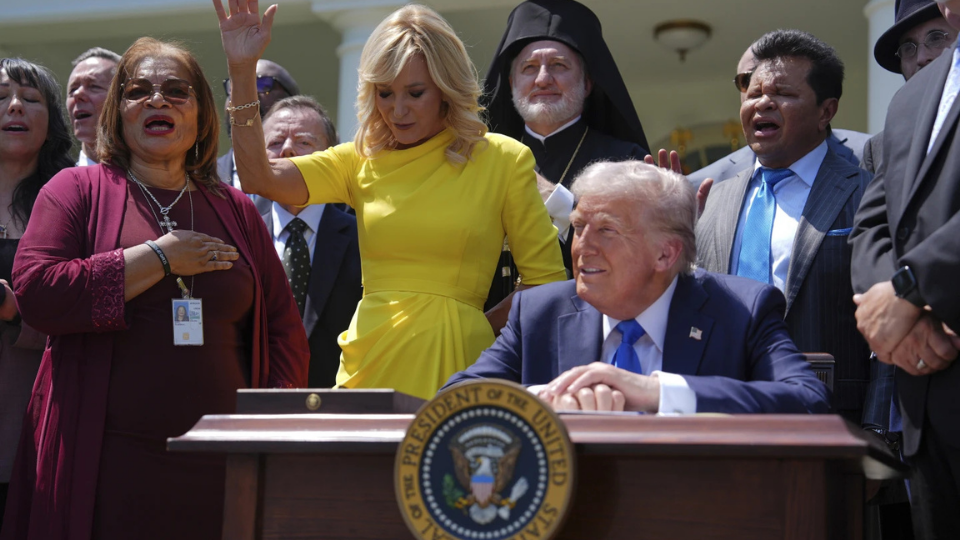
It held its first three meetings at the Museum of the Bible and has closed its meetings with a Christian prayer, “in Jesus’ name.” Only one of its members is not Christian, and the Christian members do not represent the full diversity of the Christian faith. Meetings repeatedly referenced the belief that the United States was founded as a “Judeo-Christian nation,” and the membership reflects that viewpoint.
“All members of the commission advocate for increased religiosity, and specifically their brand of Judeo-Christian religiosity, in public life. Members promoted the primacy of a Judeo-Christian worldview in the public sphere, advocated for discrimination against minority groups under the guise of ‘religious liberty,’ and otherwise supported policies that threaten religious freedom for all those who do not conform to their particular worldview.”
And all that occurred even before the Trump regime Secretary of War Pete Hegseth declared “God is good” when the U.S., on Easter Sunday, rescued a warplane pilot shot down over Iran. Earlier in the U.S. war on Iran, Hegseth asked Americans to “pray for victory in the name of Jesus Christ.”
That statement particularly steamed Pope Leo XIV, the first U.S.-born Pope and a Chicago-area native. The Christian mission, the Pope said, “has often been distorted by a desire for domination.”
“Religious freedom for some is religious freedom for none,” said Rev. Paul Brandeis Raushenbush, President and CEO of Interfaith Alliance. “The government has no right to pick and choose which religious beliefs to promote, and which to marginalize. The Trump administration has failed to uphold our country’s proud religious freedom tradition, and we will hold them accountable. Today’s lawsuit is our recommitment to fight for religious liberty for all with every tool available to us.”
“As a Muslim-American organization, we have seen firsthand how elevating a singular religion above others, especially in a country as religiously diverse as the United States, leads to the oppression and possible persecution of minority faiths,” said Ani Zonneveld, President and founder of Muslims for Progressive Values. “As Americans, we must work together so no form of religious supremacy cements itself in our country.”
“Religious liberty means religious liberty for everyone, not just one faith community,” added Ria Chakrabarty, Senior Policy Director of Hindus for Human Rights. “By stacking this Religious Liberty Commission with a narrow set of voices and hiding the commission’s work from the public eye, the Trump administration is evading the transparency and balance that federal law requires. Hindus for Human Rights is proud to stand with our multi-faith partners to defend a pluralistic democracy where Hindus, Muslims, Sikhs, Jews, Christians, Buddhists, and nonreligious people all belong as equals.”
“To stop these violations before the secretive, unfairly imbalanced commission produces what will inevitably be a biased report and policy recommendations” under a September 30 deadline, the groups “seek a court order…declaring creation and administration of the commission violates the Federal Advisory Committee Act by failing to ensure the commission is fairly balanced, not properly constituted and any report or recommendation does not reflect the views of a lawfully constituted advisory committee.” They want the judges to require its report includes “a disclaimer stating the report was produced in violation of” the law’s rule for balance ‘in terms of the points of view represented.’”
Pope Leo IV has joined in international challenges to the Trump administration’s use of religion to justify its wars and attacks on human rights around the world. Earlier this week, the Pope condemned threats by the administration to destroy civilian infrastructure in Iran by calling such attacks a violation of international law.
Earlier in the month, he condemned those who would pray for success in killing the “enemy” in war, saying that such prayers are not ones that would be answered by God. The reference was an obvious one to remarks made by Defense Secretary Pete Hegseth, who prefers to call himself Secretary of War.
There are reports now that the Pope is under threat by the U.S. for his outspoken peace policy. After the Pope delivered his “State of the World Speech” in February, the Vatican’s ambassador to the U.S., Cardinal Christophe Pierre, was summoned to a closed-door meeting at the Pentagon where he was attacked for the Vatican’s taking of positions that contradicted the militaristic policies of the U.S.
The Pope declared in the speech that a policy of dialogue and diplomacy was being replaced by a policy of militarism and support for war. He delivered his speech at a time when the U.S. had kidnapped Venezuela’s president, laid claim to Greenland and Canada, and increased its bellicose remarks directed at Cuba.
The Pope’s envoy was reminded at the Pentagon that the U.S. was the most powerful country on Earth and in a position to, if it wished, force even the Pope out of power.
The Vatican was so alarmed by the arm-twisting of its envoy at the Pentagon that it canceled plans for the Pope, the first American-born pontiff, to visit the U.S. this year during the 250th anniversary celebrations of the United States. Instead, the Pope will visit an island in the Mediterranean on July 4, Lampidusa near Sicily, where immigrants were washed ashore with many dying in transit to Europe.
Hegseth has doubled down on his bringing in of God to justify U.S. war policy. He declared yesterday that the U.S. war on Iran was “guided by divine Providence.”
We hope you appreciated this article. At People’s World, we believe news and information should be free and accessible to all, but we need your help. Our journalism is free of corporate influence and paywalls because we are totally reader-supported. Only you, our readers and supporters, make this possible. If you enjoy reading People’s World and the stories we bring you, please support our work by donating or becoming a monthly sustainer today. Thank you!
CONTRIBUTOR