“But today we return! We return from the slavery of uniform, which the
world’s madness demanded us to don, to the freedom of civil garb. We stand
again to look America squarely in the face and call a spade a spade… This
country of ours, despite all its better souls have done and dreamed, is yet a
shameful land.” —W.E.B. Du Bois, “Returning Soldier,” The Crisis, 1919
Du Bois’s searing meditation on the return of African-American World War I soldiers captures the contradictions faced by men who fought for democracy abroad only to encounter racial terror at home. Among those soldiers—now largely absent from historical memory—was Oliver Law.
In 1919, as veterans returned from Europe, the Ku Klux Klan reemerged nationwide, and white mobs lynched seventy-six African Americans, the highest number since 1908. Law returned to a nation more violently divided by race and class than the one he had left. Du Bois famously declared that “the problem of the twentieth century is the problem of the color line,” and he initially hoped that African-American participation in the Great War might soften it. Yet Du Bois himself embodied unresolved contradictions: A critic of capitalism who reluctantly joined the Communist Party of the United States of America (CPUSA) in 1961, at the age of 93, and an advocate of African American advancement who at times recoiled from radical labor organizing. Law confronted those same tensions from a different position—less as an intellectual and more as a working-class organizer committed to dismantling both racial and class hierarchies.
To understand Law’s significance, one must place his life within the context of the struggle to advance democracy in the Age of Jim Crow. His absence from our collective memories is an indictment of the apparatus that informs our knowledge about Black history.
Born in Matatorda, Texas, in 1899, Law served in the segregated 24th Infantry during World War I. Like countless African Americans escaping racial violence and economic exclusion, he joined the Great Migration North, settling in Chicago. Yet Jim Crow did not remain behind. Langston Hughes captured this painful continuity in his poem “The South,” where the region appears as both seductive and murderous, a place that “spits in my face” even as it demands love. The North, Hughes suggests, offered no warmth—only the possibility of survival.
In Chicago, Law took up a series of jobs and became deeply involved in labor organizing. He forged political kinship with activists such as James Yates, who worked with the International Labor Defense (ILD) and later fought fascism in Spain. Together, they witnessed the persistent exclusion of African-American workers from stable employment. During the Great Depression, Law found work with the Works Progress Administration and a political home in the ILD. By 1932, he had joined the CPUSA. His public denunciations of capitalism and imperialism carried real risks; he was beaten for protesting Italy’s invasion of Ethiopia, an early signal of fascism’s global ambitions.
Labor unions in Northern cities often reinforced, rather than dismantled, racial barriers. The American Federation of Labor manipulated the color line, frequently using Black workers as strikebreakers and exacerbating racial tension. By 1902, forty-three national unions barred Black membership entirely, while twenty-seven others enforced racial exclusion. Against these odds, Law advocated interracial working-class unity. Through the ILD and the CPUSA, he advanced a class-based organizing strategy that sought to confront racism by undermining its economic foundations. This commitment to solidarity would later define his most consequential leadership.
During Black History Month, Americans learn that in the 1930s, Jesse Owens humiliated Nazi racial ideology at the Berlin Olympics, Hughes drafted I Wonder as I Wander, his autobiography about his days during the Spanish Civil War, and Du Bois organized cases such as the Scottsboro Boys. However, there are no references regarding how Law committed himself to the antifascist struggle. The silence of American democracy stood in contrast to Law’s resolve—a faded resolve. The absence of an African-American narrative on the Western Front—and in antifascist memory more broadly—deeply shaped Law’s decision to join the International Brigades in Spain. Historian Robin D. G. Kelley notes that African American radicals did not see nationalism and internationalism as opposing forces, but as mutually reinforcing commitments. African-American volunteers, Kelley argues, were shaped as much by Black folk culture and racial consciousness as by international Marxism. Law embodied this synthesis.
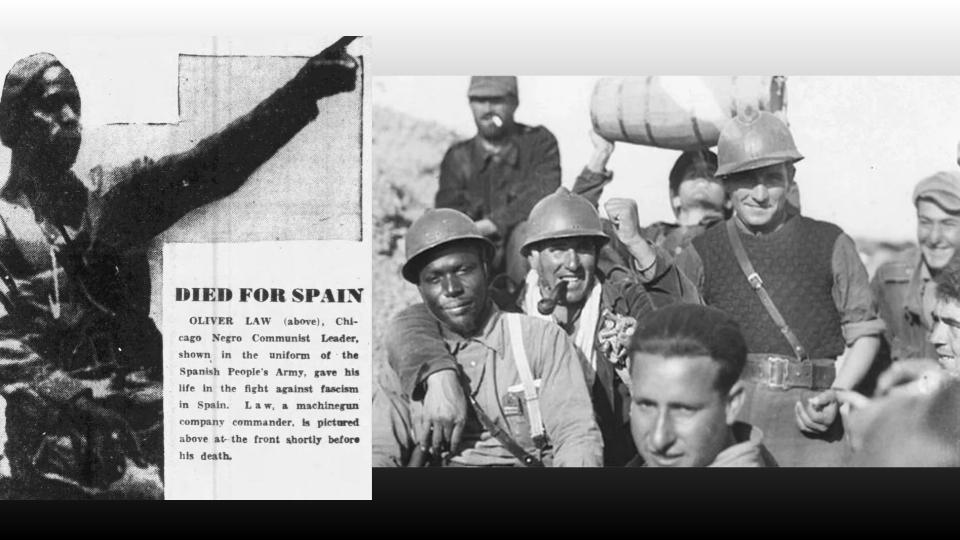
While Richard Wright indicted the American South in Uncle Tom’s Children and Du Bois wrestled with the color line from an academic distance, Law confronted fascism directly. In 1937, he was promoted to captain of the Abraham Lincoln Battalion, becoming the first African-American man to command white American troops in combat. Later that year, he was killed in action.
James Yates reflected on Law’s death with quiet gravity. Riding in a truck through the Spanish heat, alongside the body of his fallen comrade, Yates recalled Law’s rise from Chicago labor meetings to the battlefields of Madrid. “He had made history,” Yates wrote, “and now he was dead.” Decorated during World War I yet denied command at home, Law achieved in Spain what America would not allow: recognition of his leadership, regardless of race. Little has been written about Oliver Law. Some have attempted to diminish his legacy by questioning the circumstances of his death or the extent of his authority, but the historical consensus is unmistakable. Law committed his life to the liberation of others. He confronted racism, capitalism, and fascism not as abstractions, but as lived realities demanding action.
His death, which escapes many today, was reflected upon by his friend and comrade, Yates, who wrote:
“Hey, Oliver is dead. They killed Oliver Law. With me in the open-bodied truck this hot July day were four German comrades, three of them sitting in the back of the truck, and one dead, lying in a wooden casket draped in black. His remains were to be buried in Madrid. I was very quiet. My thoughts were with Oliver Law. I recalled the first time I heard of him in Chicago, and dwelled on our march in Springfield. He had made history on the battlefields of Spain and was now dead. He was the first Black man in U.S. history to become commander of a mostly white unit.”
July 9 marks the anniversary of his death—a date that has passed largely in silence since 1937. In 1987, Chicago Mayor Harold Washington proclaimed November 21 Oliver Law and Abraham Lincoln Brigade Day, a rare public acknowledgment of a forgotten hero. While Du Bois, Wright, and Hughes remain fixtures in classrooms and textbooks, Oliver Law endures on the margins of history. That absence speaks volumes. Remembering him during Black History Month does more than restore a life to memory; it forces a reckoning with the limits America placed on democracy—and with those who dared to fight for it anyway.
We hope you appreciated this article. At People’s World, we believe news and information should be free and accessible to all, but we need your help. Our journalism is free of corporate influence and paywalls because we are totally reader-supported. Only you, our readers and supporters, make this possible. If you enjoy reading People’s World and the stories we bring you, please support our work by donating or becoming a monthly sustainer today. Thank you!
CONTRIBUTOR