

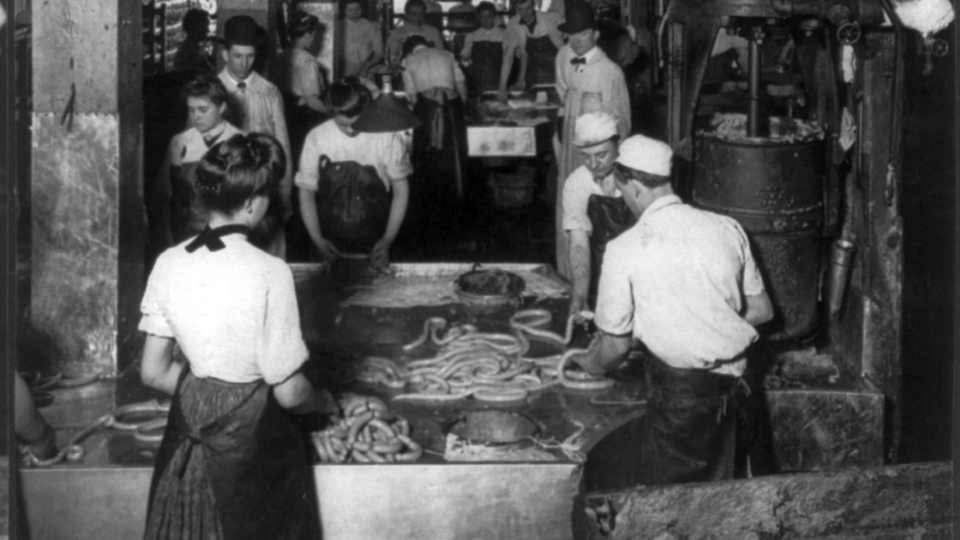
NEW YORK—Shades of Upton Sinclair and his famous exposé, The Jungle, revealing dangerous working conditions and unsafe meat through the nation’s pork processing plants more than 120 years ago. Now, a Republican rural lawmaker wants faster pork and poultry line speeds in processing plants—and the Retail, Wholesale and Department Store Union says that’s dangerous to workers and consumers.
The measure, by Rep. Brad Finstad, R-Minn., whose southern Minnesota-Iowa border district runs the entire width of the state, would extend an Agriculture Department pork processing line speedup, carried out for the past several years as a pilot project in selected plants, to all U.S. pork and poultry plants.
That speedup let the selected plants run pork, chicken, and turkey carcasses at speeds faster than the current USDA limit of 1,106 per hour.
Needless to say, the pork lobby, AKA the National Pork Producers Council, loves his idea. Also, needless to say, OpenSecrets.org, which compiles campaign finance and lobbying figures, reports Finstad, like other members of congressional Agriculture Committees, rakes in some campaign cash from the industries they cover.
“Crop production and basic processing firms” have been the leading donors to Finstad’s re-election campaign for 2026 so far, with a total of $142,307. “Agricultural services and products” are third, at $117,806. Finstad, seeking a third term, has raised $1.95 million.
For RWDSU President Stuart Appelbaum, whose union includes pork and poultry workers, something smells. “Once again, we are seeing a push by industry groups to prioritize profit and production over the health and safety of workers on the frontlines of America’s food supply chain,” he says.
Finstad’s “American Protein Processing Modernization Act is nothing more than a green light for poultry and meat processing companies to run even faster line speeds.”
Finstad, Appelbaum adds, is “ignoring years of evidence that increased speeds endanger workers and compromise food safety. If companies want to move faster, they should move faster to protect their workers, not to squeeze more profit out of them.”
Did it in early 1900s
That’s what pork processors did in the stockyards of Chicago’s South Side during the early 1900s, until Sinclair blew the whistle—and progressive Republican President Teddy Roosevelt took up the cause.
The result was the creation of the Food and Drug Administration, and a crackdown on pork producers who “use everything from the pig but the squeal,” Sinclair wrote, quoting pork baron Gustavus Swift. Not to mention offal, sawdust, and even rat feces from plant floors.
Now, “workers in poultry and meat processing plants already face some of the most dangerous conditions in the country, with high injury rates, repetitive stress disorders, and exposure to hazardous conditions. Faster line speeds mean fewer precious seconds to work safely, meaning greater risk of cuts, slips, and other serious injuries, not to mention less time to ensure food safety,” Appelbaum continued.
“We cannot allow corporations and politicians to roll back protections under the guise of ‘competitiveness.’ True modernization should mean investing in worker safety, stronger enforcement of labor standards, and ensuring our food system is both safe and sustainable.
“The RWDSU will continue to fight alongside workers to oppose this legislation and to demand a food system that values people over profits.”
The pork lobby—and Finstad—see the situation differently.
A fact sheet for Finstad’s bill touts “a proven record of worker safety” at the pilot project plants, “ensuring processors can operate at full capacity beyond arbitrary government deadlines” or “an arbitrary government slowdown.”
And Finstad “requires USDA to publish food safety criteria for operating at increased line speeds, ensuring processors who meet the criteria can continue operating without fear of an arbitrary slowdown.”
This isn’t the first time the pork and poultry producers have tried to speed up production, at workers’ expense. In the Obama administration, pork and poultry plants tried to speed up production lines, too. But they also wanted to remove the USDA inspectors from their oversight of the plants and the carcasses coming out of them.
Instead, the “inspectors” would be middle-level managers at the plants, who would have unspoken incentives to OK as many chicken, turkey, and pork carcasses as possible. That upset the Government Employees (AFGE), who represent the inspectors.
AFGE led an informational picket line in front of USDA headquarters to let consumers know of the threat to workers’ jobs and people’s health. USDA dropped that plan.
We hope you appreciated this article. At People’s World, we believe news and information should be free and accessible to all, but we need your help. Our journalism is free of corporate influence and paywalls because we are totally reader-supported. Only you, our readers and supporters, make this possible. If you enjoy reading People’s World and the stories we bring you, please support our work by donating or becoming a monthly sustainer today. Thank you!
CONTRIBUTOR


MOST POPULAR TODAY

Israeli military attempts to kill war correspondent Steve Sweeney

Trump’s Postmaster General says USPS may shut down in a year

Strategic retreat or strategic pivot? The state of the Target boycott

Praising Trump’s war, monarchist forces hijack Iranian diaspora
Today in history: Critic, playwright, Brecht translator Eric Bentley born