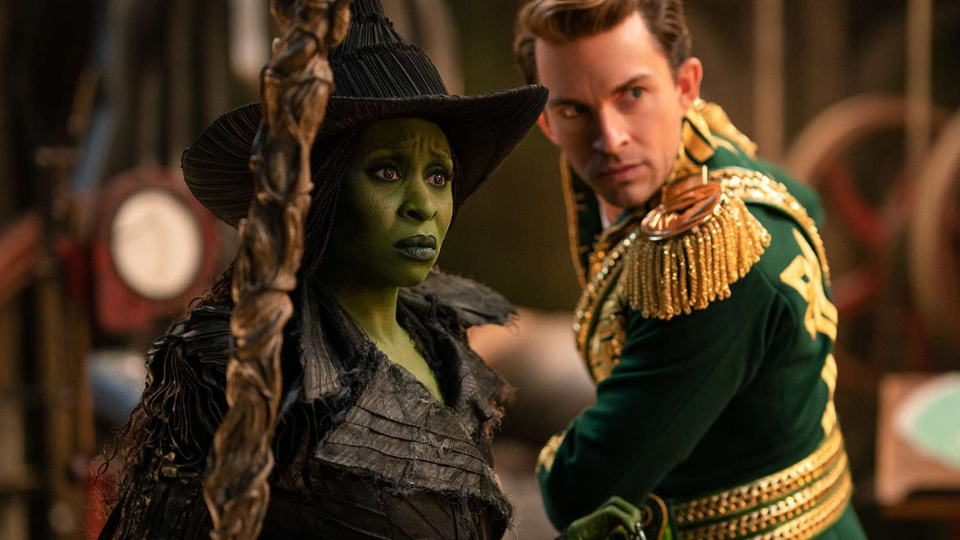
Wicked: For Good is the second part of the Wicked movie musical saga, retelling the story of the so-called “Wicked Witch of the West” from The Wizard of Oz. At the heart of the story is a young woman who has been ostracized for the color of her skin, who rises up against the fascist regime that rules Oz and is vilified for it. When the focus is on the main heroine, Elphaba, and her journey, Wicked is at its strongest—as in the first film. Unfortunately, the second half feels scattered and a bit lopsided, but powerful performances and memorable musical numbers soften the blow. And while the ending feels a bit rushed, the story serves as a beautiful condemnation of oppressive regimes and inequality, with the bonus of beautiful songs along the way.
Picking up where the first film left off, with a slight time-jump, green-skinned Elphaba, now demonized as the Wicked Witch of the West, lives in exile in the Ozian forest, while Glinda resides at the palace in Emerald City, enjoying the perks of fame and popularity. Elphaba has been working to reveal the fact that the ruler of Oz, the Wizard, has no real power and is simply using the non-human residents (the animals who can speak) as scapegoats, taking away their rights and often disappearing them from the streets if they speak up against him.
Essentially, Oz isn’t all magic and rainbows; it is really a bit fascist, as many citizens of the country eat up the propaganda the Wizard and his accomplice, Madame Morrible, dish out. This villainous duo wanted to use Elphaba’s natural magical powers to prolong their reign, but in finding out what they were doing to the animals, Elphaba chose to stand up for good and rebuked the Wizard. Glinda, who was also present during this reveal, chose to side with the regime in exchange for popularity, recognition, and perceived magical power, since she didn’t have any of her own.
Now she’s a political figurehead, positioned as the “Good Witch” in opposition to Elphaba’s “Wicked Witch” in the public eye. Things reach a peak of violence and chaos as the Wizard and Morrible attempt to rid themselves of Elphaba once and for all, forcing everyone to choose which side they truly stand on.
While Wicked (2024) seemed like it could stand on its own as a fully-fledged story, even if a sequel did not occur, Wicked: For Good relies heavily on the audience having the first film freshly in mind while watching. There are many callbacks to previously spoken lines, and the story doesn’t offer much exposition or recap of the previous film. So, if you haven’t seen the 2024 movie in close to a year, you definitely need to brush up on it to get the full impact of the little references thrown in for the concluding movie. It’s a film darker in tone than the first half, as the Wizard’s fascist regime is now in full view, straining relationships. So those looking for a mixture of happier numbers and a bit more levity will be disappointed.
Now, for viewers wanting to get into the meat and potatoes of the core of what Wicked is about—the notion of what it means to truly be “good” in the face of injustice and the complexities of who stands up and who becomes compliant—then you still might be disappointed, as For Good muddies its waters when it comes to the messaging.
Wicked is based on the Broadway musical of the same name, which is a more sanitized, condensed, cohesive—and a lot less depressing— adaptation of the book series Wicked: The Life and Times of the Wicked Witch of the West. The book series is much more adult-themed, graphic, cynical, and in-your-face in its political messaging. The Broadway musical added whimsy, comedy, friendship, and romance to the mix, ultimately making for a more approachable story with a core message that felt similar.
Film director Jon Chu, for the most part, kept much of this, yet he glosses over key elements and characters in the second half, ultimately weakening the impact. He also gives more focus to particular characters than others, resulting in lopsided storytelling.
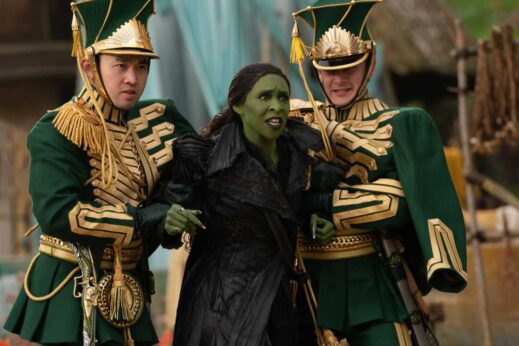
To be clear, this should be Elphaba’s story. While Glinda plays a key role in Elphaba’s life and their friendship is a catalyst for certain plot points, Wicked shines when—like the book series and in many ways the Broadway musical—it zeroes in on Elphaba. And while pop superstar Ariana Grande does a fine job as social-climber Glinda, it would appear that the studio and Chu ultimately felt like Glinda needed more of a fleshed-out character arc to prevent her from being painted as little more than an accomplice to the Wizard’s fascist regime. This fleshing-out seems to have come at the expense of screentime for other characters like Boq and Nessa, although their actors, Ethan Slater and Marissa Bode, do what they can with their very limited time in the film.
One could convincingly argue that Cynthia Erivo as Elphaba symbolizes the plight of Black women in society, an often superexploited and marginalized group that, despite their own hardships, are part of movements seeking justice and equality for all. Glinda, meanwhile, represents a certain type of white womanhood that mistakenly sides with a patriarchal and oppressive system in hopes of protection and privilege, despite the overall drawbacks.
Their friendship can be seen as a tainted sisterhood in which one side (Elphaba) shows unconditional solidarity, while the other (Glinda) offers solidarity only so long as it isn’t inconvenient to herself. And while, even in the Broadway show, Glinda somewhat gets her act together in the end, the real emphasis of her character is how she ultimately loses the people she loves because of her own initial complacency toward or outright support for tyranny.
Wicked: For Good clouds this perspective in the very end, giving Glinda a sort of “reward” that she hasn’t even come close to earning. It’s a change from the Broadway show, an edit that should have stayed on the cutting room floor. Not to mention there’s an unnecessary and bland new original movie song, “The Girl in the Bubble,” that seeks to somehow justify her horrible decisions.
To be even clearer: There is only one heroine in this story, and her name is Elphaba. Glinda is not a victim; nor is she much of a hero. If we were comparing the characters to real groups, Elphaba would represent the 92% of Black women who continue to show up for everyone else during the elections, while Glinda is that 55% of white women who continue to side with far-right trad-wife ideology for their own perceived gains at the ballot box. Softening the blow of that symbolism doesn’t do any favors for the story or the film.
For some reason, Wicked: For Good is nearly 30 minutes shorter than the first movie, and that lack of time is felt. The editing feels a bit scattered as the story jumps around from place to place. The first movie benefited from having most of the plot take place at Shiz University. There are still visually stunning moments, but, as in the first film, some scenes look either washed out or too dark.
Cynthia Erivo continues to shine as misunderstood Elphaba in part two, as she comes to realizations about herself regarding self-preservation and joy—which can also be an act of rebellion in a world that wishes to see you suffer. Elphaba also gets a new original song, “No Place Like Home,” which fits well with the plot as she attempts to convince many of the animals not to flee Oz but to stand and fight for the dream of what their country can truly be. It’s a point that’s very relevant to our own current political terrain. After all, as the Wizard points out, much of what he knows about oppression and propaganda he learned from the place he originally comes from—our non-magical world.
There are moments like these, interwoven throughout the plot, that help drive home the important message that, although Oz may be a fictional place, much of what it deals with is very real.
Best musical numbers to look out for belong to “As Long as You’re Mine,” a powerful duet between Elphaba and Jonathan Bailey as Fiyero, and Erivo’s solo of “No Good Deed.”
Overall, despite some shortcomings, Wicked: For Good is a fitting conclusion to a beautiful story about a young woman who dared to be “wicked” for the sake of true “goodness.”
We hope you appreciated this article. At People’s World, we believe news and information should be free and accessible to all, but we need your help. Our journalism is free of corporate influence and paywalls because we are totally reader-supported. Only you, our readers and supporters, make this possible. If you enjoy reading People’s World and the stories we bring you, please support our work by donating or becoming a monthly sustainer today.
CONTRIBUTOR