

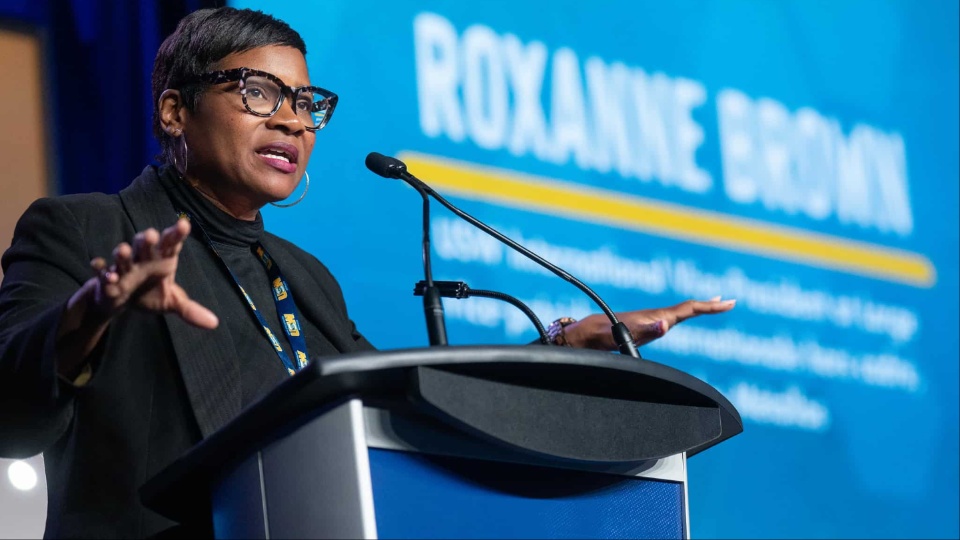
PITTSBURGH—There have been nine installations of new officers since the United Steelworkers Union was founded in 1942. To be honest, these can be boring, stuffy affairs. But there’s a reason why the festivities here on March 1 were something else altogether.
Steelworkers are used to seeing sparks flying, but along with that, the words “historic” and “pride” bounced off the walls as an overflow crowd celebrated nothing less than a new stage in the development of class consciousness of the U.S. labor movement.
The occasion? The unanimous election of 42-year-old Roxanne Brown, a Black woman and an immigrant, to the presidency of the largest industrial labor union in North America. Born in Kingston, Jamaica, and raised in White Plains, N.Y., Brown has been a USW member for 27 years and has served as an international vice president of the union since 2019.
The USW represents more than a million members and retirees. Brown’s unanimous election is an achievement owned not only by Black Steelworker members, not only by women Steelworker members, but most impressively, also enthusiastically shared by white male steelworkers. The hundreds assembled in the room all collectively embraced Brown’s ascendancy as a victory for their shared vision of the labor movement this country needs.
So, this day, the gathering wasn’t the usual navy-blue union jackets and shirts. Instead, there was glitter and flowers, a band and kids and babies and folks who flew in on their own dime packed in so tightly many could only peer in from the jammed hallways.
More than one attendee noted what a stark contrast the working-class pride and joy in that hall made to MAGA gatherings where disrespect and mean-spiritedness are the main vibe.
Among those receiving, embracing, and championing Brown’s leadership was a pantheon of labor leaders and rank-and-filers, including Fred Redmond, the national secretary-treasurer of the AFL-CIO.

Redmond’s election in 2022 as the highest ranking African American officer in the history of America’s labor movement was another important high-water mark. Redmond took the podium clearly in teaching mode. As he laid out the decades-long path—much of which he himself walked—it was clear that this shared vision wouldn’t come to be without struggle and sacrifice. The audience, young and old, Black, brown, and white, followed him closely.
Redmond is a heat treat furnace operator who became president of the Reynolds Aluminum Local 3911 based in west suburban Chicago. At the Pittsburgh gathering, he took the rapt audience through some painful history: Back in 1959 at an NAACP convention, he said, A. Philip Randolph called for the formation of a Black labor organization, the Negro American Labor Council.
Its goal would be to help Black workers organize themselves within unions. There was persistent discrimination, Redmond related, up and down the steel industry, “written into contracts and seniority systems, that limited access to promotions, skilled trades positions” and consigned Black workers to the most dirty, dangerous, low-paid jobs in coke plants and blast furnaces.
Explaining, but not forgiving
Redmond did not gloss over the union’s complicity: “As a labor movement, we are the products of society and the times we live in,” he recognized. But Redmond didn’t leave it at that. Despite that, “we are not passive,” he went on. “Labor can also be a powerful voice that pushes forward.”
In 1964, a group of steelworkers led by Rayfield Mooty formed the Ad Hoc Committee of Concerned Steelworkers. Mooty worked as a cast house overhead furnace operator at Reynolds and had earlier served as president of Local 3911. Leading Ad Hoc, he was joined by historic figures including Ola Kennedy, Oliver Montgomery, Curtis Strong and Jonathan Comer.
Against strong resistance and under the most difficult conditions, they launched a fight for Black staff representatives and a Black leader of the union’s Civil Rights Department. There were almost no such reps, in spite of the union’s 30% Black membership.
Discrimination without and within
The workers understood the connection between the exclusion of Black leaders in the union with the pervasive discrimination within the industry. By 1973, the work initiated by Ad Hoc, including legal action, led to a historic restructuring of contracts and the seniority systems in the nation’s steel industry, which then employed half a million workers.
A consent decree in 1974, though not perfect, opened the door to a reinvigorated union. “The corporations had deliberately and methodically segregated the workplace,” Denise Winebrenner Edwards, the International Secretary-Treasurer of the union’s retiree group, SOAR, told People’s World.

“To change that, we needed quotas—numbers, not empty declarations of management’s ‘good intentions.’” Edwards noted that no union bargaining settles for declarations of good intentions, and it was the quotas—concrete numbers just like any union contract—that guaranteed real gains.
According to New York Times reporting at the time, meeting these goals would cost the companies millions of dollars in higher wages for women and minority workers. Edwards’ characterization took the victory beyond that. “The changes opened the door to building a reinvigorated union,” she said, taking on the business union practices that had wiped out the steward system, imposed a 1972 no-strike agreement, and stifled inner union democracy and membership participation.
The gains initiated by Ad Hoc and its example of rank-and-file-led struggle led to grassroots activism across the board. The changes in seniority and hiring opened up opportunities for white workers as well—including not only women, like Edwards, who completed her millwright apprenticeship at Pittsburgh’s Edgar Thompson works in 1981 and this writer (who, due to quota requirements, was able to get herself hired at U.S. Steel South Works in Chicago in 1974). The changes benefited qualified white men, too, who had also found themselves sidelined by unregulated cronyism.
“The move away from corruption and cronyism made advancement possible for dignified independent people,” Edwards said, “and for a mobilized rank and file.”
It wasn’t only the lines of progression in the plant that needed upgrading. Early days of Steelworker organizing in the 1930s and ’40s had been marked by a push for Black-white unity. “Black and white unite and fight” was one of the slogans under which the union was organized, but keeping it real was an ongoing struggle. The tensions between the business union/racial discrimination vs. struggle unionism/equality trends have been an ongoing thread through the union’s history.
In fact, the issue came up at the union’s founding convention in Cleveland in 1942. The very first executive board of the Steelworkers union had been appointed prior to the convention. It was all white men. Denise Edwards recounted that her late husband, George Edwards, a white steelworker who was vice president of Lorain, Ohio’s 25,000-member Local 1104 at that time, can be found in the union’s archives debating founding president Phillip Murray on the floor of that convention in 1942.
George Edwards was arguing against Murray’s opposition to the new union having a Black vice president. Unfortunately, Murray’s opposition to Black leadership prevailed. The conflicting two tendencies have persisted through the union’s history. And significantly, the resistance to Black leadership has been attached to a tendency to business unionism.
Not many years after that founding convention, unity along with union democracy and rank-and-file activism were all but lost during the late 1940s and ’50s McCarthy period. Then, anti-communism stripped local after local of its Black and white progressive leadership. Business unionism eagerly filled the void.

After that first all-white executive board, typically the route to presidency would run through district directorship and national bargaining experience. This route left no path for a Black president. The Black caucuses had focused on having a voice by insisting on hiring of Black staff reps and the inclusion of a Black vice president position in locals, according to historian Ruth Needleman, author of Black Freedom Fighters in Steel. The first such Black local union VP in a basic steel local was Jonathan Comer who became VP of Gary Local 1011.
Even in the historic 1974 Steelworkers Fightback challenge to the entrenched leadership, it took pressure from the rank-and-file, even on the insurgent Ed Sadlowski campaign, to add Black steelworker Oliver Montgomery to the slate. In response, the incumbent leadership was forced to slate a Black candidate, Leon Lynch, on the McBride slate, and Lynch became the first International Vice President.
Union loses out on benefits of leadership and skills of Black leaders
As important as an achievement that the VP position was, there was still no path to electing a Black president. To be eternally relegated to a VP position meant having a voice—true enough a hard-fought gain—but still did not represent full equality and perhaps most importantly, denied the whole union the benefits of the experience and skills possessed by Black leaders.
In an extensive interview, Redmond described to People’s World the collective vision that his generation of Black and white leaders implemented to make possible the kind of leadership they agreed was needed to ensure the movement’s future.
Redmond described how the union’s new president, Roxanne Brown, won attention as a skilled organizer, inspirational speaker, relentlessly intensive worker, brilliant in both preparation and follow through, policy expert, and effective political lobbyist. But in a labor movement focused on its future, she was also intentionally given the opportunity to work in sectors that have traditionally brought forth new executive leaders in the U.S. labor movement.
“Everyone knows national leaders cut their teeth immersed in the nuts and bolts of contract negotiations,” Edwards told People’s World. Brown came out of the political action-mobilizing side of the union. So, in addition to building those skills, successive presidents after Leo Gerard entrusted to her the difficult oil industry bargaining negotiations, as well as work in a Kentucky uranium processing negotiation.
She developed policy during the Biden administration working for the USW on jobs creation initiatives. “Her fingerprints are on the legislative policies of the Biden administration’s massive Infrastructure Bill that created green jobs and led to a transition,” said Edwards.

Bargaining is the bread and butter of the union, so it’s fitting that’s where leadership needs to prove itself, Redmond explained to People’s World. “But we also know that that’s not where the union grows. It grows in organizing. If the union’s only focus is on contract bargaining and nothing else, we’re gonna die!” Brown’s leadership brings together both needs.
Redmond said that he and the late Gerard, Connelly, and McCall shared a vision of the kind of leadership the union needed to grow: “A leader like Roxanne!”
The lessons from the struggle of Black steelworkers are clearly being embraced by today’s steelworkers at large. The path to a reinvigorated union—one demanded by the vicious corporate offensive—lies through new levels of solidarity, including embracing Black and women leadership.
A big ‘Hell No!’ to corporate America
The unopposed election of Roxanne Brown was a symbol of defiance—a big “Hell no!” to the dream of corporate America and its MAGA frontmen for a forever divided U.S. working class.
In a striking new attitude, the white workers among those gathered in Pittsburgh described the Black leadership and woman leadership as a sign of greater strength, not as a transactional concession.
“I couldn’t be prouder!” a white 20-year union veteran told this reporter from a picket line in Whiting, Ind., where BP is currently locking out 900 Steelworkers.
Women: ‘We-get-shit-done’ leadership
Back at the swearing-in ceremony, “We’re a hugging union,” Brown declared, as she headed to the podium. When she and AFL-CIO President Liz Shuler crossed paths on stage, the pair paused for a tight embrace as they rocked back and forth, hugging the way every woman there recognized what sisters do in our rare moments of triumph.
Referencing the “communities of strong women” in the labor movement, Shuler recalled her own experience of being one of a handful of “women in the brotherhoods.” She remembered her and Brown’s shared mentorship by Fred Redmond. “It’s about lifting each other up,” she said.

She characterized these female communities of “not people looking for the spotlight, but of being the “get-shit-done” type (a remark adlibbed into her prepared speech). Hundreds of female heads nodded assent as she described our shared experience.
Brown’s 20-year rise to leadership of the nation’s largest industrial union was credited to her hard work and brilliance. But Brown herself also paid tribute to the intentional mentorship of those who knew a change was needed and worked systematically to see that happen.
Leaders like Redmond, the late USW presidents Leo Gerard, Lynn Williams, and retiring Dave McCall. They pushed a vision of a grassroots membership that was a fighting union, not a business union. That union included a new kind of leadership as well as a new kind of membership—one that was activated.
Union intentionally fortifies itself
Brown’s unconventional ascendancy to leadership—she’s no one’s son and didn’t come in as someone’s protégée—is of a piece with the union’s very deliberate self-fortification in recent years. It’s a strengthening that’s needed in the face of challenges from a ruthless billionaire class set on lowering wages, eliminating jobs, attacking safety standards, undermining working-class unity, and busting unions.
The historic presidency of a Black woman is not the only sign the Steelworker’s union—both its leadership and rank and file—has been systematically creating a network of paths for activism and for raising class consciousness.
Its extensive Rapid Response Network is based in workplaces as well as locals: It provides real-time education and opportunities to take action, with a coordinator in every local. The network’s thousands of participants receive info alerts and participate in lobby days open to every member, allowing them to take action on issues affecting job safety, retirement security, and more.
Women of Steel, launched in 1992, was formed to give official status and support to training and energizing women who now make up fully 50% of the union’s membership. It carries forward a legacy of unofficial women’s caucuses, providing a vibrant and successful entry point for women steelworkers.
And then there is the union’s formidable retiree organization, which embraces retirees from Steelworkers, their families, and communities. “Get on the bus!” one old-timer told People’s World, is SOAR’s informal slogan.
Furthermore, the union, which includes both U.S. and Canadian steelworkers, has taken steps to purposefully create international solidarity across the North American continent, including exchange visits with Mexican miners and concrete solidarity initiatives with other workers around the world. Such work also includes partnering with unions in 140 countries to form IndustriALL in 2012, which describes itself as “as a global voice to fight against the power of multinational capital.”
Back again at the March 1 installation of officers in Pittsburgh, Cecil Roberts, a sixth-generation coal miner and president emeritus of the United Mine Workers union, introduced the day’s most somber note: “As a young man,” he said, “I went when this nation went to war—a war that should never have been.” The audience knew he was talking about Viet Nam and Iran.
Roberts angrily predicted 20 years in the Middle East. “We’re going to lose working-class kids,” he somberly forecast. “How in the world can someone who is a draft dodger send anyone to war?” The audience came to their feet in sustained, undivided outrage.
Then, Roberts pivoted to lead the crowd in a pledge to:
“Stand with Roxie in negotiations!”
“Stand with Roxie for health care!”
“Stand with Roxie against ICE!”
“Stand with Roxie to make this labor movement the most powerful force on earth!”
Roxanne Brown joins other Black women union presidents: SEIU’s April Verrett and the NEA’s Becky Pringle. Their presidencies are a strong counterpoint to the MAGA narrative maligning the leadership of women and people of color.
MAGA’s narrative for the working class is one of racism and division, calculated degradation and demonization. Despite its megaphone in the corporate press, MAGA can only point to a declining support rate of 24%. On the other hand, unions have won the support of 70% of Americans.
“At a time when people have lost faith in every other institution in this country, people believe in unions,” affirmed the AFL-CIO’s Shuler. “They have faith in our message. It is up to us to show everyone. This is what it can look like!”
Postscript: The lockout of 800 BP oil workers in Whiting, Ind., highlights the union’s challenge. Despite megaprofits, the international leader of the energy industry is demanding pay cuts, job cuts, safety cuts, and union-busting concessions. 94% of the local’s members turned out to vote to reject the company’s union-busting contract. The vote was 98% no. Eric Schultz, the local’s president, told People’s World the workers had confidence in the solidarity and support of the union’s leadership. Not much further down the road, the national steel contract expires in September. The whole nation will be watching closely to see how the steel is tempered.
We hope you appreciated this article. At People’s World, we believe news and information should be free and accessible to all, but we need your help. Our journalism is free of corporate influence and paywalls because we are totally reader-supported. Only you, our readers and supporters, make this possible. If you enjoy reading People’s World and the stories we bring you, please support our work by donating or becoming a monthly sustainer today. Thank you!
CONTRIBUTOR
MOST POPULAR TODAY

Trump’s catalog of constitutional crimes: Long and getting longer

Sixty monuments under fire: The U.S.-Israeli assault on Iran’s cultural memory

The other ‘lizard people’: Why the Epstein files are shattering global theory

As Iran war rages, Netanyahu builds ‘Greater Israel’ from Palestinian and Lebanese land
The Case of the Hollywood 10: Movie moguls launch blacklist in 1947