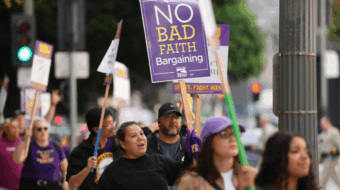
SAN FRANCISCO—The week-long San Francisco teachers strike ended in the wee hours of February 13 with a tentative agreement between the United Educators of San Francisco (UESF), a Teachers/AFT local, and the school board. The teachers and staff returned to schools on February 18, and pending final ratification of the agreement, will remain on the job.
The tentative two-year agreement “will have lasting impacts on our students, communities, and our city. Your endless sacrifice, solidarity, and steadfast belief in a better SFUSD (San Francisco Unified School District) made the district finally prioritize our students and schools we all deserve,” the union said in a statement.
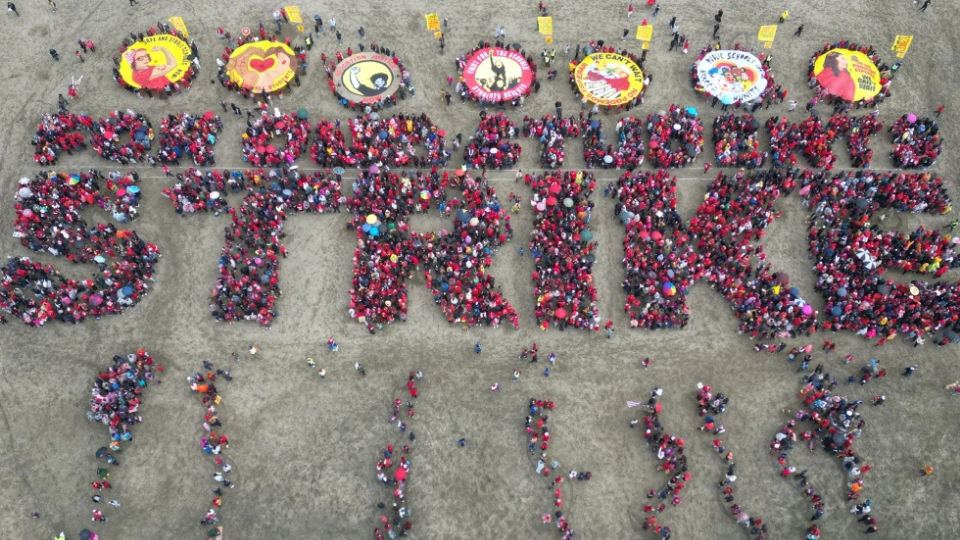
“None of this would have been possible without the thousands of you who have shown up to our board actions, signed petitions to commit to our campaign, written letters to our Board of Education, and—in the last four days—shown up in the rain to support your big bargaining team in the streets and at the beach.” A giant circle of people created a big “support our students” sign at Ocean Beach.
And when teachers called a mass march down the Embarcadero to City Hall during the strike, they not only drew local political support but also more than 20,000 people.
UESF represents 8,900 workers, including 6,400 teachers and 2,500 support staffers. A state report, that criticized the school district, said they teach and tend to the needs of almost 51,000 students, a majority of whom have special needs of various unspecified types.
The teachers are also successful at what they do, the report adds. San Francisco high schools have an 87% graduation rate. But the teachers lag behind their peers, it notes: Of eight Bay Area school districts, San Francisco was fifth in pay, and it suffered such a brain drain of teachers to adjoining districts that some classrooms have been without regular teachers for two years.
Management, pleading poverty despite a $112 million “rainy day fund,” proposed 2% raises over each of the next three years, starting on July 1. The bosses proposed paying for those hikes by eliminating Advanced Placement classes, paid sabbatical leave, department head prep pay, and class size limits.
Management lost on all those points, and the tentative agreement says teachers would receive a 5% raise over two years, while the lower-paid “classified employees,” the support staff, would receive 8.5% over that time and an extra paid floating holiday. Health care for workers and their families would be fully funded with limited cost increases.
The state added that fully paid health insurance for the workers and their families, which the union proposed and won, would cost $14 million more than currently. Besides health care retention and the raises, other tentative wins include more-decent work hours for special ed teachers and staff, continuing the school system’s status as “sanctuary schools” for undocumented children and children of undocumented people, curbs on outsourcing and use of artificial intelligence, and continuing to make schools temporary housing for the homeless.
The key point of the strike, union President Cassondra Curiel told a crowd of her members days before they officially walked, was that teachers and staff acted for their students, not themselves.
“The status quo is failing our students,” she said on February 5. “If we have to strike, we will strike for the students currently without a permanent educator.
“If district management chooses not to take responsibility, we will strike so educators can afford to ensure their families and housing in our communities. If the Board of Education does not take responsibility, we will strike to stop the exodus of highly qualified educators.”
“This strike allowed us to imagine our schools and classrooms as they should be, with staffing levels high enough that our students can learn and thrive. This is a foundation for a stable district,” the union said.
“It was our enduring collective power over 11 months of bargaining before and during the strike that forced SFUSD to prioritize students and educators, and it is our enduring collective power that will ensure that they continue to do so. In a city with historic wealth disparities, our wins tonight have reverberations beyond our classrooms, schools, and city.”
We hope you appreciated this article. At People’s World, we believe news and information should be free and accessible to all, but we need your help. Our journalism is free of corporate influence and paywalls because we are totally reader-supported. Only you, our readers and supporters, make this possible. If you enjoy reading People’s World and the stories we bring you, please support our work by donating or becoming a monthly sustainer today. Thank you!
CONTRIBUTOR