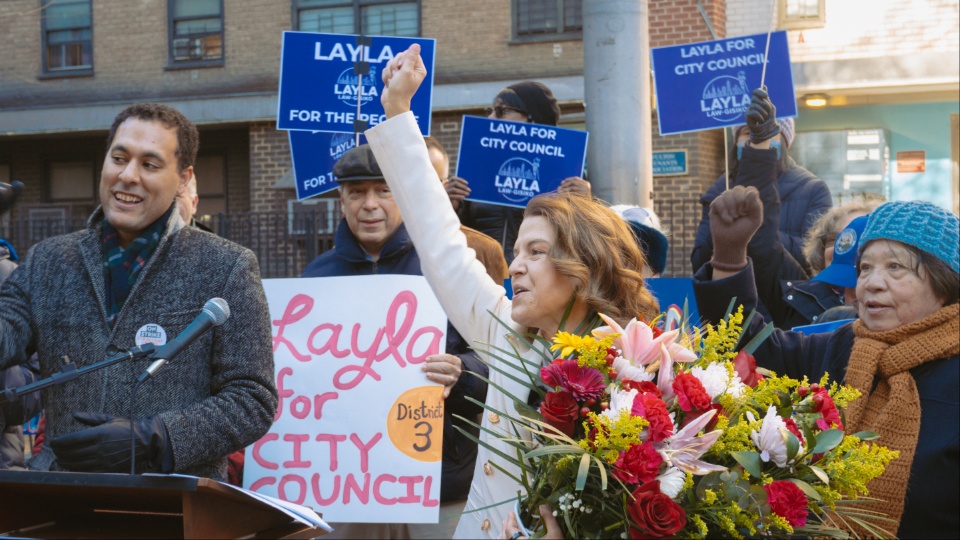
NEW YORK—At a podium surrounded by NYCHA tenants, Layla Law-Gisiko introduced herself for the few who did not already know her personally. “I am so thrilled to be here today to announce that I am running to represent District 3 in the City Council!” With this rally in front of Fulton Houses, the local progressive leader launched her bid to bring Chelsea’s housing crisis to the New York City Council floor.
Law-Gisiko, a Democratic district leader for Assembly District 75, is running to fill Councilmember Erik Bottcher’s seat, expected to be vacated after his run for an open seat in the New York State Senate. Other competitors for the District 3 seat include Carl Wilson, Lindsey Boylan, and Leslie Boghosian Murphy.
Law-Gisiko thanked some present colleagues at the campaign launch, including: Chris Marte, Councilmember, District 1; Vittoria Fariello, Democratic District Leader, Assembly District 61; and Tito Delgado, a local tenant organizer from the “Stop FEC [Fulton & Elliot-Chelsea] Demolition” coalition.
Law-Gisiko looked down at the podium, then toward the tenants, “We’ve worked on issues ranging from hospital closings…protecting municipal retirees’ healthcare…fighting casinos…and—of course—the ongoing fight against demolition of public housing.”

The tenants nodded. “If NYCHA and related have their way, this building behind me—behind us, along with all the other buildings in Fulton and Elliot-Chelsea, will be torn down.” Law-Gisiko motioned toward Fulton Houses, part of the public housing complex NYCHA seeks to put into the hands of private or nonprofit developers, a measure they claim might lessen an alleged $78 billion deficit. The Elliott-Chelsea Houses Tenant Association has long contested the claim. They fight against demolition through legal motions and community education on the true nature of the NYCHA’s plan: privatization.
Law-Gisiko looked around the tenants booing at the mention of NYCHA administrators, “This demolition is the symbol of absurd policies that are based on greed and laced with laziness. The buildings are in need of tender care, not the wrecking ball. These buildings are people’s homes. We cannot, and will not, let this demolition happen.”
Law-Gisiko, in her time as a district leader, developed a close working relationship with the tenants, especially Renee Keitt, president of the Elliott-Chelsea Houses Tenant Association. In August, the two of them spoke to NY1 about how senior citizen tenants—many of which do not speak English—were served 90-day vacate orders, effectively displacing them.
“We need to protect our tenants. We need to bring true affordable housing to the district…. Our district stands as one of the starkest examples of income inequality in New York, a place where gleaming towers sit within distance of NYCHA buildings that are struggling to keep the heat on—I just heard from a tenant, they don’t have hot water in this building!” Law-Gisiko turned to point to the building behind her. A couple tenants to her right interrupted the pause to share personal corroborations.

A moment passed, “This is unacceptable. We are the economic vitality of this district. We, the working class, the artist, the retirees who have spent a life of labor, the children who aspire to learn and to embody our future, the immigrants who seek a better life. We are not disposable—we are not interchangeable. We should not be treated as if we have become some pesky annoyance that comes in the way of maximizing profits and that can be ignored or even vilified…and this is exactly why I am running.”
Toward the end of her speech, as she was given a bouquet of flowers, Law-Gisiko addressed the crowd without the microphone, “This is for all of you guys. All of you, and we’re gonna get this! We’re gonna bring strong, independent government to the City Council!” The crowd cheered, but, as she moved to step aside, Law-Gisiko turned back around and took the mic again.
“So, these flowers are actually very, very significant,” she explained, “a flower shop run by an individual who is at risk today—and you can understand why [a clear allusion to heightened ICE presence]—saw hope in this campaign… [a tenant in the back shouts, “He saw hope!”] He saw energy in this campaign… [the same tenant shouts again, “He saw energy!”] He saw a reason to trust that he will be able to stay here and see his daughter grow up—he saw that in this campaign—and he took the risk and made the effort to close the shop for 10 minutes, come down, and give us these flowers. Thank you.” As she stepped to the side a second time, the crowd closed with a chant: “Law-Gisiko! Law-Gisiko! Law-Gisiko!”
Only after a few endorsements and words from tenant organizer George Weaver and other residents—clearly impromptu from the shyness they approached the podium with—did the rally close.
“Yeah, well, ICE should be abolished. Let’s just start with that.”
In an interview with People’s World a few days after the rally, Law-Gisiko detailed her personal background and key campaign issues.
To start, Law-Gisiko joined the local community board, Manhattan Community Board 5, due to quality-of-life issues she’d experienced as a French immigrant.

“I am a resident of New York. I was born in Paris, France, and I came to this country 29 years ago. Back then—people probably don’t remember—but the economic conditions [in France] were actually very, very hard. So, I came for better professional prospects. I was 25 at the time, and I was very fortunate,” she explained.
Law-Gisiko arrived in the U.S. with two duffel bags and little connection to New York City. She found a way to stay and find work as a freelance journalist and reporter, which left her to navigate “the precarity of an uncertain professional life.” But, she added, “I was always very fortunate to be able to make a living and live in this great city, in this great country.”
Of course, life in the United States came with many of the same difficulties seen in France, especially with poor housing conditions. It was this struggle which revealed to Law-Gisiko “all the tools that existed” for change and, to her, “the great work that one can do for the community.”
“I became passionate about that side of activism: community engagement, and community organizing. And, for 20 years, I served as a member of my local community board.” She’d chaired the Land Use Committee and, “as a result, became very involved in urban planning, land use, and zoning issues in probably one of the most expensive—if not the most expensive—district in New York City.” Law-Gisiko described the experience as an important “learning curve” in her efforts to answer the question: “How do we make sure that we keep the public good at the center of decisions concerning land use, urbanism, and housing?”
The answer presented to her was an apparently disheartening one: “What I saw, especially in my district, which is predominantly the business district, was an overtaking by the interests of developers. They ended up having much more of a say than the local community that was treated either as an afterthought or a nuisance, an encumbrance that needed to be eliminated or ‘dealt with.’”
Law-Gisiko ran for office in 2022, off of this experience. Assemblymember Richard N. Gottfried announced, then, that he was not seeking re-election. “It was an open seat, and I decided to throw my hat in the ring. I ran a very grassroots campaign, as I was a first-time candidate with zero experience in electoral politics, and came close second. That was my awakening to the importance of an electoral process that [up until that point] I had only engaged with as a voter—I always voted.”
The experience resonated with her specifically due to the realization that “there was an opportunity to shape that [the electoral field] so that when voters go to vote, they are more well-served by a choice of candidates that might actually be reflective of their preoccupations and needs.”
Over the course of many years as a producer and documentary director, she’d become acquainted with such needs; she knew very well which preoccupations voters want their political candidates to address.
“I did a lot of current affairs stories about a number of issues–I did a documentary about police brutality that actually ended up being presented at the Shadow Convention, which was this big convention that was held in Philadelphia parallel to the Republican Convention.”

Law-Gisiko went as a guest speaker to the Shadow Convention, which was held in 2000 and featured her documentary War Zone. “It was sort of like a protest convention…. Basically, what I’d noticed is that there was a proliferation in the use of SWAT teams all around the country.” Her documentary explored the repatriation of military-grade weapons to domestic law enforcement agencies after the end of the Cold War. The alarming relevance of this militarization was not lost on Law-Gisiko.
“Yeah, well, ICE should be abolished. Let’s just start with that,” Law-Gisiko asserted. “There is this big “Hands Off New York” movement that gathers dozens of labor groups, political groups, and civic organizations. Chelsea created its own sort of subset under the umbrella of “Hands Off New York” called “Chelsea Neighbors Coalition, and I’m a part of it.”
As she detailed, the group organizes information sessions and canvasses businesses door-to-door, distributing Red Cards and signs which identify private sections for the workplace. She clarified, “you know, we appreciate [sarcastically] that ICE does not encumber themselves with following the law and seeking warrants before they do their interventions, but—at the same time—[the signs] have been effective to then challenge [in court] any actions taken.”
These grassroots defense efforts have been broadly and enthusiastically supported by the Chelsea community. With ICE incursions increasing in Manhattan, such as the recent publicized kidnappings in Chinatown, immigrant New Yorkers—and the daily threat to their livelihoods—are sure to be a top issue in the now-hotly contested race for City Council District 3.
Law-Gisiko’s campaign, acquainted as she is with local tenant and immigrant struggles, is an evidently rare opportunity where voters might indeed be “well-served,” this time by a candidate that could not only be “reflective of their preoccupations and needs,” but one that they might come to see as having already fought for those needs alongside them. Law-Gisiko continues to attend the tenants’ court hearings against NYCHA, and recently held a press conference with them as they prepared for months more of resistance against displacement.
We hope you appreciated this article. At People’s World, we believe news and information should be free and accessible to all, but we need your help. Our journalism is free of corporate influence and paywalls because we are totally reader-supported. Only you, our readers and supporters, make this possible. If you enjoy reading People’s World and the stories we bring you, please support our work by donating or becoming a monthly sustainer today. Thank you!
CONTRIBUTOR