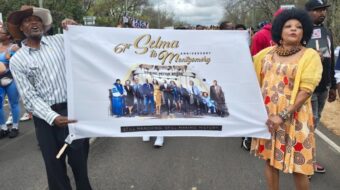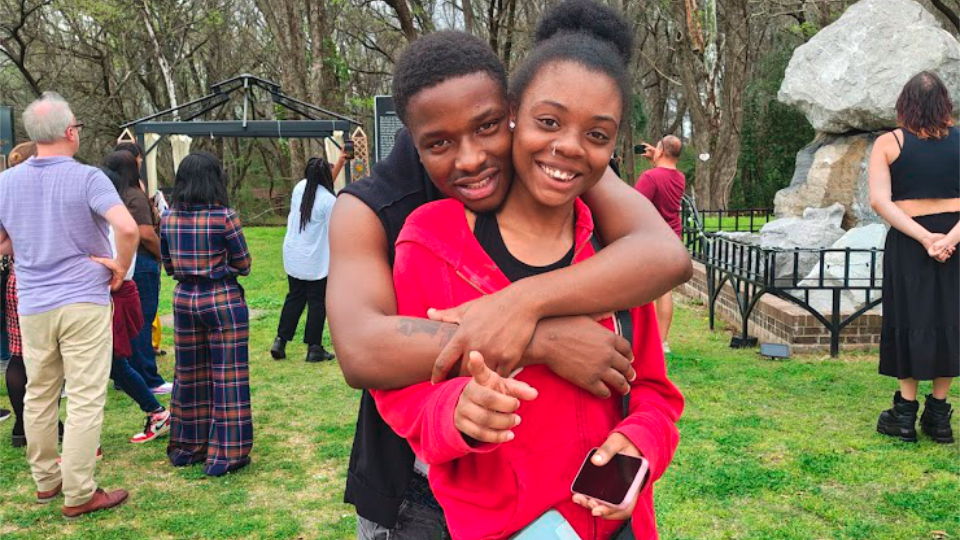
SELMA, Ala.—The streets of Selma buzzed with excitement last weekend. In the lead-up to the 61st anniversary of the infamous Bloody Sunday attack, when unarmed civil rights marchers attempting to cross the Edmund Pettus Bridge were violently brutalized by a gang of Alabama State Troopers, the small Alabama city was transformed into what was effectively one giant convention.
The Bridge Crossing Jubilee, which officially kicked off on Monday, March 2, offered a platform for a wide variety of Black and brown working-class organizations. Theaters, community centers, churches, and lecture halls across Selma played host to teach-ins, rallies, documentary screenings, and even theatrical productions.
While Bloody Sunday was a horrific tragedy, it was also a watershed moment for the Civil Rights Movement. Due to the presence of news media film crews, the attack itself was broadcast live across the country, interrupting regularly scheduled programming on multiple television stations. In one notorious case, the footage interrupted the broadcast of a documentary on the German Nazi Party.
Americans from coast to coast witnessed state-sanctioned, reactionary, violence carried out in their own nation while watching a film covering the state-sanctioned, reactionary, violence of Hitler’s Nazis, a regime that was seen as the antithesis of Americanism in the eyes of the public. The irony was not lost on the people. The footage of events in Selma was so brutal, and so clearly cruel, that it was the catalyst for many to drop their apathy in exchange for solidarity.
Despite the pain carried by the memory of what happened on that day in Selma, the feeling last weekend was not one of sorrow. This entire city, it seemed, felt motivated and uplifted by what can only be described as unabashed joy in the struggle.
Vendors lined Broad Street, selling t-shirts and bumper stickers plastered with images of Black political heroes from the 1960s and beyond. Gospel, hip-hop, funk, and other genres blasted out of car stereos and PA systems.
Hotel parking lots were full, and “No Vacancy” signs lit the street-facing billboards. Black people from all over the country, as well as people of numerous ethnic backgrounds, poured into Selma to partake in this politically-charged celebration of resilience. While the fascist agenda of the current administration in Washington colored the content of the events, fear in the face of this bitter political moment did not cripple the spirit of joyful resistance in Selma. Everyone seemed prepared to be defiant. Or, as the John Lewis would have put it, everyone seemed prepared to get into some “good trouble.”
In the mid-’60s, the Dallas County Courthouse was at the center of the fight against Black disenfranchisement. The building hosted the registrar’s office, which would systemically deny the registration of Black voters using a myriad of legal loopholes and tricks to get around the 15th Amendment to the Constitution.

Last weekend, however, the same building that was once a symbol of white supremacy hosted a comedic mock trial put on by the National Bar Association in which Kristi Noem, portrayed by a volunteer actress, was convicted for murder, reckless endangerment, and misconduct in public office. While the trial was, of course, for show, the Black judge as well as the many Black attorneys involved were no actors.
Actual legal professionals portrayed their real jobs. The “jury” was made up of local Selma High School students. The production was hilarious, drawing loud laughs from the audience at multiple points, but it was also incredibly cathartic.
“The main purpose is just to think alternatively about what could be if we had a justice system that was actually interested in being just, and treating everyone of all classes the same,” said Hamid Saahir, a personal injury and civil rights lawyer as well as a member at large for the National Bar Association. As a Black lawyer working within the U.S. legal system, Saahir is no stranger to its systemic flaws, including those that exist by design.
However, to Saahir, the flaws of the system don’t mean Black and working-class people should avoid working within it. “It’s always been [about] access. The system itself is designed to keep the ones with power in power. So, it’s about trying to figure out how to get over those hurdles.”
What is liberation?
As the production came to a close and the courtroom cleared out, most of the audience proceeded to walk across the street to the Walton Theater, where a screening of a documentary on the Black Voters Matter organization was set to start. During the 2020 presidential election, Georgia shocked the nation when Democratic candidate Joe Biden won the state over incumbent Donald Trump by a slim margin.
It was the first time the state went for the Democratic ticket since 1992, and the on-the-ground work of Black Voters Matter was in large part responsible for those results. The documentary, titled “Love, Joy, and Power: Tools for Liberation,” chronicled the BVM organizers’ journey across the Deep South aboard the affectionately nicknamed “Blackest Bus in America,” registering Black voters and engaging in mutual aid.

The film follows BVM co-founders Cliff Albright and LaTosha Brown, a Bronx-born New Yorker and a Selma native respectively, as well as activist April England-Albright, Cliff’s equally formidable wife. While the content of the documentary was mostly centered around electoral politics, there were many moments where the organizers on screen alluded to some illusive political promised land that exists beyond the ballot box: liberation.
The word appears in the title of the film, and is scattered throughout the snippets of speeches delivered by the BVM team in multiple scenes. Yet at no point did the film define what liberation looks like, or even what it is. After the screening, People’s World caught up with Cliff Albright himself, who was in attendance, to ask him about what liberation means to him.
“That’s a great question,” Albright said, tucked away in a corner of the theater as the audience began to exit, illuminated by the light of the projector displaying the logo of the organization he co-founded. “I think it looks like different things to different people. And I think it’s a challenging question, even for me, because to a certain extent it requires us to think about a reality that none of us have really seen, right?”
Cliff is not alone in being challenged by this question. To peer into the future and imagine a better world while being firmly situated in our oppressive present is a task that has proved difficult for revolutionaries for generations.
Without grounding that vision in some form of scientific analysis, it can become easy to give into the limitless excesses of an imagined utopia. Through daydreaming in this way, one can unintentionally lose touch with the realities of our contemporary class society, a reality that inherently contains the embryo of whatever better world is to come from within it.
After pausing for a moment to ponder his answer, Cliff began to describe his take on liberation.
“Some of the ingredients that I believe it includes are people being able to be their full selves, their best selves, without having to worry about the extra weight and unfair treatment that we face. It’s us being able to get to the full health that we deserve. The full economic justice, economic freedom, that we deserve. To be who we want to be, just as people, whether that’s race, or gender, or identity, or anything. Just to be able to be.”
For a man attempting to describe the indescribable, his answer was lucid, and his face showed a determination that said one thing: Cliff Albright is serious about liberation.
Faith in the struggle
The following morning, a Christian panel discussion on the state of Selma’s contemporary Black community was held at the historic Tabernacle Church, which at one point was the site of the first-ever mass meeting in Selma’s storied history of Black organizing. The Southern Christian Leadership Conference, an organization co-founded by the Rev. Martin Luther King, Jr., hosted the event.

The panel was made up of three Black leaders, each differentiated by their diverse careers but bound together by their shared Christian faith: Judge Vernetta Perkins Walker of the Dallas County District Court, former member of the Georgia State House and SCLC veteran Tyrone Brooks, and the current SCLC field director, Jeremy Ponds.
While still ultimately conveying a sense of hope drawn from the panelists’ faith, the discussion veered in some difficult directions as the panelists grappled with the high murder rate in Selma’s Black community and the perceived performative character of some among the city’s Black leadership. Just the night before, as Judge Walker emphatically pointed out, seven Black people in Selma were shot.
“Where is the urgency?” Walker asked the audience, the despair palpable in her voice. “I’m not here to make you feel good. Dead bodies are on the other side of us performing and not strategizing.” The panelists discussed the differences between the Black leadership of the Civil Rights era and that of today, coming to the conclusion that the effectiveness of the 1960s movement leaders came from the fact that they were pastors and community organizers, not politicians.
It was an ironic statement to hear coming from a panel that included two politicians. The discussion ended with a call to prayer. With hands in the air, the audience was asked to pray in whatever faith tradition they identified with. Afterwards, the conversation continued in a more casual manner outside the church as the attendees waited for the next event, a discussion on Black and brown unity.
Cross-community coalition-building
The panel was supposed to include legendary labor organizer and feminist Delores Huerta as well as civil rights activist and Baptist minister Dr. Bernard LaFayette, Jr. However, LaFayette died the Thursday before and Huerta was unable to attend. The death of LaFayette, as well as the recent death of Rev. Jesse Jackson, served as stark reminders that the powerful voices of the Civil Rights Movement will not be with us forever as more are lost to the unending march of time.
Despite the unfortunate circumstances, the panel continued with former State Sen. Henry “Hank” Sanders, Jarmal Jabbar Sanders of the Alabama New South Coalition, and Frank Barragan of the Alabama Coalition for Immigrant Justice.
The panel, which was focused on the shared interests of Black and Latino Americans as well as divides that exist between the two communities, took the form of an open discussion inclusive of audience participation. Together, the audience and the panel grappled with questions of negative stereotypes while also reflecting on the shared class interests of working people in both communities. At one point, the sole Asian member of the audience pointed out that her community was so often ignored in topics of unity that they were not even listed in the panel’s title.

“It’s easy to divide people, it’s hard to bring people together,” Hank Sanders said. “You can divide people with one lie…but it takes many truths to bring people together.”
Next on the agenda was another panel discussion, titled “Organizing Our Communities for 2026: An Open Discussion.” It was hosted across town at the George Corley Wallace State Community College, in a lecture hall named after the same Hank Sanders who spoke at the previous panel.
The session brought together formerly incarcerated community leader Pastor Kenneth Glasgow, Center for Popular Democracy co-executive director DaMareo Cooper, chief executive officer of the League of Women Voters of the United States Celina Cooper, and Human Rights and Community Relations co-director at the American Federation of Teachers (AFL-CIO) Brendien Mitchell. Topics ranged from the ways in which funding sources force progressive organizations to fight over the same funds to how infighting can cripple the resistance to Trump’s agenda.
Mitchell talked about the ways in which unions can leverage labor to make real, material changes to the conditions of the working class. He detailed how his union has the second largest pension fund in the country and how they voted to divest every cent from Tesla stock in response to Elon Musk’s DOGE cuts.
He also described how his union is the reason Florida schools are still able to teach the topics and books that Gov. Rick DeSantis attempted to ban, such as books on critical race theory and gender expression. Afterwards, the room broke out into a mingling and networking session, and People’s World was able to ask Mitchell how he helps workers move past their fears of employer reprisal when organizing in the often union-hostile U.S. South.
“[AFT President] Randi Weingarten often speaks about the importance of us sharing with folks how unions really lift people up, and the dignity that unions help bring the workers,” Mitchell said, with a grin on his face.
“Working-class folks have been told for so long that you don’t go against your boss, you don’t do those things, you stay in your lane, make sure to keep your head down. Unions say that you rise up together, you come together. But if we’re putting this in a real, just simple kitchen-table-issues context, you say things like, ‘Unionized workers make more money, unionized workers have better benefits.’”
He also made it clear that the benefits of a union go beyond economics, also entering the realm of resistance. “Your union can move beyond just your worksite. It’s in your community. And honestly, if more people were unionized and understood labor solidarity, as I shared in our conversations, we would have a much stronger fightback against the billionaires, the autocrats, and the authoritarian regime we’re facing.”
Mitchell paused for a second. Then, as if he felt he wasn’t being clear enough, added, “That authoritarian regime is backed by billionaires and autocrats who want to see unions die.”
All across the room, representatives of various organizations, as well as unorganized working people, continued to mingle. A member of a Texas-based voter outreach group gushed about her admiration for Angela Davis.

The trending topics of the crowd were politics, labor, race, and liberation. That same word that stood out in the film screening of the prior night was once again being uttered in conversation after conversation.
Sometimes mentioned with an uneasy vagueness, and sometimes spoken about with ideological gusto, the idea of liberation was inescapable in the room. In fact, the idea of liberation was inescapable all weekend.
From devout Christian leaders to labor organizers to political activists, it seems that the one thing everyone present at Selma’s jubilee could confidently agree on was that a better world is possible. And if there is a lesson to be learned from the events of Bloody Sunday, it is that the road to that better world must first cross the bridge of oppression, a bridge relentlessly guarded by a ruling class whose reign is entirely dependent on keeping us on the other side.
There will be roadblocks. There will be barriers. There will be state troopers in gas masks ready to beat us senseless. But we can cross that bridge, we must cross that bridge, because it is our liberation at stake, so many at the jubilee felt.
We hope you appreciated this article. At People’s World, we believe news and information should be free and accessible to all, but we need your help. Our journalism is free of corporate influence and paywalls because we are totally reader-supported. Only you, our readers and supporters, make this possible. If you enjoy reading People’s World and the stories we bring you, please support our work by donating or becoming a monthly sustainer today. Thank you!
CONTRIBUTOR