Silvio Rodríguez is arguably the most important Latin American singer-songwriter of his generation, perhaps of all time. Testament to that is the multi-generational audience in attendance at his most recent concert on September 19 in the “escalinata de la Universidad de la Habana” (the stairway of the University of Havana). An iconic venue, it brings back memories of his 1985 concert at that exact location. Perhaps for some in the audience, it was their second time making their way through the historic, green campus to witness the master poet, guitarist, and musical composer. For many, like myself, it was clearly their first time seeing Silvio live .
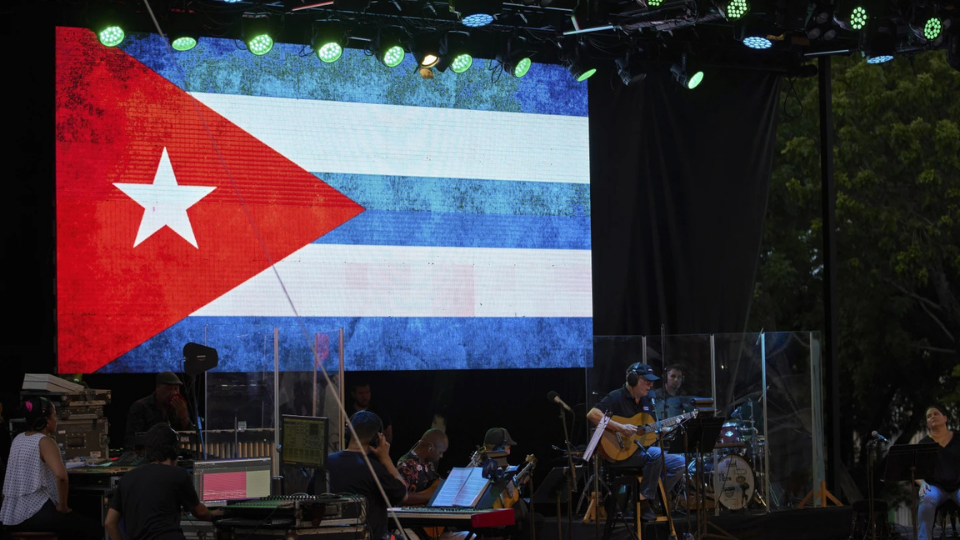
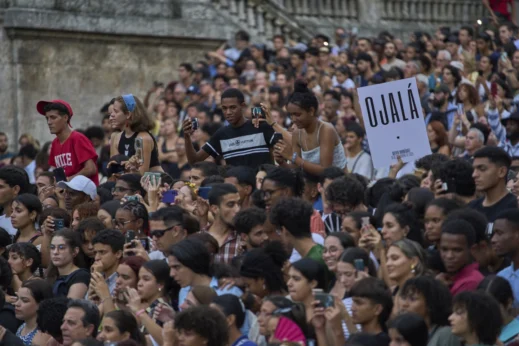
At around 4:30 pm, folks began trickling in, claiming their spots on the stairs, saying hello to friends, and getting their Cuban, Palestinian, Venezuelan, Chilean, Uruguayan, and LGBTQ flags ready for the big event. At the bottom of the stairs, the stage was set up. Nothing was extravagant, yet there was universal recognition that this was sure to be a special night. Nothing was for sale, people brought their own drinks and snacks, and there were no corporate sponsors of any kind. It was drizzling light rain, but the winds blew cool air and dispersed the clouds. By 7 pm, there was nothing but clear skies and expectant onlookers filling virtually every inch of space. Residents of the nearby buildings also came out to their balconies and windows to enjoy the two-hour-long concert.
When Silvio walked onto the stage, everybody stood to catch a glimpse. Folks cheered, clapped, and the crowd began to chant his name. He opened with an essay. Its author: José Martí. The light, elegant strum of his acoustic guitar followed the words of the apostle of the Cuban nation melodically. The celebrated citation, “Ser bueno es el único modo de ser dichoso. Ser culto es el único modo de ser libre” (To be good is the only way to be happy. To be cultured is the only way to be free), set the tone for the concert. Silvio’s deep and prodigious intellect, his immense care for words, and his socially conscious vision promote a world in which peace, love, and fraternity reign over hate, war, and division.
Silvio only made a few remarks in between songs from time to time. Most of his songs required no introduction, as the crowd clearly expressed their great satisfaction at the start of each one, recognizing them, singing along to them, carrying their smaller friends on their shoulders to get a better look at the stage as Silvio and his band performed, and clapping with joy at the end of each one of them.
But Silvio took time at the beginning to thank the workers who support his concerts with logistics, who set up the stage and clean up afterward. He described them as “invisibles e imprescindibles” (invisible and indispensable). Without them, he noted, there could be no concert, and no music with which to lift the spirits to keep studying, working, and loving. He also thanked the Instituto de la Música and everybody in attendance, as well as those who were there in spirit.
Love was a major theme throughout the night. Love as the motivating force behind all revolutionaries. Love as a collective project. Love as forgiveness. Love as strength. Love as human emancipation. Love as sometimes hurt, confusion, and impossibility. “Quién fuera”—one of his most famous, and which was performed toward the end of the night—reckons with the challenge of love, its complex and sometimes painful nature, and the doubt and melancholy of its twists and turns. Silvio also performed songs by other famous musicians of the Cuban trova genre who have passed, such as “Yolanda,” a more classically romantic tune by Pablo Milanés, and “Es más, te perdono” by Noel Nicola, which tells the tale of unrequited and lost love.
Silvio read another essay about halfway through the concert. On this occasion, he read the work of the Cuban poet Luis Rogelio Nogueras. The poem, originally from 1979, recounts the atrocities of the Holocaust, describes Auschwitz as a factory of horrors, and remembers the “judíos de Jerusalén y Jericó… hombres de la tierra de Sión, que estupefactos, desnudos, ateridos cantaron la hatikvah en las cámaras de gas” (Jews of Jerusalem and Jerico… men of the land of Zion, who stupefied, naked, frozen stiff sang the Hatikvah in the gas chambers). As Silvio read, his daughter, Malva, came from behind to place a keffiyeh on his shoulders, with which he performed the rest of the night. The poem ended with a gesture toward the genocidal violence then and now being perpetrated against Palestinians, ruminating “no acierto a comprender cómo olvidaron tan pronto el vaho del infierno” (I cannot comprehend how quickly they forgot the vapor of hell).
Emotional cheering and chants of “Palestina Libre!” engulfed the stairway as Silvio and the band broke into the classic “La Era Está Pariendo Un Corazón,” a song that captures the sense of being in critical turning point in history, filled with all the agony of birth as well as the hope of new life, new consciousness, and ultimately fundamental change. After folks sang along and clapped at the song’s conclusion, more chants of “Palestina!” and “Palestina Libre!” rang out.
Beyond the crisp strumming of Silvio’s acoustic guitar, the audience was treated to the talents of the band that accompanied him on the various songs, some of them from his more recent album Quería saber, and others from his timeless albums of decades past. Jorge Aragón and Malva Rodríguez played the piano, the latter also serving as chorus vocals for certain songs. Maykel Elizarde was on the Cuban tres, an instrument that resembles a guitar, but instead of having the normal 6 strings, it has 3 pairs of strings, each tuned to the same pitch. Rachid López played the guitar. Oliver Valdés was on percussion, alongside Emilio Vega, who also played the vibraphone. Undoubtedly, the most important instrument on the stage, next to Silvio’s guitar, was played by his wife Niurka Gonzáles: the flute. It featured in nearly every song, at times becoming the center through brief solos.
Classic songs such as “El Necio,” “Ojalá,” and “La Maza” were highlights, so much so that it was sometimes difficult to discern Silvio’s voice—which has not lost its clarity and magical enchantment despite his age—among the multitudes singing with him. “Escaramujo” was a personal favorite and felt right for the university setting. The jovial spirit of a wondering person is the essence of the song: “Yo vivo de preguntar: saber no puede ser lujo… Yo vine para preguntar, flor y reflujo. Soy de la rosa y de la mar, como el escaramujo” (I live by asking: knowing cannot be a luxury… I came to ask, flower and ebb. I am from the rose and the sea, like the rose hip). Through playful lyrics, the song asserts that the right to know is for all, not a fortunate few.
The spirit of nature, curiosity, youth, and rebelliousness filled the stairway, and so did wisdom that comes with age and experience. As such, the idea of questioning as a cycle of life, as itself a discovery, and as a quest for a greater understanding of our presence and place on this planet, could not have found a better articulator: Silvio turns 79 in a couple of months, yet he remains “un niño que pregunta,” (a child who asks questions) like in the song. Silvio reminds us that life is a constant learning process.
“¿Por qué la tierra es mi casa? ¿Por qué la noche es oscura? ¿Por qué la luna es blancura que engorda como adelgaza? ¿Por qué una estrella se enlaza con otra, como un dibujo? Y ¿por qué el escaramujo es de la rosa y el mar?” (Why is the earth my home? Why is the night dark? Why does the whiteness of the moon wax and wane? Why does one star link to another, like a drawing? And why does the rose hip belong to the rose and the sea?)
Silvio encourages us to see beauty in the earth, and to see ourselves as part of it. His music encourages us to be brave, to walk the earth as we are, and to live without compromise. His art pushes us to live life committed to each other and to encounter it with imagination, finding fantasy in the banal and everyday. It felt as though Silvio did not want to leave the stage, as though he could not bring himself to do it. After “ending” the night with a guarachita, a more traditional Cuban musical genre with ra apid tempo meant to be danced to, the crowd asked for more. Silvio picked up his guitar and delivered three more songs before putting it down again, standing up, thanking the crowd, and walking off stage.
“¡Gra-cias, Silvio! ¡Gra-cias, Silvio!” the crowd roared as Silvio exited. Quickly, the stairway was cleared as folks walked out, too. Some crowds gathered, perhaps looking for a late-night bar or park to hang out and extend the festivities. Others walked on dark streets to homes likely without electricity as Cuba continues to struggle with power outages. Yet, like his last time performing on the island five years ago in 2020, when he toured more than 100 poor barrios across the nation to give free concerts like this one in the university, Silvio left an indelible mark of hope within those in attendance, and to those who could not make it, too.
Now, Silvio goes on his Latin America tour—“¡Sudamérica en Vivo!”—to perform in Santiago, Chile; Buenos Aires, Argentina; Montevideo, Uruguay; Lima, Peru; and Bogotá, Colombia. But an intimacy embraced the concert goers that humid Havana night with the warm conscious sense that we had all experienced history as it was being made, a sense that will likely be difficult to reproduce anywhere else in the world.
We hope you appreciated this article. At People’s World, we believe news and information should be free and accessible to all, but we need your help. Our journalism is free of corporate influence and paywalls because we are totally reader-supported. Only you, our readers and supporters, make this possible. If you enjoy reading People’s World and the stories we bring you, please support our work by donating or becoming a monthly sustainer today. Thank you!
CONTRIBUTOR