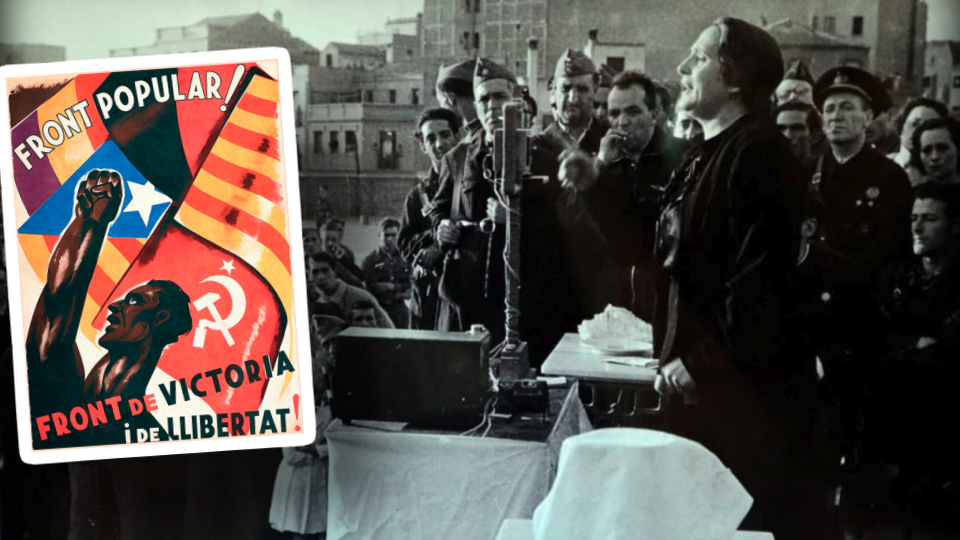
Ninety years ago, the people of Spain delivered a forceful rebuke to right-wing extremism and opened one of the most dramatic chapters in working-class history. The election victory on Feb. 16, 1936, of the Popular Front (Frente Popular)—an alliance of socialists, communists, republicans, and other democratic forces—was much more than a routine parliamentary transition of government.
It was a mass uprising at the ballot box, fueled by workers, farmers, women, and youth. They were determined to defend democracy and push forward with reforms that had been long-delayed by a series of right-wing administrations. Soon, that broad coalition would be fighting not only to rescue the Spanish Republic but to save the entire world from fascism.
Though the battle was just getting underway, they already knew what they were up against. As Mundo Obrero (Workers World), the newspaper of the Communist Party of Spain, put it the next day: “It would be a grave mistake to think that reaction will accept its defeat. It will do all in its power to rob the people of their election conquests. Today, they are already threatening civil war.”
The Republic vs. reaction
The Popular Front’s triumph came at a decisive moment for Europe. Hitler and the Nazis had crushed opposition and consolidated their power in Germany. Mussolini held Italy in his dictatorial grip. Across the continent, reactionary forces sought to smash labor movements and parliamentary democracy alike. In Spain, too, powerful landowners, monarchists, military officers, and clerics plotted to reverse the gains made since the proclamation of a republic in 1931.

The roots of the Popular Front victory lay in the unfinished business of that earlier democratic breakthrough. When King Alfonso XIII fled the country in 1931 after municipal elections signaled overwhelming support for an end to the monarchy, hopes ran high for social and economic transformation.
The newly-established Spanish Republic promised land reform in a country where vast estates dominated the countryside, secular education in a society long controlled by the Catholic Church, regional autonomy for Catalonia and the Basque Country, and expanded rights for workers and women.
Spain’s working class—which was organized into socialist and anarchist trade unions—and its growing Communist Party pressed for structural change. But the Republic faced fierce resistance. Thanks to intense opposition from landlord-linked politicians, plans for land reform moved slowly. The generals who commanded the military and had enjoyed broad authority under the monarchy resented efforts to curtail their power. The Church—which was also a large landholder—opposed both the secularization of public life and limits on clerical influence over the state.
Capitalist industrialists and conservative politicians rallied their forces and prepared to strike. By 1933, with the country gripped by economic crisis and political fragmentation amid the Great Depression, right-wing parties regained control in elections.
The two years that followed—known as the “Black Biennium”—brought intense repression of labor union militancy and a rapid rollback of the halting land reforms that had been initiated by the Republic. In October 1934, a mass uprising by miners in the Asturias region of northwest Spain was brutally crushed by the army, with General Francisco Franco playing a key role. Colonial troops were shipped in from Spanish-controlled Morocco, and more than 2,000 people were killed, while thousands more workers were jailed.
The lesson was clear: Spain’s ruling class was prepared to use violence to defend its privileges.
Forging anti-fascist unity
It was in this climate that the Popular Front was forged. Inspired by the anti-fascist unity strategy advanced by the Communist International after 1935, Spanish left and republican parties agreed to a common electoral program.
The three major parties of the left—the Spanish Socialist Workers Party (PSOE), the Communist Party of Spain (PCE), and the Republican Left (Izuierda Republicana)—joined forces in January 1936. They were supported by progressive Galician, Basque, and Catalan nationalists and inconsistently by a Trotskyist group called the Workers’ Party of Marxist Unification (POUM), along with a handful of other smaller left parties.

The organized working class was the foundation of the coalition’s support, as both major trade union federations backed it—the socialist-aligned Workers’ General Union (UGT) unconditionally and the anarchist-oriented National Confederation of Workers (CNT) with some reservations.
The Popular Front pledged amnesty for political prisoners, restoration of democratic reforms, and renewed efforts at land redistribution and social justice. It promised a new Law of Public Order to protect the constitutional rights of citizens from arbitrary police and state actions.
Essentially, the Popular Front’s aim was to protect and restore liberal democracy in Spain. The program was moderate in scope but radical in implication: It sought to mobilize the broadest possible coalition to defend democracy from fascist encroachment.
On Feb. 16, 1936, the Popular Front won a narrow but decisive victory in elections to the Cortes, the Spanish parliament. Its deputies took 278 seats compared to the right’s 124—a feat all the more impressive because, as the Daily Worker reported in New York, “30,000 anti-fascist leaders are in jail” and the election machinery “was in the hands of the right and fascist groups.”
Among the most electrifying deputies elected that day was Dolores Ibárruri, known to millions as La Pasionaria. A leader of the Communist Party, Ibárruri embodied the fusion of working-class militancy and democratic resolve that defined the Popular Front. A gifted orator from Asturias, she gave voice to the hopes of women and workers who had long been excluded from political power.
Around the country, celebrations erupted in working-class neighborhoods on election night. Over 250,000 Socialist and Communist Party members held a victory march through Madrid. In Barcelona, the Daily Worker said, “police were forced off the streets, and the people took over the city, wildly expressing their enthusiasm and joy over the victory of the anti-fascist front.”
Georgi Dimitrov, the famed anti-fascist leader who had announced the popular front strategy to the world at the Communist International congress just months earlier, hailed the victory in Spain, saying that “the establishment of the people’s front signifies a turning point in the relation of forces between the proletariat on the one hand, and the fascist bourgeoisie on the other; to the advantage of millions of the working masses.”
Within days, political prisoners and workers still detained since the days of the Asturias strike were freed. Public sector workers who had been fired for their politics were reinstated. Gen. Franco was removed as army chief of staff and demoted to a position in the Canary Islands. The new government moved to reinstate regional autonomy in Catalonia and restart land reform. For millions, it seemed the promises of 1931 might finally be fulfilled.

Civil war
Yet even before the ballots were counted, a conspiracy to overturn the people’s will was already underway. Sections of the military, backed by monarchists, Falangists (the name adopted by Spain’s organized fascists), and powerful capitalist economic interests, refused to accept the legitimacy of the result.
They framed the Popular Front as a “Bolshevik threat,” though its program centered not on socialist revolution but rather on defending the bourgeois democratic republic. Reactionary newspapers whipped up hysteria. Assassinations and street clashes heightened tensions.
According to the Daily Worker’s reporter in Madrid, even on the first day after the vote, “Spanish fascism was threatening civil war.”
The Communist Party of Spain warned that “the material base of power for the privileged…is their ownership of the land. The PCE urged its allies in the new Popular Front government to move decisively to “give the toiling masses the land which rightfully belongs to them” and expropriate the “big landlords and the church” to cut off reactionaries’ funding sources.
The Communists said that the new government had to act quickly against the “pistoleros (gunmen) who murder workers and attack their organizations.” Time was not on the Popular Front’s side, however.
On July 17–18, 1936, the plotters launched a military uprising, beginning in Spanish Morocco and spreading to the mainland. When the fascist generals rose in rebellion, it was Dolores Ibárruri who issued the defiant cry that would echo around the world: “¡No pasarán!”—They shall not pass. Her speeches rallied the Republic’s defenders and symbolized the moral clarity of the anti-fascist cause.
The generals’ coup did not immediately succeed. In key cities—Madrid, Barcelona, and Valencia—workers seized arms and, alongside soldiers still loyal to the Republic, defeated the rebel army units. The ruling class’s hopes for a swift coup vaporized, so they turned instead to full-scale civil war.
Rehearsal for world war
The conflict that followed was both a Spanish tragedy and a world-historical confrontation. The elected Republican government—supported by unions and the hundreds of thousands of members of the Socialist and Communist Parties, and a wide spectrum of democratic forces—faced an insurgent coalition soon headed by Franco.

The fascist regimes of Germany and Italy intervened on the side of the ruling class rebellion. Hitler sent his Condor Legion, whose planes bombed Spanish cities, including the infamous destruction of Guernica. The German dictator would later say that Spain gave his troops a “dress rehearsal” for their later conquests across Europe.
From Rome, Mussolini sent tens of thousands of troops, aircraft, and supplies to bolster Franco’s forces. António de Oliveira Salazar, Portugal’s dictator, offered essential logistical support for the transportation of fascist soldiers and shipments.
The Republic, by contrast, was strangled by the so-called “Non-Intervention” policy of the U.S., Britain, and France. The U.S. Congress put an arms embargo on Spain, but U.S. corporations did intervene in the war—on the side of the fascists. Texaco gave Franco oil on credit (with free shipping), for instance, and General Motors provided trucks for his army.
On the continent, London and Paris also blocked the sale of arms to the legitimate government and refused to stop the flow of fascist aid to Franco. Only the Soviet Union sold significant military assistance to the Republic—including aircraft, tanks, artillery, and advisors—although it was limited by geography.
The Lincoln Brigade

From around the world, however, came volunteers who refused to stand by and let fascists kill democracy in yet another nation. The International Brigades—workers, intellectuals, and anti-fascists from more than 50 countries—fought and died on Spanish soil in defense of democracy. Among them were thousands from France, the U.S., Britain, Canada, the German and Italian exile communities, Poland, Romania, Argentina, and beyond.
The Abraham Lincoln Brigade, initiated by the Communist Party USA, mobilized 3,000 American volunteers—Black and white soldiers, on an equal basis—to fight the fascists. The U.S. Army at the time was still segregated, but not the anti-fascist battalions.
Fighting-age volunteers like Oliver Law and Dave Doran didn’t hesitate to sign up. Known as the “first to advance and the last to retreat,” the men of the Lincoln Brigade earned a reputation as some of the bravest soldiers on the line.

Law, a Black Communist labor organizer and U.S. Army veteran, brought his skills to Spain, heading a machine gun detachment and serving for a time as commander of the whole Lincoln Battalion. Doran, a leader of the Young Communist League, was known throughout the U.S. labor movement as a dedicated organizer in coal and steel.
The CPUSA and its allies worked tirelessly to build solidarity and support for democratic Spain in the U.S. Cultural figures like Ernest Hemingway, Dorothy Parker, Lillian Hellman, Albert Maltz, and others filled the pages of publications like New Masses and the Daily Worker with appeals to aid Spain. Fundraising campaigns for ambulances and medical supplies brought in mass support. Paul Robeson went on tour across Spain, singing for troops at the front.
Outraged by fascist Italy’s brutality in Ethiopia, African American nurse Salaria Kea arrived in Spain in 1937. Back in Harlem, she had helped desegregate the hospital workforce; in Spain, she was in charge of the field hospital in Villa Paz. She was head surgical nurse, supervising white nurses and treating patients of all nationalities—all of which would have been impossible in the Jim Crow U.S.
So many American volunteers distinguished themselves in the struggle to stop fascism, but tragically, almost 700 of them—including Law and Doran—died on the battlefields of Spain.
The final fall
Within Republican-held areas, the war unleashed profound social transformation. Factories were collectivized in parts of Catalonia. Peasants took over land in Aragón and elsewhere. Women organized militias and demanded equal rights. At the same time, internal tensions among the Republic’s diverse forces complicated coordination.
The Communist Party, growing rapidly during the war, argued for prioritizing a united war effort and centralized government to defeat fascism first, while others—like the Iberian Anarchist Federation (FAI), which controlled the CNT labor federation, and the Trotskyist POUM—pressed for immediate revolutionary transformation and wanted to splinter the country.
The latter’s tactics repeatedly split the united front against fascism and diverted Republican government forces from the front with their behind-the-lines rebellions and attempts at insurrection in places like Barcelona in May 1937.
Despite heroic resistance—immortalized in the defense of Madrid and the protracted battles along the Jarama and Ebro Rivers—the Republic’s position deteriorated. Superior fascist firepower, unified command under Franco, and sustained foreign backing from Hitler and Mussolini took their toll. By early 1939, Barcelona had fallen. Madrid surrendered in March. On April 1, Franco declared victory.

The consequences of the fascist triumph were devastating. Hundreds of thousands fled into exile. Tens of thousands were imprisoned, executed, or forced into silence. Even more disappeared into concentration camps, their fates never known.
Daily Worker reporter Art Shields, who went to Spain as a correspondent but ended up a combatant. In 1939, just before the fall of Madrid, he was among a group of Communists captured by anarchist FAI troops who were cooperating, in practice, with Franco’s forces as a “Fifth Column” inside the capital.
Shields told of how he narrowly dodged execution and barely escaped from Spain in his book, On the Battle Lines. He would write that the Spanish people and the international volunteers “left a glorious tradition…that has inspired lovers of liberty ever since.”
Franco’s dictatorship would endure until his death in 1975, suppressing unions, outlawing left parties, and entrenching conservative social order. Spain became a warning of what fascism meant in practice: mass repression, cultural darkness, and the systematic destruction of democratic life.
The legacy of the Popular Front
Yet the legacy of the Popular Front endures. Its 1936 victory demonstrated that broad unity against fascism is not only possible but necessary. Workers, peasants, middle-class democrats, and national minorities found common cause in defense of shared freedoms. The International Brigades embodied global solidarity at a time when Western capitalist governments failed.

Today, with fascist leaders and far-right movements again actively working to destroy democratic institutions in many countries, the Spanish experience offers urgent lessons. Division among progressive forces can open the door to reaction. Being timid in the face of fascist threats or underestimating their danger can prove fatal.
At the same time, the courage shown by those who defended the Spanish Republic is a reminder that that history is shaped not only by generals, corporate bosses, and dictators but by organized people.
Ninety years after the Popular Front’s election, Spain’s anti-fascist fighters remain symbols of resistance. Their struggle did not end in 1939; it lived on in exile, in clandestine organizing, and in the eventual re-emergence of democracy. Remembering 1936 is a call to build the broad, democratic alliances needed to confront the dangers of our own time—and to ensure that “No pasarán” is more than a just a slogan.
We hope you appreciated this article. At People’s World, we believe news and information should be free and accessible to all, but we need your help. Our journalism is free of corporate influence and paywalls because we are totally reader-supported. Only you, our readers and supporters, make this possible. If you enjoy reading People’s World and the stories we bring you, please support our work by donating or becoming a monthly sustainer today. Thank you!
CONTRIBUTOR