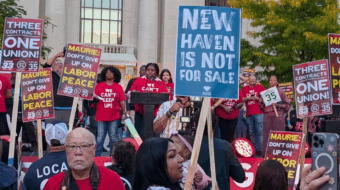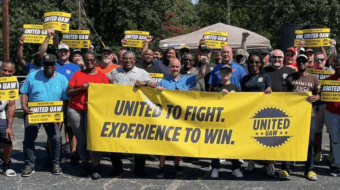
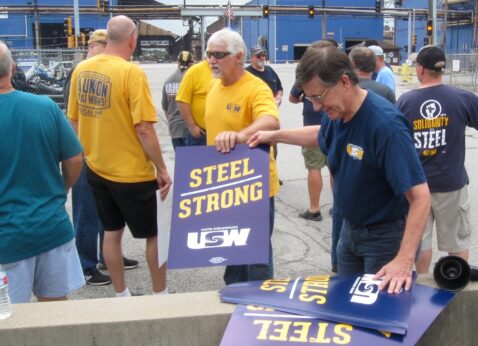
GRANITE CITY, Ill.—For Jason Fernandez, a Steelworker from Granite City, Ill., the current bargaining over new contracts between the United Steelworkers and two of its biggest employers, U.S. Steel and Cleveland Cliffs, is both professional and personal.
It’s professional because Fernandez, a Steelworker since 2008, is on one of the union’s bargaining teams as USW works through details of trying to reach agreement with the companies on five-year contracts. The current contracts expired September 1, and the companies and the union agreed to extend their provisions for a month until new pacts are gained or talks break down.
And it’s personal for Fernandez because the key issue, and the key stumbling block in the talks, is rising health care costs, who’s going to pay for them and how much. And Fernandez, who started a family after joining USW and going to work at U.S. Steel’s Granite City plant, now knows how important comprehensive health care coverage is.
“I didn’t understand the totality of health care,” Fernandez told the St. Louis-Southern Illinois Labor Tribune. “Now it’s more of a thought for me, preservation for myself, for my family… It’s the life that I’ve created that I want to sustain.”
As a negotiator for the union with the two firms, Fernandez, who is also USW Local 1899’s Grievance Committee chair, has often been away from home since the talks began months ago.
“I understand that it’s hard that I’m away from home, but there’s reasons that I’m here,” he said.
The talks are important to the union and the two companies, which together employ 22,000 Steelworkers nationwide, 60% of them at U.S. Steel. They also represent a test of both the negotiating team led by new union International President Roxanne Brown, and of the good faith of U.S. Steel in particular.
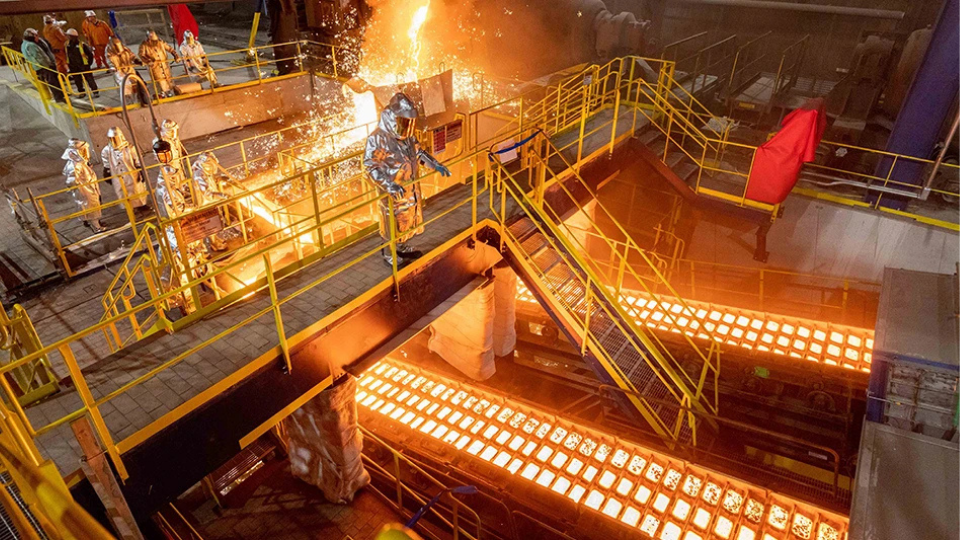
That’s because USW then-President David McCall and the international union opposed the multi-billion-dollar deal which saw the U.S. Steel board sell the firm to Nippon Steel of Japan. USW actually advocated for Cleveland Cliffs, now the nation’s largest steel producer, to buy U.S. Steel. Despite its iconic status in the industry, U.S. Steel is now #5.
But Nippon won after promising to invest $2.7 billion in nationwide plant modernization—and to preserve Steelworkers’ jobs nationwide. Brown intends to ensure the new contract holds them to that.
That promise drew rank-and-file support for the deal, as workers viewed it as preserving their jobs. One local, 2227, openly defected, supporting the Nippon takeover. Now Brown knows she must win trust from the dissenters by delivering on a good contract. And health care is at the center of that contract.
She also admitted top international union leaders didn’t always communicate well with the rank-and-file, and vows to change that.
“Families don’t always agree, and this was one of those instances,” said Brown over divisions within the union about Nippon’s purchase. “But the goals we are pursuing are Steelworker jobs today and in the future, period. And making sure there are jobs for those who come after us, period.”
“The USW remains committed to reaching strong agreements that recognize the contributions of union members and protect the future of good, family-supporting steel jobs,” Brown said in a statement announcing the talks will continue and the current contracts will stay in force, in one-month increments.
“While negotiations continue, workers will remain on the job, producing high-quality products under the terms and conditions of the current agreements.”
And Brown elaborated on winning members’ trust in a pre-bargaining interview with Pittsburgh TV station KDKA. Pittsburgh is USW’s headquarters, and the talks are held there.
“We’ve focused on our members in the Mon (Monongahela River) Valley so we can make sure we all are together on the same page, and fighting for the contract they deserve,” Brown said.
The Steelworkers have not released any figures on wage gain aims, though the expiring five-year contracts with the two firms produced 20% raises over those years. But even if those are equaled in the current talks, the union says the two firms proposed so much in health care takeaways that they would wipe out any raises.
In particular, the Labor Tribune reported, U.S. Steel advocated a joint labor-management committee to convene and discuss how to deal with rising health care costs if insurance premiums increased by more than 3% yearly.
The federal government’s Consumer Price Index said overall medical inflation was 2.7% for the 12 months ending in July, but hospital care costs rose at double (5.2%) that rate. The only larger inflation rates were in air fares, fuel oil, gasoline—all more than 25%—and car repairs.
But the Center on Budget and Policy Priorities calculated that once Congress let the $700 Affordable Care Act’s individual tax credits lapse, at the end of last year, annual health insurance premiums for a typical family of four making $60,000 yearly would more than triple, from $1,200 to $3,912.
In the meantime, while waiting for whatever that committee would decide, the company proposes to steer workers towards options that would drive Steelworkers’ premiums and other shares of costs up, the Labor Tribune added. They include getting workers to use “lower-cost sites of care and generic medications.”
Elizabeth Donald of the St. Louis-Southern Illinois Labor Tribune contributed material for this story.
We hope you appreciated this article. At People’s World, we believe news and information should be free and accessible to all, but we need your help. Our journalism is free of corporate influence and paywalls because we are totally reader-supported. Only you, our readers and supporters, make this possible. If you enjoy reading People’s World and the stories we bring you, please support our work by donating or becoming a monthly sustainer today. Thank you!
CONTRIBUTOR