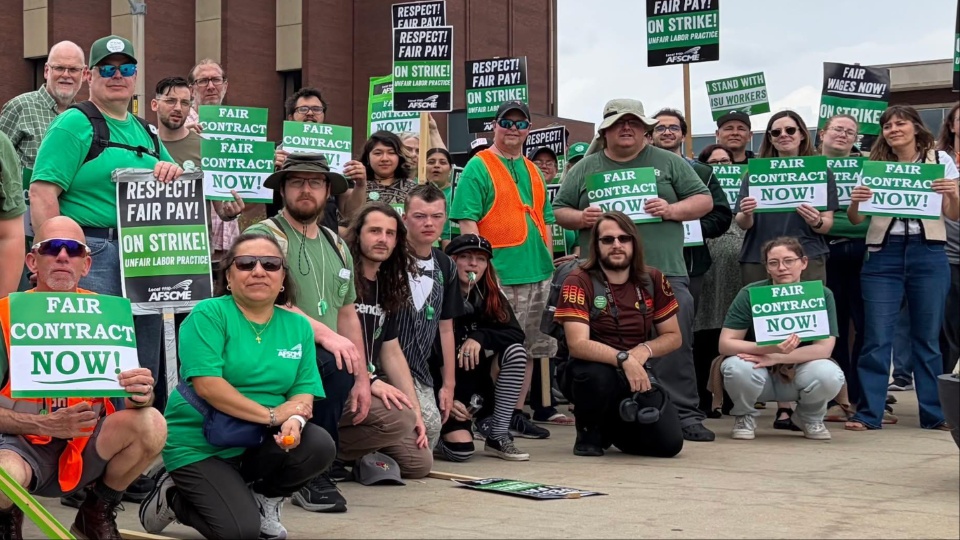
NORMAL, Ill.—The workers of Illinois State University’s (ISU) American Federation of State, County, and Municipal Employees (AFSCME) Local 1110 went on strike April 8 and are now entering their third week on the picket line as the administration has refused to negotiate after the federal mediator brought both back to the table April 15.
While the union went in ready to negotiate and had a compromise prepared, university administrators refused to budge or further negotiate. Striking workers are picketing at various locations around campus, including the dining halls and resident dorms, the Hovey Hall administration building, the Bone Student Center, and the warehouses at Central Receiving, all locations where the majority of AFSCME’s 350 workers are stationed.
This strike comes after months of negotiations. AFSCME 1110 are some of the university’s most critical workers. They consist of building service workers (janitorial), culinary workers, and grounds workers. They work tirelessly to ensure the university functions and are some of the essential workers required to come in when the rest of the university is closed due to weather conditions.
ISU’s culinary workers serve no less than 10,000 meals a day, and the building service workers help ensure all of that is cleaned up and properly disposed of. Then there is the other trash collection and day-to-day services that 24,000 people rely on.
The strike authorization vote was March 24. Workers cast authorization votes throughout the day and were greeted by Chewbacca, the enemy of both bosses and Sith Lords, holding an AFSCME sign demanding a fair contract. Some 97% of members who cast ballots voted in favor of the strike authorization.

The vote unfortunately continued the university’s recent tradition of making their workers’ lives harder than that have to be. Four years ago, almost to the day, AFSCME 1110 held a strike authorization vote for their last contract, which saw a 96% yes vote.
AFSCME 1110 is not the only union on campus that faces this sort of push back from administration. As previously reported, ISU administration has pulled the same stalling tactics with the Grad Workers Union (SEIU 73), United Faculty (IFT/AFT-AAUP representing tenured and tenure track faculty), Illinois State University Education Association (ISUEA representing the non-tenure track faculty), and sister local AFSCME 3637—all within the last four years.
1110’s last contract ended July 2025, and negotiations for a replacement started in April 2025. Since then, the university and union met 30 times, eventually with the help of federal mediation, as negotiations stalled. AFSCME 1110’s remaining sticking points include retroactive pay between the two contracts and equal pay increases in line with their non-union coworkers.
Currently, the university is refusing to provide retroactive pay back to their last contract, which in the past has been given nearly without question. The other major sticking point is an additional protection so the university cannot punish workers for joining a union by providing non-union workers higher wage increases. Most recently, non-union workers received a 3.5% increase in October, while AFSCME workers did not.
The university’s lack of movement has only added to the unease and declining trust with ISU administration. According to workers and organizers alike, it feels like this administration is looking for a fight compared to the people in charge during past negotiations.
Four years ago, AFSCME 1110 bargained with then-President Terri Goss Kinzy’s administration, who had taken over from former President Larry Dietz and his staff. Dietz and his administration was well liked and respected across campus, even as unions such as the Grad Workers Union fought tooth and nail for their first contract.
Kinzy, however, abruptly left her position less than two years into her four-year contract. While her administration seemingly had little effect on staff, conversations with faculty revealed her administration did not inspire trust or provide adequate support. Her sudden and unplanned departure did not help either, as Professor Christopher Breu told the student newspaper, The Vidette.
Similarly, some students did not have much trust in her administration in regards to unaddressed hate crimes, likely referencing the murder of ISU student Jalani Day, and tension with the campus Queer community. She also left with a $144,000 payout and a silence clause.
This is the backdrop of declining trust which current President Aondover Tarhule, the former provost, inherited. He responded with his RISE (“Resilience, Innovation, Sustainability, and Excellence”) Initiative. RISE, promoted as a strategic enhancement to better the university’s financial standing, sustainability, accountability, and transparency, quickly became an excuse to promote austerity measures, citing the “higher education enrollment cliff.”

The university’s concerns about a potential cliff are not entirely unfounded. Some universities across the state are experiencing sharp declines in enrollment and are facing crisis, as the majority of university funding now comes from tuition rather than state coffers. Western Illinois University has lost half of its enrollment since 2006; Eastern, Southern, and Northern are in similar, though not as dire, situations. ISU has not followed such declines, though, and has instead saw record enrollment for the Fall 2025 semester, an outcome that’s repeated for the past 15 years.
RISE has also come with budget restructuring, departmental shuffles, new positions without new money (amounting to budget cuts), presidential hiring approvals that have left positions unfilled for months, or even years, and pauses in what the university calls “merit increases” but are really just cost of living adjustments.
RISE took such a toll on university workers that a petition was circulated in the Spring of 2025 where more than 200 faculty and staff signed on demanding an increase, later climbing to more than 300. The university then announced the previously mentioned October 2025 3.5% increase to all staff, except those in the union.
AFSCME 1110 staff were left behind, and other staff across campus saw what amounted to less than an extra dollar an hour. University administration, on the other hand, saw multi-thousand dollar increases to their own salaries, including RISE champion Vice President of Finance and Planning Glenn Nelson (a $10,500 raise). This caused many to recall when United Faculty were in their negotiations in 2024 and discovered administration’s salaries, on average, increased 18.8% over the past five years, while faculty salaries only increased 10.1%, all while prices jumped about 25%. All university salaries are public.
This is what AFSCME 1110, and all unions on campus, are up against. Secretary for 1110, Tia Reese, put it bluntly, “President Tarhule makes $450,000 a year, but he’s telling us we need to get by on less than $20 an hour.” A living wage for a single adult in McLean County without kids is $21.49.
ISU published a negotiation status page, as it has previously, to release what it calls the “facts” of negotiations, a typical anti-union tactic. Part of that page includes contingency plans to ensure critical functions continue. Since the start of the strike, ISU has hired external workers—scabs and strikebreakers—to do AFSCME’s 1110’s duties. These include Chicago-based company Rozaldo Services and Bloomington company Go Green to provide cleaning services.
The university has also relied on student workers who they know they can be persuaded to do extra duties because they are in an even more precarious economic position and unsure how to respond to the bosses’ demands. These students have been observed and reported to be cleaning garbage cans as part of their food service duties and operating fryers and other kitchen equipment they do not normally touch and are not trained to do. Managers and directors have been seen taking on cleaning duties, while an increasing number of bathrooms and locations across buildings like the Bone Student Center are closed.
Despite this, students and student workers remain supportive of 1110’s strike and are finding ways to help by documenting unsanitary conditions, reporting issues to 1110 to showcase how much work is not being done, and making calls and complaints to various university administrators, primarily President Tarhule.
The Vidette also wrote an editorial in support of the workers, as well as positive coverage of the strike generally. Students also find their voices shared in local reporting by CIProud. Students Gracie Neal and Isabelle Lynn talk about how much more visible trash is around campus and how widespread recognition is that these workers need a living wage to keep the university running.
As reported by AFSCME Council 31, Logan Riter, a student worker at ISU, refused to cross Local 1110’s picket line when his supervisor asked him to be a “replacement worker.” He replied, “I’m no scab!” Managers also happen to be their own worst enemies, as it has been reported that one Waterson Dining Manager berated a student worker for daring to take a small break after trying to work through piles of dishes, made two workers cry who subsequently walked off, and is pushing others to take more hours above their 28-hour limit.

Students are also on the front lines supporting the workers. Andrew Franson, a sophomore, spoke at the strike authorization press conference: “AFSCME, like every other labor union on campus, they’re my family. They are people I care about, and ISU administration has time and time again chosen—instead of giving them a contract and the fair and just wage that they deserve—that profiteering is more important to them.”
Franson also spoke at two rallies for AFSCME 1110 on April 13 and 14. These rallies were also attended by United Faculty, students, and community members demanding Tarhule and Hovey Hall provide a fair contract.
Parents of students are also complaining and making it known the university’s positions are unacceptable. On a parents and families page for ISU, one reported a student had thrown up in a resident hall bathroom. When students talked to the Resident Assistant, the RA stated to call down to the front desk, and the front desk then responded to clean it up themselves. Students don’t have access to cleaning closets or materials. Plus, they pay room and board to have staff take care of these issues. This is something that would have been handled, quickly, by an AFSCME worker.
Another parent has shared a story of how their child got food poisoning from Watterson Dining Center and ended up at the hospital.Unions across campus and town also gave statements of support after AFSCME’s announcement. United Faculty and ISUEA gave statements of support, as well Bloomington-Normal’s Trades and Labor Assembly.
Jason Pascal, Trades and Labor President, went on to state: “These are the hard-working people who are the foundation of ISU. They prepare the food, clean the classrooms and offices, shovel the snow, and beautify the grounds. They deserve a living wage and a fair contract.” Workers from other unions have also shown up to picket lines and remain in contact with AFSCME leadership. In expected, and welcome, fashion, Teamster drivers for UPS, DHL, and others are refusing to cross pickets and refuse to make deliveries to campus.
Public officials have also expressed their support. Illinois 17th District Rep. Eric Sorenson, State Sen. Dave Koehler, and State Rep. Sharon Chung—herself a union member—have all attended rallies and visited picket lines. Normal Township Supervisor Krystle Able expressed her support as well, and cancelled her attendance at ISU’s presidential breakfast with President Tarhule until the strike is over, as did County Board President Elizabeth Johnson.
You can follow AFSCME Council 31, which Local 1110 is a part of, on Facebook for further updates and ways to support.
People’s World is in the midst of its annual fund drive, trying to raise $140,000 by May Day. To support working-class journalism, please consider make a donation or become a monthly sustainer. Thank you.
CONTRIBUTOR