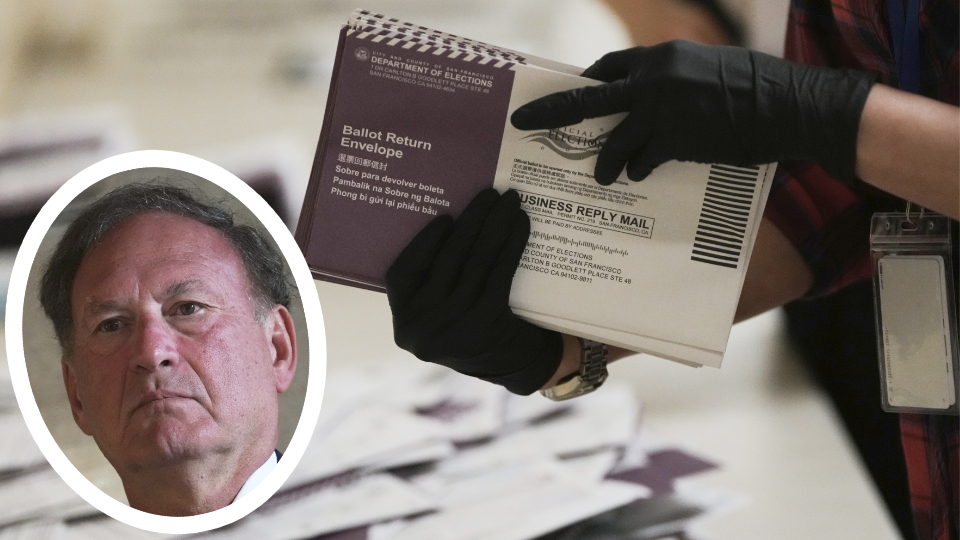
WASHINGTON—By a 5-4 margin, the U.S. Supreme Court delivered a huge blow to President Donald Trump’s long-running campaign against mail-in voting. The majority ruled that mailed-in ballots postmarked by Election Day but received at local elections boards after that must be counted under deadlines the states set. Trump demanded Election Day itself be the cutoff for any counting.
The decision was one of several important rulings the justices handed down Monday.
Shortly before they announced the ruling on mail-in balloting, they rejected hearing Trump’s appeal of the sex abuse verdict that E. Jean Carroll won for 5 million dollars in 2023.
In another decision important to workers they ruled that Trump could legally fire National Labor Relations Board member Gwynne Wilcox just because he wanted to.
Trump dumped Wilcox, despite the law setting up the NLRB and staggering its members’ terms, along with banning the firing of a member except for cause. Trump said Wilcox, a former Service Employees counsel and the board’s first-ever Black female chair, didn’t genuflect to the administration’s pro-corporate agenda.
The Wilcox firing was one of several such Trump moves. The court rejected one Trump firing, of another African American, Lisa Cook, a Federal Reserve Board member, due to the board’s unique status as the agency whose monetary policy helps govern the economy. Cook claimed the firing was on a trumped-up charge and said she was denied due process. The justices sent her case back down to the lower courts.
The mail-in ballot decision cheered the Alliance for Retired Americans (ARA), whose Mississippi members filed a friend-of-the-court brief siding with that state and its mail-in ballot law. The Mississippi law—the statute the justices pondered–lets local election offices count those legal ballots received up to five days after Election Day.
And by inference, the justices’ ruling upheld similar laws in other states around the U.S. Eight states, plus D.C., send out all their ballots in advance, along with nonpartisan voter guides, and encourage people to vote by mail. California, Oregon, Colorado—which is holding its primary on June 30—Vermont, and Washington state are completely vote-by-mail. The others are Hawaii, Nevada, and Utah.
“No eligible voter who casts a ballot in a timely manner should have that vote tossed out because of circumstances they cannot control. Today’s decision affirms a simple principle: Legally cast ballots should be counted,” said Richard Fiesta, ARA’s executive director.
“Mississippi’s law has worked well for decades and protects voters who do exactly what the law requires: They cast and mail their ballots by Election Day. The court correctly recognized no eligible voter should lose their voice because of mail delays or other circumstances beyond their control.”
“For generations, states have adopted practical election rules that reflect the realities of mail delivery, protect the right to vote, and meet the needs of their citizens. The decision means voters in the 14 states that provide a grace period for regular mail ballots, and the 29 states which allow additional time for at least some mail voters, including military and overseas voters, can breathe a little easier.”
“By upholding these long-standing protections, the court preserved certainty for voters and election officials; respected the ability of states to administer their own elections, and protected election laws that millions of mail voters across the country rely upon.”
The court’s ruling also comes just days after the Postal Workers (APWU) launched a nationwide campaign to protect voting by mail and less than a week after the top Democratic senator on the Government Affairs Committee, Gary Peters of Michigan, called new Postmaster General David Steiner on the carpet over another Trump scheme to restrict the right to vote.
That plan involves a Postal Service proposed rule, with a comment deadline of July 2, ordering states to turn in the names, addresses, and other identifiable data about all registered voters who request mail-in ballots in advance. The USPS would then create a master list of names and try to match the two up. APWU has set up a response form on its website.
Steiner’s proposed rule says that voters whose names or other data don’t jibe, such as married women who had not changed their last names on their registrations, would not get absentee ballots. And states that refuse to provide the lists would not get any of their postal mail delivered by the USPS.
The USPS proposal is part of Trump’s and the GOP’s constant campaign to deprive people—especially people they view as enemies, such as workers, women, students, and people of color—of the right to vote.
Trump has fumed against voting by mail for at least a decade, although hypocritically. He uses it himself.
He screams it produces fraud. He claims fraud due to mail-in ballots, and particularly from voters of color in Detroit, Atlanta, Milwaukee, and Philadelphia, cost him Michigan, Wisconsin, Georgia, Pennsylvania, and the 2020 presidential election.
“Under pressure from the White House, the Postal Service is trying to rewrite the rules on who gets to Vote-by-Mail, and we urge postal workers to speak up before it’s too late,” the Postal Workers’ alert begins.
“If a voter’s name gets dropped, misspelled, or lost in a database somewhere, that voter could be cut off from their ballot–through no fault of their own,” it continues later.
“Our job is to deliver the mail to everyone, reliably and without discrimination. Deciding who gets to vote isn’t in our job description, and it shouldn’t be.”
“The people who will pay the price are the voters who depend on mail ballots most: Americans in rural communities, people with disabilities, voters who can’t easily get to the polls. For a lot of Americans, the mail is the only way they can vote at all.”
“The proposed rule on voting by mail would enable President Trump to hijack the Postal Service for his own political gain,” said Peters.
“Last year, the Postal Service reaffirmed its job is to simply transmit the mail and explicitly said they do not administer elections.
“Ultimately, the federal government will serve as the final arbiter of who can vote by mail,” though the Constitution gives elections responsibility to the states, said Peters. He got every Senate Democrat, the day before the hearing, to sign a letter to Steiner opposing the USPS scheme.
“The Postal Service has one mission, to deliver the mail no matter who sends it or where it’s going. Mr. Steiner, I urge you to abandon these efforts and return the Postal Service to its constitutional role of simply delivering the mail, not acting as a partisan tool for the president.”
We hope you appreciated this article. At People’s World, we believe news and information should be free and accessible to all, but we need your help. Our journalism is free of corporate influence and paywalls because we are totally reader-supported. Only you, our readers and supporters, make this possible. If you enjoy reading People’s World and the stories we bring you, please support our work by donating or becoming a monthly sustainer today. Thank you!
CONTRIBUTOR