“Legalized racism!”
“Court-imposed apartheid!”
“Dred Scott reborn!”
All of the above labels and more have been slapped on the Supreme Court’s Sept. 8 decision approving racial profiling and giving a legal stamp of approval to the abduction, disappearing, and detention of brown people by roving gangs of armed, masked white men. It is a 21st-century rendering a 19th-century decision.
The Supreme Court, officially regarded as the “highest” court of the land, has now become the “lowest” court of the land with this blatantly racist decision. It ruled by a 6 to 3 vote that Immigration and Customs Enforcement (ICE) can stop and detain persons based on criteria including their skin color; whether they speak Spanish; and if they happen to be working at a car wash, in landscaping, in agriculture, or any other manual labor or low-paying job; or just standing on a street waiting for a bus.
The court, by affirming racial profiling, has legalized racial and ethnic discrimination, essentially becoming the modern-day standard bearer of Ku Klux Klan (KKK)-style racism. The Klan, historically, was a collection of gangs of armed, masked white men terrorizing people of color, primarily African Americans. Today, we have gangs of armed, masked white men terrorizing another people of color, primarily brown people, on orders from the state.
The similarities between the rogue, racist Roberts Supreme Court decision last week and the Dred Scott decision of March 6, 1857, are chilling and frightening beyond contemporary reflection.
In the Dred Scott case, to make a long story short, the Supreme Court ruled that, to paraphrase, “A Black man had no rights that a white man was bound to respect.” Chief Justice Robert Taney wrote in the 7 to 2 ruling that from the moment of the U.S.’ founding, a “perpetual and impassable barrier was intended to be erected between the white race and the one which they had reduced to slavery.”
The court declared that no person of African descent could be a U.S. citizen, and it extended the “property rights” of slaveholders to every state in the union, no matter whether a particular state was a slave state or a free state.
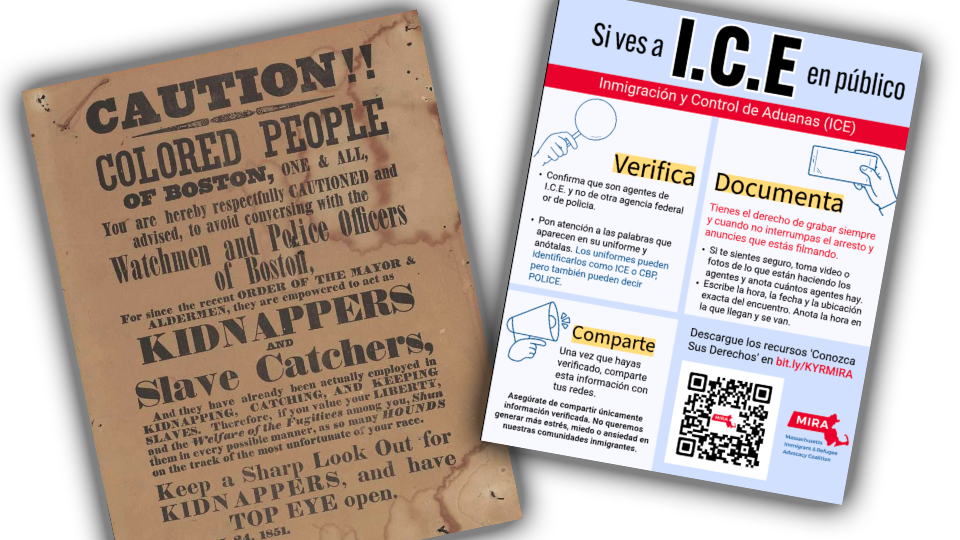
In that horrific epoch of U.S. history, a freed African American could be stopped on the street by any white man and required to show manumission papers to prove they had been freed from enslavement—in other words, to prove their right to walk freely.
Fast forward to the 21st century, and we find the Supreme Court deciding that any brown person can be stopped and detained solely on phenotype, solely on physical appearance, and required to show papers confirming the right to walk freely in the United States. This is Dred Scott all over again.
This was so aptly put by dissenting Supreme Court Justice Sonia Sotomayor when she said the majority decision forces upon “an entire class of citizens” the requirement “to carry enough documentation to prove they deserve to walk freely.”
The key words here are “to walk freely.” Sotomayor is making the unmistakable connection between this decision and the 19th-century Dred Scott ruling.
The Roberts Court, as might be expected, gave no legal explanation for its ruling. That’s because there is no credible judicial reasoning that could be presented for stepping back in time by 168 years.
As with all op-eds published by People’s World, this article reflects the views of its author.
We hope you appreciated this article. At People’s World, we believe news and information should be free and accessible to all, but we need your help. Our journalism is free of corporate influence and paywalls because we are totally reader-supported. Only you, our readers and supporters, make this possible. If you enjoy reading People’s World and the stories we bring you, please support our work by donating or becoming a monthly sustainer today. Thank you!
CONTRIBUTOR