A timelier book could not have been published. The Cherokee War of 1776, hot off the presses in May, is especially fitting given the mainstream celebrations of the 250th anniversary of the United States’ founding. The book, by Kevin Kokomoor, a lecturer in the history department at Coastal Carolina University, is a history of the first Indigenous–settler war fought by the newly minted United States. I could not wait to read it, following a lifelong pursuit of Cherokee history.
Although I found the work praiseworthy overall, I had disagreements with some aspects, which I will express as this review progresses.
The war was fought by American forces with the clear intent to exterminate the Cherokee people, as evidenced by a colonial statesman who declared that a “speedy end will be put to the outrages of those detestable savages.”
To further amplify this terminology, Kokomoor notes that the Declaration of Independence states that King George III “endeavoured to bring on the inhabitants of our frontiers, the merciless Indian Savages, whose known rule of warfare, is an undistinguished destruction of all ages, sexes and conditions.” We have Thomas Jefferson to thank for such an appalling reference to Indigenous people.
Kokomoor largely begins by pointing out that more American forces took the field against the Cherokee in the opening months of the war than fought in most of the battles waged anywhere against the British during the entire so-called Revolutionary War.
Indigenous nations were deeply involved militarily in the struggle, making political decisions to protect their people, sovereignty, and cultures in a history-making moment. They proceeded as independent nations and independent allies pursuing what they saw as their own best interests.
In this respect, it must be noted that the American Revolutionary War was not just a war between Great Britain and the American colonies; it was also a “race war” between the American colonies and Indigenous nations.
Starting with the South, the cause of the Cherokee War was illegal encroachment by thousands of racist white squatters on Cherokee land in violation of treaties with the colonial governments. The Cherokee leadership had made numerous complaints to colonial officials requesting the removal of the settlers, who had millions of unoccupied acres of land behind them controlled by land speculation companies. Land speculation was the driving force of the so-called Indian wars of early U.S. history, in this period of nascent capitalism.
The land mania of the settlers was not lost on some colonial statesmen. One of them said, “I confess my feelings are hurt and my humanity shocked when I reflect on the unbounded thirst of our people after lands they cannot cultivate and the means used to possess themselves of those that belong to others.”
Kokomoor shows that no less a personage than George Washington was a heavy speculator in unceded Indigenous land. For colonial leaders like him, the acquisition of Native land meant making money. The same was true for colonials like Thomas Jefferson and Patrick Henry. Jefferson eyed Ohio Indian lands that he could divide into 200-acre parcels for resale. Henry acquired land on paper amounting to almost 3,500 acres, also for resale.
 Keep in mind that this was Indian land to which they had no real title—all held in violation of the Royal Proclamation of 1763, which forbade private dealings in Native land. These transactions were the ongoing, underlying cause of Cherokee anger, fostered by illegal settler encroachment. The poor whites victimized by land speculation posed the greatest threat to Cherokee sovereignty—they were the shock troops of an emerging capitalism.
The war, driven by illegal occupation fostered by land speculation, began on July 20, 1776, as an eviction action by Cherokee forces against white squatters residing on their lands in violation of treaties that were suppoed to be “the law of the land.” The Cherokee Nation even sent eviction notices to the offending settlers, giving them a reasonable amount of time—40 days—to leave. In response, the racist settlers began constructing fortifications and even making military threats against the Cherokee Nation.
In turn, Cherokee leadership, after the eviction notice period had expired, authorized Cherokee war companies to evict the recalcitrant squatters. Thousands of illegal settlers refused to move from river settlements well within treaty boundaries. Armed conflict ensued.
Kokomoor refers to the Indigenous eviction action as the “Cherokee invasion,” when in fact it was a legal response to an illegal invasion by white settlers.
What was the response of the “revolutionary” colonial governments to the Cherokee eviction action? Enormous settler armies (enormous for that period of U.S. history) were immediately raised to annihilate the “merciless Indian savages” that the signers of the Declaration of Independence claimed King George III had set upon peace-loving citizens. The United States of America was at war with Indigenous people almost from the very first day of its existence.
Despite the fact that the colonial invasions of the Cherokee Nation did not achieve their genocidal objectives, the 1776 American onslaught was one of the largest and most comprehensive military offensives against an Indigenous nation in U.S. history.
Three separate armies immediately rampaged into Cherokee country to annihilate Indigenous people. One colonial official is recorded as declaring that within a month or two he expected “every trace of that savage nation will be erased from the earth.”
Kokomoor points out that, notwithstanding the devastation wrought by the settler armies, there was always Cherokee resistance. Aside from a number of battles, which for the most part Kokomoor is dismissive of, he does mention the constant attacks endured by the white armies from small groups of Cherokee warriors, oftentimes from no “greater distance of eight or ten steps” from the invading settler forces. The warriors attacked supply trains, took horses, and killed livestock used as food by the colonial troops. Colonials were also attacked when they stopped to camp for the night.
The killing of the elderly, women, and children is also noted as standard practice by Kokomoor. There is mention of women and children being burned alive. Those Cherokee women and children captured but not immediately killed were sold into slavery.
The scale of destruction and devastation of Cherokee towns and villages remains unparalleled almost anywhere in the annals of Euro-American settler–Indigenous conflict, Kokomoor maintains. However, the colonial settlers’ attempt to exterminate the Cherokee people did not come close to eradicating them.
It did, however, result in the relocation of the majority of Cherokee people from hometowns in upper East Tennessee and western South Carolina, towns they had known since time immemorial, to the southern part of the Cherokee domain. Under the leadership of those determined to fight on, thousands of Cherokees, the majority of them, relocated to more defensible geography.
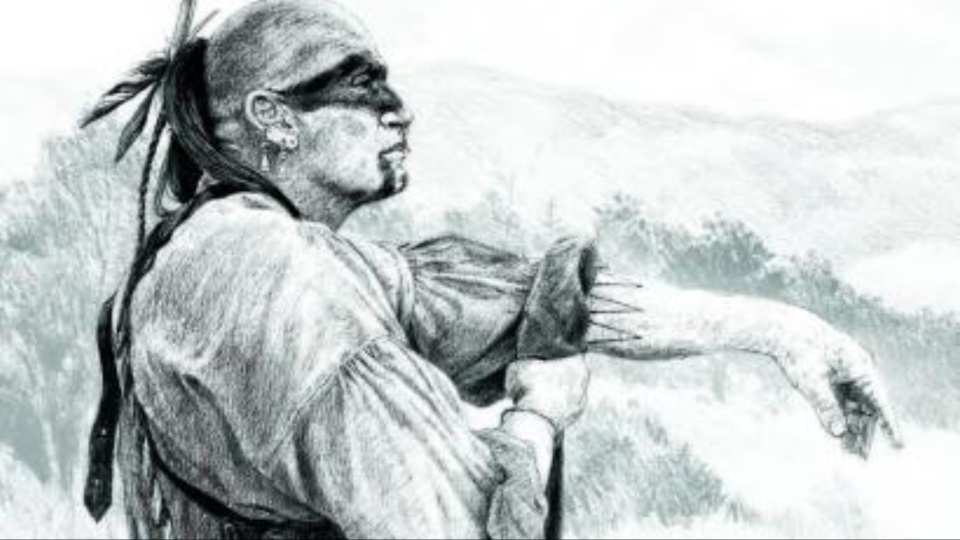
Foremost in this leadership was the indomitable war leader Dragging Canoe, who I feel is not given his due by Kokomoor. Dragging Canoe is hailed by many historians as a military genius and is often called the “Savage Napoleon.”
Nonetheless, Kokomoor writes decisively, and to his credit, that the majority of Cherokees elected to move to new locations rather than submit to American domination. This was a radical relocation undertaken to maintain independence and continue the fight—a most important historical point.
Countless historians writing Cherokee history have maintained that the majority of Cherokees remained at peace with the American colonists during the so-called American Revolution. Repeating hackneyed narratives, they have characterized Dragging Canoe and the so-called Chickamaugas as merely a band of recalcitrant Cherokees raiding white settlements. This is simply false, and Kokomoor sets the record straight where so many others have gotten it wrong.
Moreover, as Kokomoor points out, sooner or later almost all Cherokee communities relocated to continue the war against the Americans. By November 1776, the American colonists had finished devastating Cherokee country and were hearing reports that hundreds, if not thousands, of Cherokees were relocating to carry on the resistance. The war of extermination the settlers had so vehemently advocated quickly devolved into a colonial land grab.
Kokomoor shows that the relocated Cherokee immediately began to regroup and rebuild, “impatient to begin again” with the intent to seek “revenge.” Much has been made of the Cherokee being supporters of the British in the Revolutionary War, but the point to be understood is that the Cherokees were independent allies. The Cherokee Nation was a world power on the colonial stage, and the Cherokee War began on Cherokee motives and a Cherokee timetable.
Another point made by Kokomoor, heretofore not well known, is that the colonial governments were baffled that Cherokee resistance continued after the collapse of British military action. In fact, Cherokee resistance continued for 11 years after the end of the Revolutionary War.
Kokomoor points out that “nobody in North America” suffered more than the Cherokees during the Revolutionary War period. He relates historical accounts of Cherokee women and children “butchered in cold blood, or burned alive.” Other accounts tell of Cherokee women being decapitated while running to escape settler cavalry.
The main theme of Kokomoor’s book, with which I completely and proudly agree, is that Cherokee resistance continued nonstop even after an unparalleled military invasion that wrought destruction on a scale not experienced by any other Indigenous nation in American history. It is an inspiring narrative to be emulated in the very trying times we now face—part of 250 years of the proud history of fighting racism and genocide.
In conclusion, I will say that the term “merciless Indian Savages” will forever haunt the Declaration of Independence.
The Cherokee War of 1776: Native Destruction at the Dawn of American Independence
By Kevin Kokomoor
Hopkins Press, 2026
We hope you appreciated this article. At People’s World, we believe news and information should be free and accessible to all, but we need your help. Our journalism is free of corporate influence and paywalls because we are totally reader-supported. Only you, our readers and supporters, make this possible. If you enjoy reading People’s World and the stories we bring you, please support our work by donating or becoming a monthly sustainer today. Thank you!
CONTRIBUTOR