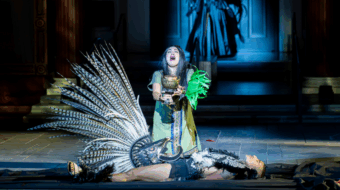
LA Opera’s current production of The Magic Flute is a revival of a unique reinterpretation of Mozart’s masterpiece by the Australian and British co-directors Barrie Kosky and Brit Suzanne Andrade, with Welsh filmmaker/animation designer Paul Barritt, which last graced the Dorothy Chandler Pavilion in 2019. Wolfgang Amadeus Mozart’s last opera is far more than an exceedingly whimsical flight of euphonic, euphoric fancy.
In addition to being one of the world’s immortal operas, The Magic Flute is a work of propaganda, which actually contributes to and enhances the opera’s enduring greatness. The Magic Flute premiered in Vienna in 1791—two years after the sans-culottes had stormed the Bastille and launched the French Revolution, challenging the divine right of monarchies that ruled Europe. Mozart’s Flute music plus Emmanuel Schikaneder’s libretto, believed to be based in part on the tale Lulu by the Age of Reason author Christoph Martin Wieland, expresses the ideals of the Enlightenment.
Mozart and Schikaneder’s phantasmagorical story was originally set in the Temple of Isis at Memphis (in ancient Egypt, not Tennessee, wisenheimer) around the time of Ramses I. In this love story, the Egyptian prince Tamino (Michigander tenor Miles Mykkanen) pursues Pamina (Californian soprano Sydney Mancasola), the beautiful daughter of the Queen of the Night (the superb Saint Petersburg, Russia soprano Aigul Khismatullina). She tells Tamino that Pamina has been abducted by Sarastro (South Korean bass Kwangchul Youn), the High Priest of Isis (Egyptian goddess of healing and magic), and that if Tamino returns her and avenges the Queen, he will be given Pamina’s hand in marriage.
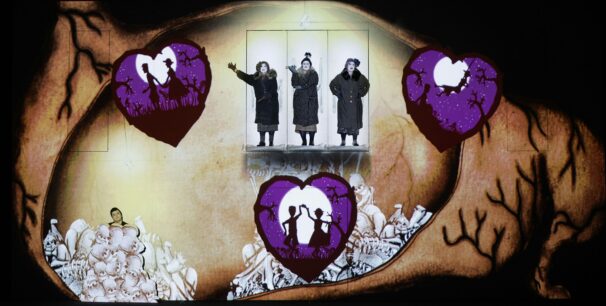
To rescue the object of his desire, Tamino embarks on a mystical journey fraught with risks through a surreal landscape. Along the way, Tamino encounters the likewise lovelorn Papageno (Californian baritone Kyle Miller), comical caretaker or catcher of the birds, who yearns to find a wife (Pennsylvanian soprano Emily Damasco as Papagena). During their perilous odyssey, the duo is confronted by dangers, including Monostatos (Chinese tenor Zhengyi Bai), a monstrous Moor, who has his own sexual designs on Pamina, and he guards at Sarastro’s palace.
So much for the basic fantastical plot. According to The Victor Book of Operas by Biancolli and Bagar, Flute is: “A seeming wonder book of sorcery and fantasy thus becomes the illustrated manifesto of a social and political creed, perhaps even a shrewdly veiled assault on all forms of autocratic rule, including that of the Hapsburgs… the ‘Mysteries of Isis’ are nothing more than the mysteries of Freemasonry,” which attracted many freethinkers and others who rejected the autocracies that dominated the 18th century world.
In 1784, Mozart joined the Freemasons, a faction of which advocated the Enlightenment ideals espoused by philosophes such as Diderot and Rousseau (Papageno seems to embody the latter’s concept of “the noble savage”). Over the centuries, the Freemasons have been viewed as “secret societies” or simply as “fraternal organizations,” but a detailed look at Freemasonry is beyond the scope of this review. Nevertheless, the highly allegorical The Magic Flute is a prime example of opera as propaganda—call it: Op-aganda.
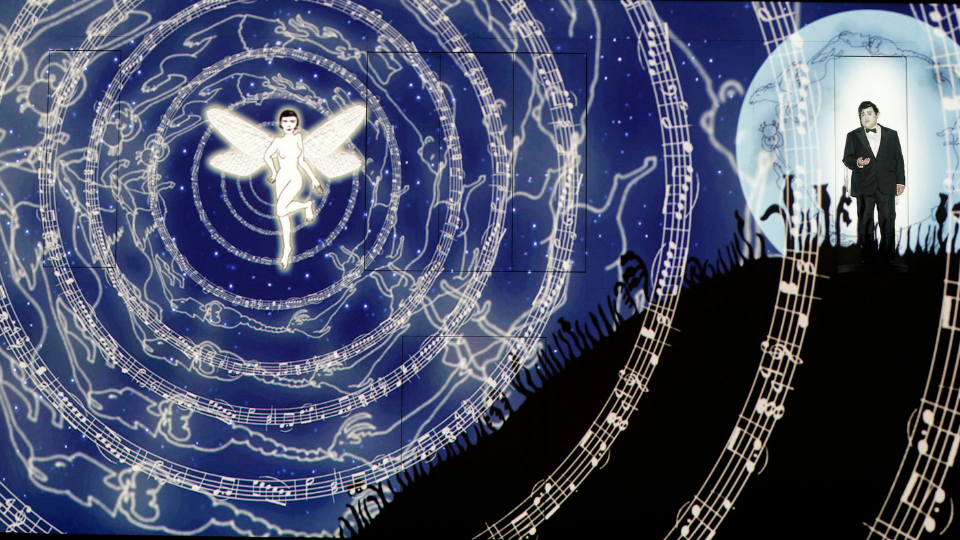
Flute is LA Opera’s second opera this year, set in ancient Egypt, where Philip Glass’ Akhnaten, which opened last February, is also set. But aside from some verbal references to Egyptian gods/goddesses such as Osiris, the Kosky/Andrade/Barritt version now being presented by LA Opera eschews any explicitly Egyptian setting and imagery. In fact, far from it, as this hybrid, multi-medium production combines live performances by not only the singers (including LA Opera Chorus, with Jeremy Frank, chorus director) and LA Opera Orchestra, but animation with a singular cinematic panache, referencing silent films in particular, enhanced by German scenic and costume designer Esther Bialas.
Papageno appears in whiteface and garb distinctly reminiscent of comedian Buster Keaton. Pamina recalls Louise Brooks (who starred as Lulu in 1929’s Pandora’s Box, directed by G.W. Pabst, who is the title character of Daniel Kehlmann’s excellent 2023 novel The Director), while some of the other Flapper-like young women resemble Brooks and/or “It Girl” Clara Bow. With his top hat and long coat, Sarastro calls to mind Dr. Caligari from the creepy 1920 German Expressionist movie, while Monostatos resembles Nosferatu in F.W. Murnau’s unforgettable 1922 vampire classic.
Best of all is Mozart’s peerless music; as Richard Wagner gushed: “A godlike magic breathes through this score.” About two minutes into the mood-setting overture, Wolfgang lets rip with a soaring, sonic wave composed to release the endorphins in any human with ears—and a heart. Papageno’s aria in Act I, Scene 1, as rendered by Miller, is appropriately airy and lighthearted, with clever musical references to the birds the character catches or cares for.
But Khismatullina’s bravura rendition of the Queen of the Night’s cavatina is alone worth the price of admission to this rarefied show. In this short aria with no repetitions, Khismatullina unerringly hit all the high notes on opening night, summoning heartfelt bellows of “Bravo!” from bedazzled theatergoers, who also gave the Russian songbird a standing ovation during the curtain call. Her sublime vocalizations provided this ardent operagoer with one of the most memorable moments he’s ever experienced at the Dorothy Chandler. (Ironically, Schikaneder’s lyrics are rhapsodizing about not love but revenge, as the Queen sings: “The vengeance of hell seethes in my heart”!)
According to LA Opera’s publicist Marlene Meraz, Mozart’s final opera will also be “James Conlon’s last production conducting as Music Director.” After 20 years at the helm as LA Opera’s Richard Seaver Music Director, conducting 70 operas with more than 500 performances, Conlon is hanging up his baton. In addition to his pre-show talks illuminating the operas he was conducting, another one of Conlon’s most significant achievements has been the “Recovered Voices” project, which rescued and resurrected works suppressed by the Nazis. Fortunately, Meraz assures us “he will come back as Conductor Laureate. As such, he will conduct The Marriage of Figaro [May 29-June 20, 2027] in our new season as Conductor Laureate,” a newly created title and role for Conlon.
At the end of the almost three-hour Flute, during the curtain call, there was a loud bang and silvery confetti filled the air, wafting down from the proverbial rafters inside the Dorothy Chandler, presumably in honor of Conlon’s longtime tenure waving the wand of LA Op. A sort of commemorative booklet entitled “The Conlon Era, Twenty Seasons at LA Opera” is available at no charge to all operagoers, celebrating the conductor who has been a gladiator in the struggle to ensure the continuing legacy and relevancy of the operatic art form.
How fitting that the maestro ends his tenure as Music Director with one of opera’s greatest love stories, for his relationship with the music and Angeleno audiences has been an affair of the heart. It’s no exaggeration to say that with this cinematic Magic Flute, James Conlon is literally and figuratively going out with a BANG! not a whimper.
The Magic Flute is sung in German with English supertitles and titles (projected upon the set itself presumably in lieu of recitative) and is being presented June 6, 11, 17, and 20 at 7:30 p.m. and Sundays June 14 and June 21 at 2:00 p.m. at the Dorothy Chandler Pavilion, 135 N. Grand Avenue, Los Angeles, CA, 90012. For tickets, go here or call (213)972-8001.
We hope you appreciated this article. At People’s World, we believe news and information should be free and accessible to all, but we need your help. Our journalism is free of corporate influence and paywalls because we are totally reader-supported. Only you, our readers and supporters, make this possible. If you enjoy reading People’s World and the stories we bring you, please support our work by donating or becoming a monthly sustainer today. Thank you!
CONTRIBUTOR