ATLANTA—This past week the Georgia State Legislature wrapped up a special session called by Gov. Brian Kemp to consider redrawing the state’s voting maps, following a Supreme Court decision that voting districts no longer have to account for Black voter representation. However, Kemp’s gerrymandering campaign, so far, is going nowhere.
Despite the initial reasons for the special session, just hours before lawmakers gathered, Republican leaders announced they had cancelled their plans to redraw the voting maps. In a letter to Kemp, Republican legislators cited the need for further judicial opinion and more public input before moving ahead.
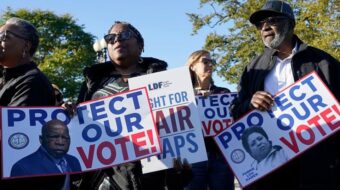
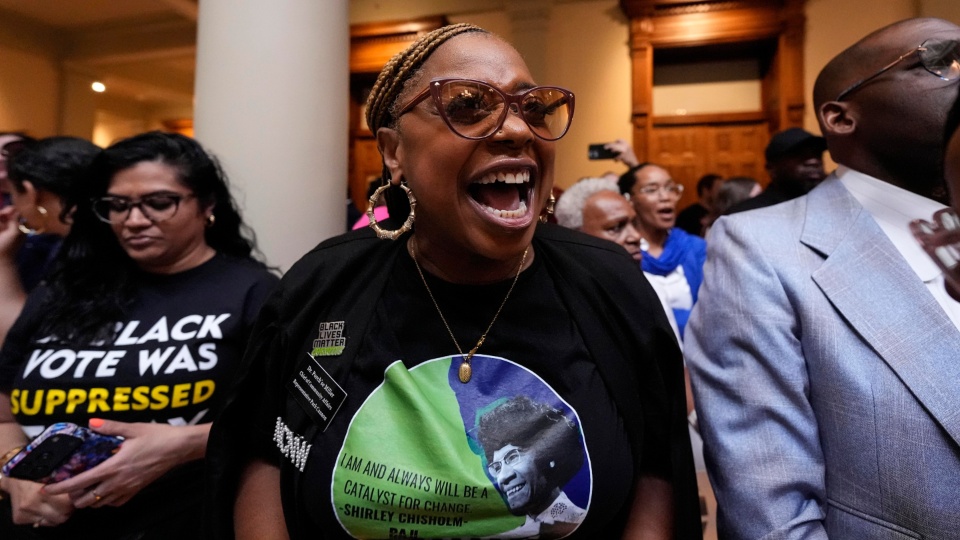
While politicians rushed between committee rooms of the State Capitol, civil rights organizations took to the streets to object to the Republican governor’s demands. Led by organizations such as BLM Grassroots, Black Voters Matter, the League of Women Voters, and the Georgia NAACP, activists from across the city and state put together a coalition to fight back against redistricting.
Under the name “The South Got Somethin’ to Say,” activists and organizers immediately planned a series of actions and protests to run the entire course of the special session.
In addition to the pullback on redistricting, other notable outcomes from the legislature include the delay of ending ballot counting by QR code and a failure to pass a bill that could raise sales taxes in Georgia.
Addressing the state’s pivot from QR code ballots was also a priority for the coalition. At the moment, after voters make their choices in Georgia, they receive a printed page with a QR code that then they feed into a machine which reads and counts the results. In 2024, the legislature passed a bill that would ban QR code ballots starting in July 2026.
Earlier this year, during the legislature’s regular session, lawmakers did not pass a bill establishing a new system to replace the QR code system. With backlash from civil rights organizations and no back up option for the existing system, Republicans had no choice but take the loss on their original plan to scrap QR code vote counting next month.
During the special session, however, Republicans in the State Senate added a provision to the legislation that requires the top two state elections to be hand counted. Despite the initial change, a State House committee later changed the provision so only the top two elections in which candidates finish within 0.5% of each other would require hand counts.
At a House Governmental Affairs Committee meeting last Monday, Brittany Burns of Black Voters Matter raised her voice against the legislation. In the meeting, she told lawmakers: “Hand counting is actually significantly more error-prone and more costly than machine counting. It’s also slower, delaying the delivery of election results and risking certification problems.”
As the legislation now stands, Georgia has a new deadline of January 2028 to end the QR code vote counting system.
The legislature also had to consider Kemp’s intention of holding a referendum to allow voters to decide whether to lower property taxes and raise sales taxes. If passed in the House and Senate, Georgia voters would decide on the measure.
On the Republican side, lawmakers argued that voters should be able to make their own choice of how they spend their taxes. Democrats, opposed, brought up the fact that many Georgia residents are already struggling with cost-of-living issues. Adding more taxes on consumption would create more burden and less relief. Nonetheless, the legislation did not reach a two-thirds majority necessary to move the referendum forward.
One of the legislators inside the State Capitol fighting against these bills was Gabriel Sanchez, State Representative for House District 42. In an interview with People’s World, Sanchez laid out the importance of civil rights groups coming together to fight attacks on voting rights, especially in the South.
With socialist election wins and union victories accumulating in the Northeast and on the West Coast, Sanchez believes “it’s important to show that the South has the ability to fight for progressive values.”
In response to the redistricting effort, Sanchez co-sponsored HR 11EX, which would create an independent commission to decide voting districts. The goal of the bill, he says, is to not allow legislators to decide how voting maps are drawn, given their inherent stake in outcomes as elected officials.
Even though 37 Democratic colleagues signed onto the bill, Republicans refused to hear bring it before the House Governmental Affairs Committee, essentially killing the bill during the special session.
Sanchez called the failure of Kemp’s redistricting efforts a victory but cautioned voters not to lose sight of the issue. He believes that Republicans will revive the effort after the November elections.
As he sees it, redrawing voting maps now “would galvanize the Democrat voter base” and lead to widespread Republican losses. For now, Georgia Democrats and civil rights organizations are holding their breath. The decision to drop the issue was not a total concession by Republicans but rather a calculated short-term move to hold onto power in the long run.
As the daily rallies, press conferences, and public testimony showed, conceding is not in the plans for civil rights activists, either. The redistricting efforts in Alabama, Tennessee, and Louisiana would decimate the Black vote and representation in government. With leaders fighting in and outside of the State Capitol, voters want legislators to know: The South Got Somethin’ to Say.
We hope you appreciated this article. At People’s World, we believe news and information should be free and accessible to all, but we need your help. Our journalism is free of corporate influence and paywalls because we are totally reader-supported. Only you, our readers and supporters, make this possible. If you enjoy reading People’s World and the stories we bring you, please support our work by donating or becoming a monthly sustainer today. Thank you!
CONTRIBUTOR