A month before the U.S. military kidnapped Nicolás Maduro, President Donald Trump told American oil executives: “Get ready.” They should start preparing, he informed them, because big changes were coming to Venezuela, home of the world’s largest known oil reserves.
Lawmakers in the U.S. Congress, who have the constitutional power over war, were completely shut out of discussions about imperial strategy, but oil bosses were given an early preview of what was to come, according to reporting by the Wall Street Journal.
Public relations people at the biggest energy corporations are keeping mum, claiming they weren’t tipped off in advance, but “the oil companies were absolutely aware that we were thinking about doing something,” Trump claimed on NBC News two days after the attack on Caracas.
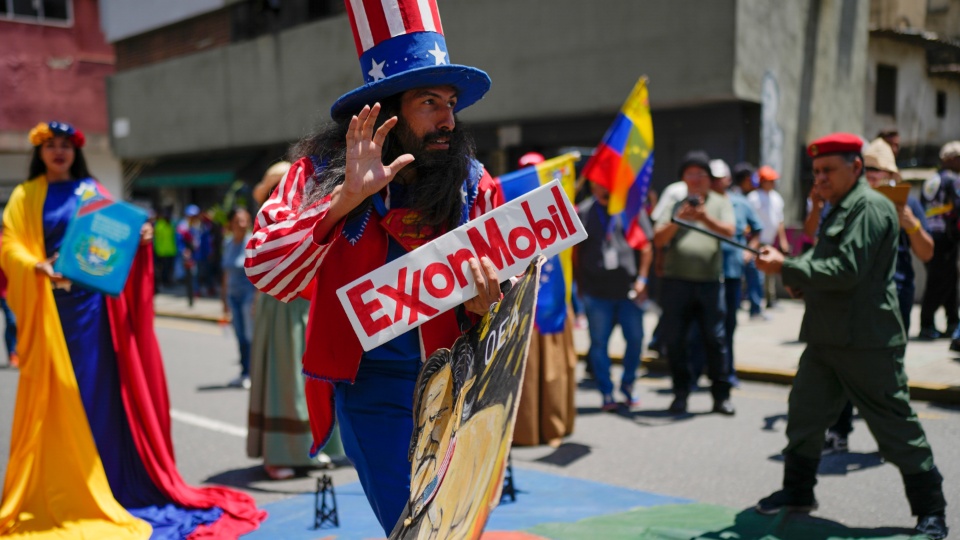
Regardless of what they did or didn’t know, companies like Chevron, ConocoPhillips, and ExxonMobil are expressing reluctance about investing in Venezuela now that the deed of removing Maduro is done.
They want a clearer picture of the country’s political future and guarantees that they won’t be sinking money into something that might not pay off. So, to put their minds at ease, Trump is offering up the American people’s money as enticement.
Public subsidy, private profit
The president said this week that energy corporations can expect to be “reimbursed” by U.S. taxpayers for any costs they incur from taking over Venezuela’s oil industry and ramping up production there.
While future “revenue” from the sales of stolen oil may also supposedly figure into recouping capital expenditures, the dangling of free public money may be precisely what these companies have been waiting for.

With Venezuela’s left-led government still in place (minus Maduro), a long history of nationalizations in the country, and sanctions continuing in effect, the assurance of subsidies to backstop their bottom lines is something the Trump administration hopes executives will find too good to pass up.
With the promise of public money, the president is essentially offering a no-risk guarantee for the oil companies, a sweetheart investment deal if ever there was one: maximum profits in exchange for minimum or no cost.
Trump acknowledged that “a lot of money”—likely hundreds of billions of dollars—will be needed to exploit the oil resources in eastern Venezuela. The heavy crude oil in the Orinoco River basin is dense, and its recovery requires expensive extraction techniques.
“A tremendous amount of money will have to be spent, and the oil companies will spend it, and then they’ll get reimbursed by us or through revenue,” Trump said. The administration appears confident that allowing oil companies to raid the public purse—possibly for years to come—will help them overcome any lingering worries about socialism in Venezuela.
Building a U.S. bloc
Unlike past U.S. presidents who embarked on regime change plots under cover of promoting democracy or protecting human rights, Trump has been much more direct in admitting that control of resources and markets is the key motive for his attack on Venezuela.
Though halting drug trafficking and migration have been used as facades to dress up his administration’s actions, the naked calculus of profits and rebuilding a U.S. bloc, or sphere of influence, covering all of North and South America are the parameters of U.S. imperialism under Trump.
That reality was openly declared in the updated National Security Strategy (NSS) released in December. The document says the U.S.’ top priority is to “reassert and enforce the Monroe Doctrine to restore American pre-eminence in the Western Hemisphere.”

This so-called “Trump Corollary,” announced on the doctrine’s 202nd anniversary, is a prescription for renewed U.S. domination, disguised as protecting the region from outside actors, primarily China.
In the wake of the Maduro kidnapping, Trump has rebranded the NSS the “Donroe Doctrine” in comments to the media. It vows to “deny non-hemispheric competitors the ability…to own or control strategically vital assets,” using coded language for a determination to prevent Latin American cooperation with China on infrastructure and development. It boasts, for instance, of restoring U.S. “privileged access” to the Panama Canal.
The removal of Maduro and planned takeover of Venezuela’s oil are the next steps in the NSS’s pursuit of U.S. control over the entire region. As Trump declared on Jan. 5, “American dominance in the Western Hemisphere will never be questioned again. It won’t happen.”
The costs of “dominance”
Achieving such dominance won’t come cheap. Leaving aside the uncalculated political and social costs of imperialism for both the peoples of targeted countries and U.S. workers at home, the direct financial costs of taking Venezuelan oil will be staggering.
The country has faced years of punishing sanctions and technology export restrictions as part of a prolonged bipartisan U.S. effort to strangle its government. This compounds the effects of decades of imbalanced allocation between social expenditure and capital upgrades by the state-owned oil company, PDVSA.
Taken together, all this that means the Venezuelan oil industry is severely underinvested and hobbled by aging equipment and infrastructure.
The most recent estimates by the Venezuelan government are that more than 300 billion barrels of oil lie beneath its soil, the largest supply of fossil fuels on the planet. Some estimates say there could actually be as much as one trillion barrels, though not all of it can be reached.
Because of sanctions, the expense of extraction, and dilapidated drilling, transport, and refinery assets, the country’s oil production has only averaged around 900,000 barrels a day over the last few years, making up less than 1% of daily global consumption.
Trump claims that within 18 months U.S. oil companies will “be taking a tremendous amount of wealth out of the ground,” but getting from here to there is going to be costly. And that’s where the taxpayer subsidies come in.
Oil bosses hold out for more
So far, the oil companies appear to be holding their cards close to their chest in hopes that Trump will pad their profits even further. ConocoPhillips and ExxonMobil are keeping quiet about their plans; they both left Venezuela in the mid-2000s after the government of Hugo Chávez nationalized their assets.
Chevron, the only one of the big three oil giants to continue operating there after the nationalizations, is getting the most attention from the White House. As it already has facilities and employees in the country, as well as contracts with the government in Caracas, it is best-positioned to quickly increase investment and production.
According to an unnamed source cited by the Wall Street Journal, the company already has detailed plans for expanding its footprint in Venezuela. No-bid contracts and little environmental or regulatory oversight are key points, but that’s not enough. Chevron and its peers want guarantees they will get their money back if things go south.
Unanswered questions about who will be in charge in Venezuela, what policies will shape the contracts, when the U.S. oil blockade will be lifted, and, crucially, whether the next administration in Washington will honor Trump’s promises all figure into the oil companies’ decisions.
Pre-existing capital commitments to other investments, like the $7 billion Chevron is spending to exploit a major oil discovery in Guyana, also mean these corporations would love to have public money to offset their risks in Venezuela.

Wall Street is expressing restrained optimism about the opportunities in Venezuela, but the explosion in stock value and demand that Trump likely expected has been rather muted thus far.
After an initial spike when trading first opened Monday morning, shares flattened—a reflection that few investors expect any payoff from Venezuelan oil in the short term. As of this writing, ConocoPhillips (COP) has gained roughly 3% in value since the Maduro kidnapping, Chevron (CVX) climbed 2%, while ExxonMobil (XOM) added an even more reserved 1%.
The people of Venezuela—like the people of any country targeted by U.S. imperialism—are sure to get the raw end of any “deal” that Trump makes with the oil execs. But the U.S. people, too, will be losers.
Not only are their domestic social needs like education, health care, and jobs sacrificed to fund the Pentagon’s military machine, now Trump and the capitalist class wants them to also foot the bill for oil companies as they steal Venezuela’s natural wealth—never mind the price all the world’s people will pay as the burning of fossil fuels accelerates the global climate crisis.
We hope you appreciated this article. At People’s World, we believe news and information should be free and accessible to all, but we need your help. Our journalism is free of corporate influence and paywalls because we are totally reader-supported. Only you, our readers and supporters, make this possible. If you enjoy reading People’s World and the stories we bring you, please support our work by donating or becoming a monthly sustainer today. Thank you!
CONTRIBUTOR