The Panama Canal was the subject of several bombastic claims by President Donald Trump in his inaugural address back in January. He declared the Canal “has foolishly been given to the country of Panama” and alleged that “China is operating the Panama Canal,” despite the fact that “we [the U.S.] didn’t give it to China.”
He added that, “the spirit of our treaty has been totally violated…. American ships are being severely overcharged and not treated fairly in any way, shape, or form.”
The treaty in question is one of the two Torrijos-Carter Treaties of 1977 that guided the transfer of the Panama Canal to Panamanian ownership in 1999.
Addressing Congress on March 5, Trump announced, “My administration will be reclaiming the Panama Canal, and we’ve already started doing it.” He said that on that very day, “a large American company announced they are buying both ports around the Panama Canal.”
That company is the U.S.-based BlackRock investment firm, which at the Trump administration’s urging, declared it would purchase the port operations of the privately owned, Hong Kong-based CK Hutchinson Holding company.
It operates ports in 23 countries, among them ports in Balboa and Cristobal, entryway cities to the Panama Canal. The $19 billion deal subsequently fell apart after China’s government expressed its displeasure.
U.S. Defense Secretary Pete Hegseth and the Panamanian Minister of Public Security Frank Abrego met in Panama City on April 8. They signed a Memorandum of Understanding that established terms of U.S. military involvement in Panama and of U.S.-friendly operations of the Canal. Two themes emerged:
- Cooperation between the armed forces of the two countries in “professional education and development of capacities” with training and bilateral exercises taking place in Panama.
- Arrangements for security and defense of the Canal and for compensating the U.S. Navy for tolls and other charges its warships incur passing through the Canal—and compliance of those arrangements with the Treaty of Neutrality of 1977, one of the two Torrijos-Carter treaties.
Secretary Hegseth and Panamanian President José Raúl Mulino issued a Joint Declaration. There, the two officials accept the Memorandum of Understanding, and Secretary Hegseth congratulates Panama as “the first country in our hemisphere to abandon [China’s] Belt and Road initiative” and for its success in stemming the flow of migrants across the Darien Gap.
The Panamanian version of the Declaration includes Hegseth’s “recognition [of] Panama’s leadership and inalienable sovereignty over the Panama Canal and its adjacent areas.” The U.S. version of the agreement leaves out those words.
The Memorandum of Understanding authorizes the U.S. government to deploy troops to three Panamanian bases built by the U.S. government when it occupied the now defunct Canal Zone. U.S. troops may soon be using a fourth base being constructed by Panama near the Darien Gap, one well-suited for discouraging migrants heading north.
U.S. troops already deploy to Panama. According to a U.S. Southern Command announcement, Airmen and Marines from Joint Task Force-Bravo were in Panama from March 24 to April 4, 2025, engaging with counterparts there “to strengthen relationships in the security, humanitarian, and logistical fields.” U.S. Marines arrived in Panama on June 5 to conduct “forest operations” with Panamanian troops. Joint air and naval exercises took place on July 13-18.
Panama’s continued control of the Canal and its national independence are under siege. In the background are serious U.S. interventions. In 1903, the U.S. government under President Theodore Roosevelt engineered the secession of Colombia’s northernmost province and thereby arranged for the newly independent state of Panama to authorize the U.S. to build the Canal.
On Dec. 20, 1989, the U.S. military invaded Panama in order to capture President Manuel Noriega, the onetime CIA asset accused of drug-dealing and money laundering. According to NACLA, “The U.S. invading forces destroyed 20,000 homes and killed hundreds of innocent Panamanians, dumping bodies into mass graves.”
Panama’s government shows signs of a dependency relationship with the United States that may portend significant U.S. authority over the Canal. An aroused anti-government people’s movement rejects that possibility.
José Raúl Mulino, veteran right-wing politician and former minister of public security, became president in 2024 with 34% of the vote. Analyst Abdiel Rodríguez Reyes indicates Mulino “has no charisma…and no [political] base…. [H]e is fundamentally supported by an important group of Panamanian businessmen and by U.S. interests.” Mulino has dutifully spoken out against Trump’s declarations on the Canal.
Distractions prevail that are likely to weaken any resolve Mulino might muster to block U.S. ambitions, thowever. His government undoubtedly attends to what is described as “the most modern and successful international banking center in Latin America.” It co-exists with Panama’s well-known problems of money laundering and terrorist financing, although these have eased recently. Panama’s great wealth inequalities and social class divisions serve power brokers wanting to block a united front capable of taking on U.S. power.
Commentator Francisco Javier Bonilla reports that “Trump’s declarations [on the Canal] have split the country. There has historically been a section of the country, populated mainly by the upper and upper-middle classes, that has been an ally of the most recalcitrant U.S. chauvinism.” Bonilla describes labor unions as “the only active anti-imperialist organizations in the country.”
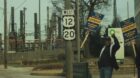
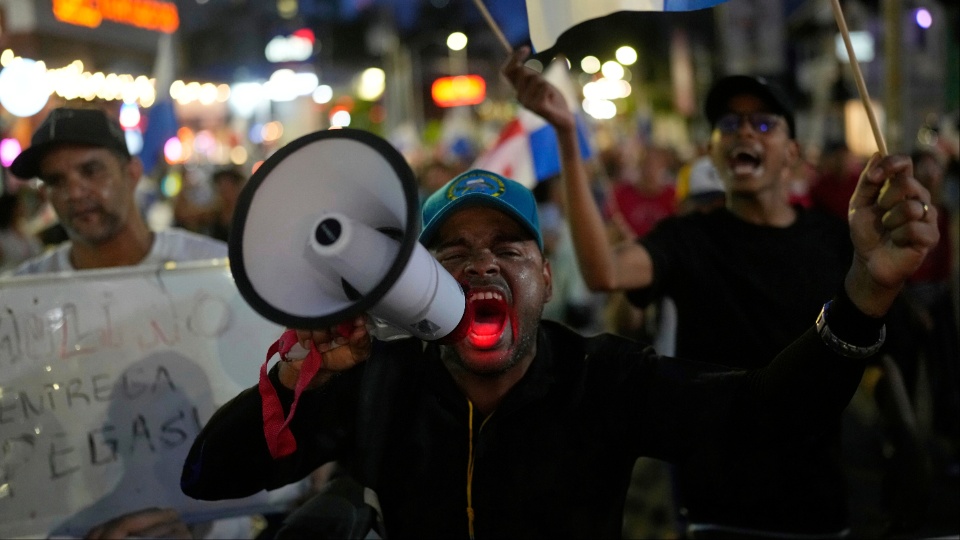
Actions taken by Mulino’s government have provoked a popular uprising consisting of strikes, street protests, and mobilization of a vigorous, multi-sector labor movement. Responding, the government has resorted to police actions, arrests, and a state of exception applied to Bocas del Toro. That’s a poverty-stricken province in northwest Panama, given over to banana monoculture and intense worker confrontations with the Chiquita company, which recently dismissed 5,000 workers.
These labor-led protests target three measures advanced by the Mulino government. One is a package of pension reforms with elements of privatization. Another is Mulino’s plan to revive the Cobre Panamá open-pit mine in Donoso district, the largest copper mine in Central America. Massive street marches in 2023 and an adverse Supreme Court ruling forced the mine’s closing.
Street actions greeted the April agreement on the Canal between the Mulino government and the Trump administration. Protesters were reacting also to the prospect of an increased U.S. military presence throughout Panama and, specifically, to the prospect of U.S. troops returning to their old bases.
Writing for Deutsche Welle on June 4, reporter Sandra Weiss paints a picture of “the biggest protests in Panama in 30 years”:
“Battles with people wounded, entire provinces blockaded and economic losses in the millions: Panama seems these days like a country at war. On the one hand, there is the government, discredited but supported by the security forces; on the other hand, trade unionists, environmentalists, students, women, teachers, and indigenous people are in the streets, fed up with a political-business class seen as corrupt and inept.”
Analyst José Eugenio Stoute, quoted by Weiss, claims that, “The government has lost control of two provinces, Bocas del Toro, controlled by the strikers, and Darien, controlled by the indigenous. And in the capital, there are marches every 24 hours.”
Introducing a petition, the International Trade Union Confederation declares that the Panamanian construction workers’ union SUNTRACS “is facing an unprecedented attack on the right to organize, represent its members, and engage in collective action…. SUNTRACS has been on strike alongside teachers and banana workers, defending pensions, the environment, and conditions for workers.… The union’s general secretary Saúl Méndez was forced to seek political asylum at the Bolivian Embassy in Panama.”
Saúl Méndez told a reporter that, “What we have here is a setback to national sovereignty.… What the Panamanian government has done is an act of treason. They are traitors and must be tried.” He was responding to the “Memorandum of Understanding” that U.S. Defense Secretary Pete Hegseth had signed in April.
All signs suggest there is trouble still ahead for Panama’s national sovereignty and its people.
We hope you appreciated this article. At People’s World, we believe news and information should be free and accessible to all, but we need your help. Our journalism is free of corporate influence and paywalls because we are totally reader-supported. Only you, our readers and supporters, make this possible. If you enjoy reading People’s World and the stories we bring you, please support our work by donating or becoming a monthly sustainer today. Thank you!
CONTRIBUTOR