Since the start of the military occupation in the capital city, the Trump administration has framed Washington, D.C.’s crime issue as a problem for which the youth are mostly to blame.
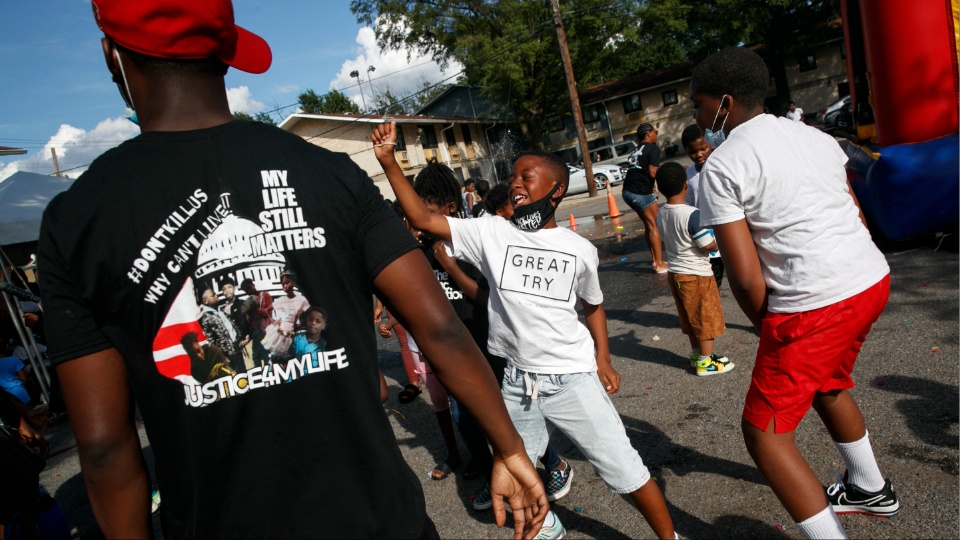
The president’s political allies and complicit local politicians like Mayor Muriel Bowser have amplified this focus on the youth of the city via harmful legislation and the establishment of a curfew. The most afflicted population from these recent developments have been the Black children of the city. That is no coincidence, of course, and it continues the long historic trend in the U.S. of criminalizing Black youth.
The Trump government, in tandem with Bowser’s office, through the “Safe and Beautiful” Task Force, have utilized multiple methods to target the Black youth of D.C. The most notable has been Bowser’s citywide curfew, banning all persons under the age of 18 from being outside between the hours of 11 p.m. and 6 a.m. The same initiative allows the D.C. police chief to go even further, granting the power to designate “high-risk zones” where curfews can be imposed as early as 6 p.m.
Curfews: Discriminatory and ineffective
The D.C. Council and Bowser’s office had already been zeroing in on the issue of crime even before Trump dispatched troops to the capital with the passing of earlier legislation, such as Councilwoman Brooke Pinto’s “Secure DC” and “Peace DC” bills.
Peace DC, launched in early 2025, consolidated all the existing violence intervention programs under the Mayor’s Office of Neighborhood Safety and Engagement, set up a three-year transition team to help establish the newly unified office, and offered training for violence interrupters. Despite the good intentions, there are still concerns that these efforts started by Peace DC lack proper funding and may not reach those who need help the most.
Secure DC, which was passed in 2024, designated “drug-free zones” across the city, areas where police can disperse any group of two or more people if officers have “reasonable suspicion” of drug dealing, ownership, or use. These zones became the political justification for the emergency acts that created the new youth curfew laws.
The emergency acts took the form of the first Juvenile Emergency Amendment Act of 2025, which gave the mayor and police chief temporary curfew for 90 days, lasting only until early October. Over the summer, many teens were hassled by police as a result of enforcement. The law was later extended through the Second Juvenile Emergency Amendment Act, which returned curfew powers to the mayor and chief through early 2026.
The idea of a curfew might seem harmless, but in truth the idea of an evening curfew that applies only to the youth of the city is not only discriminatory but also fails to even stop crime in most cases. The curfew essentially criminalizes the non-criminal act of walking around the city past a certain time and puts children in the city at risk of harmful encounters with law enforcement.

There is also the fact that the “high risk zones” where curfews have consistently been implemented are in areas frequented by Black youth. Some of the areas that have been designated curfew zones include U-Street and the Banneker Recreation Center, which are notably places that not only Black youth frequent but also students from Howard University. This highlights who the real targets of the curfews are.
Since the establishment of the curfews, police have been caught on video stopping Black youth at Metro stations during the evening hours while ignoring other people going in and out of the train. Police have also worked with the National Guard to apply more pressure to fare evaders, including youth, since the start of the military takeover.
On Halloween night 2025, police at Navy Yard arrested five teens during a gathering of youths. Two of the teens, both 14, were only arrested because they refused to be taken in by police, not for any criminal activity. National Guard soldiers collaborated with the Metropolitan Police Department in dispersing the teens, highlighting the fact that the partnership between the military and MPD is effectively designed to target people of color in D.C.
This raises another issue with the curfew, which is the fact that it doesn’t make a dent on crime in the city. The vast majority of crime is committed by adults, which means the curfew isn’t impacting the age groups most responsible for offenses. If anything, more crime may end up being recorded, as youth in the city have an increased chance of being arrested for curfew violations, which would then add to the number of “crimes” in total.
There is also the possibility that curfews actually cause an increase in gun-related incidents. A 2015 study analyzed the trends of gun shots in D.C during the starting hours of an older standing curfew from the Juvenile Curfew Act of 1995. This law barred youth under the age of 16 from being outside past 11 p.m. throughout most of the school year and midnight during the latter half of the summer break.
The study found that there were more incidents of gunshots during the hours of the curfew—an increase of 150%. The study theorized that the increase of gun shots during the curfew was a result of there being fewer bystanders and witnesses in public areas. This means that the new curfew could also incentivize people intending to commit because they will know there’s nobody around who could be a witness to their activity.
The sentiment that the curfews will do more harm than good is not just coming from young people and their parents but also many local organizations that focus on supporting Black youth in D.C. Black Swan Academy, Guns Down Friday, and many other groups that focus on anti-racist activism in D.C. issued a joint statement that calls out Bowser’s curfews, saying, “These measures are about control, not safety.”

Historically, curfews have taken many shapes and forms in the U.S., but in most cases, they have been specifically used to restrict the movement of people of color. “Sundown towns” were communities that utilized curfews in order to prevent the presence of Black people in cities or small towns that had a predominantly white population. In most cases, a Black person who was in a city or even a whole county past the curfew of sundown risked being hunted down and killed by white supremacist mobs.
While there were many cases where sundown curfews existed but were never codified, thousands of municipalities made sure that sundown restrictions were law. It wasn’t until the Civil Rights Act of 1968 that sundown towns officially became illegal in the United States. However, many of these same communities still attempt to push Black people out from living in their spaces and continue upholding the social contract of the sundown curfew, despite its illegality.
Curfews have also been used to stop the mass mobilization of Black people protesting against racism and white supremacy. In Los Angeles, the Watts Riots of 1965 occurred after Black people in the city grew tired of constant abuse by the Los Angeles Police Department towards their communities. In response, the city government, working with the National Guard, established a curfew zone in the city that spanned 46 square miles. The zone encompassed many Black communities in L.A., and anyone who was found breaking the curfew was threatened with arrest or being shot. Twenty-three people were killed as a result of the LAPD’s actions during the riot.
In more recent times, curfews have been used against Black Lives Matter protests in 2020, such as the one established in D.C., where over 400 people were arrested for violating the curfew, despite being outside solely to protest police brutality. More people were arrested by MPD for violating the BLM curfew than for participating in the Jan. 6, 2021, Trump coup attempt.
Today, the racist pattern of curfews shows itself again in the form of the current military occupation of D.C. by the National Guard in alliance with the MPD and other federal law enforcement.
Trump’s bias against Black youth
Along with the recent curfews, there are also several bills recently passed by Congress that, by design, directly target Black youth in D.C.
For example, the Juvenile Sentencing Reform Act would lower the age in which a minor can be tried as an adult to 14. These bills not only act as a means to arrest Black youth but also make it more difficult to challenge police misconduct and almost eliminate any chance of young people ever leaving from the prison system once they’re in it.
These laws were all pushed and championed by not just Trump and the Republican Party but also a handful of Democrats in Congress.
The fact that the federal government and the mayor’s office think that curfews and such legislation are needed doesn’t match up with recent crime statistics in the city. Since 2024, there has been a drastic drop of violent crime in D.C., a 35% decrease overall. This marks the biggest decline in violent crime in the past 30 years. It makes the various initiatives being taken by Trump and Bowser seem like a massive overreaction.

Interestingly enough, Trump has recently attempted to sue the D.C. government because of its strict gun laws, claiming that the city’s restrictions on semi-automatic weapons is violating the Second Amendment. This sets up a contradiction. The president claims D.C. needs the National Guard in order to stop violent crime, despite the decline of crime, but he is also open to loosening restrictions on ownership of, for instance AR-15s, for citizens in the city.
It was the easy access to firearms that resulted in the death of two National Guard soldiers during Thanksgiving week, and yet Trump framed it as an issue of immigration rather than one linked to the need for gun reform. In fact, it was thanks to Trump specifically that the shooter in that incident entered the country, as he was a part of CIA-allied forces in Afghanistan and the Trump administration approved the paperwork for him to live in the U.S.
Despite this, the president has continued his pattern of racism and restricted nationals from dozens of other countries from obtaining visas to travel to the U.S. This is a common theme from this government: blame marginalized communities for structural issues that have only been made worse by the administration’s own actions.
Trump has made it abundantly clear that a major reason for his deployment of the National Guard was to implement the mass policing of people of color in D.C., with a specific emphasis on Black youth. As data disproves the need for this level of over-policing, these recent moves from the federal government can only be chalked up to Trump’s own anti-Black racism and its agenda of militarized control of cities.
On his social media, Trump has repeatedly referred to the Black youth of D.C. as “thugs” and “gang members” in order to justify his mass militarization of the city. Trump’s war on Black youth isn’t something that started in D.C. though. Before he was even president, Trump was a New York City businessman who ensured that no Black person could rent any property he owned.
It was also during this period of time that Trump took out a full-page ad in the newspaper demanding the death penalty for a group of young Black and Hispanic children who later became known as the “Central Park 5.” The five youth were falsely accused of the rape and attack of a woman, despite no DNA evidence of a single one of the kids. Despite the Central Park 5 not being guilty, Trump still remains adamant that they committed the crime.
This track record of racism is Trump’s most consistent quality, and it is the racist fearmongering that Trump utilized in the presidential campaigns that helped build up the MAGA base in the first place. Today, it’s clear that it is also his racist ideology that frames many of his actions towards the residents of the capital.
The Chocolate City’s needs
Washington, D.C., has historically been a majority Black city since the early 1950s. Redlining practices kept many Black families in the Southeastern neighborhoods, which is where the majority of the Black population of the city currently resides today. It was only recently that the Black population in the city had begun to see a decline—a direct result of gentrification. Housing prices in the city started to go up, which pushed Black families out of neighborhoods like Shaw and Navy Yard.
The Black families that stayed east of the Anacostia River didn’t see investment or serious infrastructure upgrades in their communities. Many neighborhoods in the Southeast like Anacostia are considered “food deserts,” which are areas where there are few or no options to access fresh and healthy food. There are also notably fewer Metro and bus stops within the heart of the Southeast.
Schools in many Black neighborhoods of D.C. are underfunded and have outdated facilities. With these infrastructure failures and the growing rate of unemployment—now 9.9% of the Black population—these conditions have created a perpetual cycle of poverty born from neglect towards Black neighborhoods in the city.
D.C. has some of the highest rates of childhood poverty in the country; over 9,000 students who attended D.C. public schools from 2024 to 2025 were homeless. This count doesn’t even include children who are in temporary housing situations. Some of the kids recorded in this study were as young as 5 years old.
It is from these conditions that crime originates. As young children go without the resources they need to thrive, it’s not surprising that youth crime is an issue in the capital. People in desperate situations will do what they can in order to get food on the table for them and their family, and in some cases, they can end up turning to crime.
Black youth in the city are already overrepresented in criminal arrests, but these arrests aren’t necessarily indicative of whether these children have even committed a crime or not. There is also the fact that Black communities already face regular over-policing, which skews the numbers, as police are prioritizing a presence in Black communities where crimes done by Black people are more likely to happen instead of white communities where white crime is more likely to happen.
Police across the U.S. have been known to fall into racial profiling and bias when it comes to interactions with Black people, which have so often resulted in unneeded escalations and death. In 2021, 27-year-old An’Twan Gilmore was murdered by police after they surrounded his car while he was sleeping in D.C. A year prior, police recklessly killed Deon Kay for pulling out a gun—despite police cam evidence showing that he was trying to throw away the weapon. Kay had only recently turned 18, which only showcases how police encounters with Black youth can end up costing lives.

The biggest issue with the recent crime bills and the youth curfew is that they fail to address the underlying causes of youth crime in Washington, D.C. Instead of confronting the conditions that create crime, politicians emphasize punishment of individual youth. The youth crime issue in Washington is not an issue of Blackness, as Trump claims; it is instead a problem of poverty under capitalism. If young people and their families had their basic needs met, crime would become a far less viable option in the first place.
This requires multiple structural solutions. For example, although education receives the second-largest share of the D.C. budget, many schools still face funding gaps and unfinished repairs. D.C. bases funding for public schools primarily on student enrollment, meaning schools experiencing a declining number of students receive less money. In Wards 7 and 8, which are majority Black and have child poverty rates above 30%, this funding formula places additional strain on already under-resourced schools. At the same time, repairs and modernizations are handled separately through the Department of General Services, leaving many school buildings with long-delayed maintenance.
Fully funding underfunded schools would mean more teachers and support staff, smaller classes that give students more one-on-one time with their teachers, and more after-school programs, clubs, and recreation. This would keep students engaged, reduce absenteeism, and lower the likelihood of youth involvement in crime.
Funding must also be directed toward job opportunities and internships for youth. This initially was done under Mayor Marrion Berry through projects like the Summer Youth Employment Program, which helped teens and young adults get paid work. Expanding internships, youth jobs, and social welfare programs like TANF (Temporary Assistance for Needy Families) would alleviate the issue of poverty for many families while offering young people alternatives to criminal activity.
However, changes in leadership and Congress’ continued control over the District’s budget have limited the stability and reach of these programs. The Trump administration has shown no interest in supporting anything aimed at improving conditions for Black youth. Without full control over its budget, D.C. lacks the tools needed to lift people out of poverty or reduce youth crime.
The most effective way to reduce youth crime is to reduce poverty and expand support for the families and youth most impacted. Trump’s war on Black youth is one of the many conflicts that Trump is creating amongst oppressed communities across the country, and it’s clear he won’t stop until his white supremacist goals are actualized. In order to combat these serious attacks, organizers must work together to support current initiatives aimed at uplifting communities afflicted by poverty in the city and find ways to protect the Black youth of the capital from police harassment and abuse. There also needs to be support for initiatives that prioritize youth education and out-of-school programs. Groups like the Fair Budget Coalition advocate for a D.C. budget that takes into account racial discrepancies and equity in their advocacy for a better city budget while others, like the Out of School Time Coalition, hope to expand current after-school and summer school programming and make it universally accessible across the city.
These initiatives—along with the ongoing struggle for home rule in D.C.—are charting a path towards not only better protecting Black youth in the city but also finding ways to better answer their needs.
We hope you appreciated this article. At People’s World, we believe news and information should be free and accessible to all, but we need your help. Our journalism is free of corporate influence and paywalls because we are totally reader-supported. Only you, our readers and supporters, make this possible. If you enjoy reading People’s World and the stories we bring you, please support our work by donating or becoming a monthly sustainer today. Thank you!
CONTRIBUTOR