

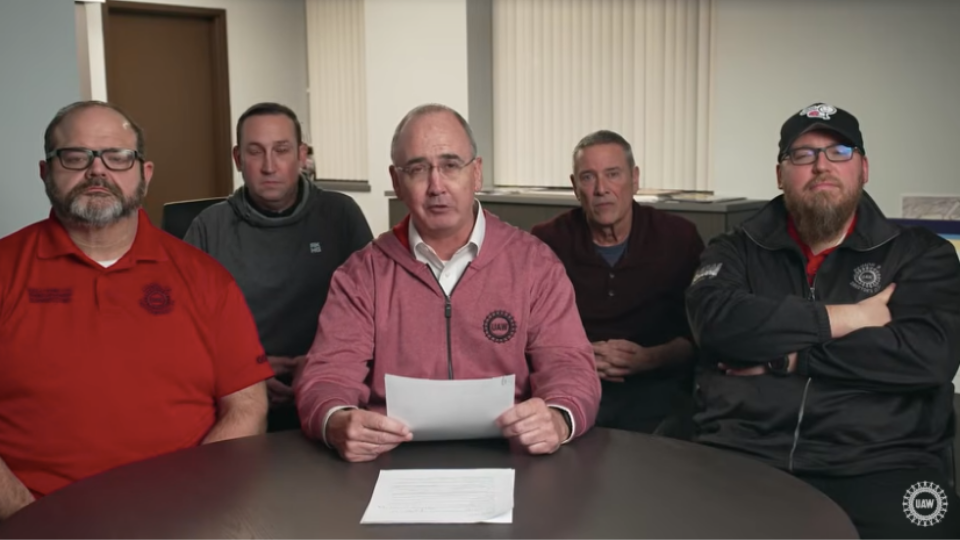
CHATTANOOGA, Tenn.—Nearly two years after 3,200 autoworkers won their union with the United Auto Workers at Volkswagen’s Chattanooga plant, they have finally reached a tentative agreement for their first union contract. The membership will now vote on whether or not to adopt the tentative deal, which the union is calling a “historic agreement” secured through a concerted campaign that overcame years of corporate and political opposition to union organizing in the South.
“The days of favoritism, harassment and unequal treatment at VW are over,” UAW President Shawn Fain said. “People said Southern autoworkers could never form a union or win a union contract. Volkswagen workers in Chattanooga said, ‘Watch this.’”
The breakthrough comes almost two years after the plant’s workers voted overwhelmingly—2,628 to 985—to join the UAW in April 2024. That election marked the union’s first major organizing win at a foreign-owned auto plant in the South, succeeding where attempts in 2014 and 2019 had failed.
Workers celebrated the win as their pathway to securing the substantial wages and benefits UAW members at the Big Three automakers won in their 2023 Stand Up Strike.
“For years, Chattanooga workers were told to settle for less while Volkswagen made record profits. So, the workers stood together and won their union—and now they’ve secured a life-changing first agreement,” said Fain. “This deal proves what happens when autoworkers stand up and demand their fair share.”
The 2024 VW campaign was the first win in the UAW’s two-year, $40 million drive to organize the approximately 150,000 unorganized autoworkers at foreign-owned “transplant” factories across the South. It was won despite a concerted campaign by the company and six right-wing Republican governors to block the organizing effort.
The union also filed half a dozen unfair labor practice charges against Volkswagen during the organizing drive, citing illegal interference and union-busting.
The tentative agreement delivers on the workers’ key demands, the union said. It provides an immediate 20% across-the-board wage increase, affordable high-quality healthcare with no premium increases, and substantial bonuses, including a $6,550 ratification bonus and annual $2,550 bonuses.
Importantly, it will establish “real job security protections against outsourcing and plant closures, stronger health and safety standards with union representation, paid time off, fair scheduling rules, and a clear grievance procedure.”
The gains are especially significant given Volkswagen’s recent performance; the world’s second-largest automaker reported $20.6 billion in profits in 2024 alone. The tentative agreement represents a major improvement over the company’s so-called “final offer” in October, which prompted workers to authorize a strike.
The improved deal includes new product commitments, enhanced right-to-strike protections, and stronger language on job security, the union said.
The Chattanooga workers “also got the health care they can afford,” Fain said. “Health care will cost them less in 2030 than it did in 2024,” he added, without giving specifics.
The tentative agreement also includes “better strike protections,” the UAW said. Its contracts with the Detroit 3 expanded the union’s right to strike to include strikes over unsolved grievances.
The path to reach this tentative agreement has not been easy. In fact, even throughout bargaining, workers faced a new anti-union campaign at the plant—a well-funded decertification effort dubbed “Take Your VW Raise.” The campaign, backed by veteran union-busting lawyer Maury Nicely, who has a history of anti-UAW campaigns, has tried to exploit the long delay in reaching a first contract.
But for the majority of workers there who have continued to fight, “This contract is proof that if you stand up and stick together, you can win a better life,” said Kelcey Smith, a worker in the paint department. “No matter where you live, or where you work, autoworkers deserve a union contract.”
The victory in Tennessee is part of a broader, contested landscape for the UAW in the South. In Kentucky, the union recently won an organizing campaign at the BlueOval SK battery park plant in Glendale, overcoming similar management intimidation and unfair labor practices. However, nearly all 1,600 workers there now face layoffs as Ford Motor Company “restructures” its operations, claiming “lower-than-expected demand and high costs.”
UAW Vice President Laura Dickerson affirmed the union’s commitment to fight the Kentucky layoffs. “Ford has a legal obligation to bargain the effects of the closure with us,” she told The Detroit News.
The UAW sent Ford a formal demand to bargain and is gathering support for a petition demanding that any future ownership of the facility commit to rehiring the laid-off workers under the union contract. They have more than 1,000 signatures already, Dickerson said.
For the workers at Chattanooga, they will now determine whether this hard-fought agreement becomes a new reality on the factory floor. But beyond the ratification bonus and wage increases, the true impact of the contract will be in its implementation and the continuing fight against big business profiteering. For now, autoworkers at a Southern “transplant” plant can point not just to the promise of a union, but to the tangible rewards of a successful struggle.
“To all the non-union autoworkers listening out there, this is your victory, too,” said Fain. “A future like this is out there for you—and it starts with joining a union.”
We hope you appreciated this article. At People’s World, we believe news and information should be free and accessible to all, but we need your help. Our journalism is free of corporate influence and paywalls because we are totally reader-supported. Only you, our readers and supporters, make this possible. If you enjoy reading People’s World and the stories we bring you, please support our work by donating or becoming a monthly sustainer today. Thank you!
CONTRIBUTOR




MOST POPULAR TODAY
As Iran war rages, Netanyahu builds ‘Greater Israel’ from Palestinian and Lebanese land

Trump’s Postmaster General says USPS may shut down in a year

The other ‘lizard people’: Why the Epstein files are shattering global theory

U.S. Student Association tells Congress: Save education, Stop the SAVE Act

Europe refuses war script: Spain’s rebuke exposes limits of U.S.–Israeli escalation in Iran