

Editor’s Note: The vote on the Senate resolution referred to in this article was held after our story was published. The resolution failed by a vote of 51 to 48. Two Republicans, Sens. Rand Paul and Lisa Murkowski, voted in favor, while Democratic Sen. John Fetterman voted against.
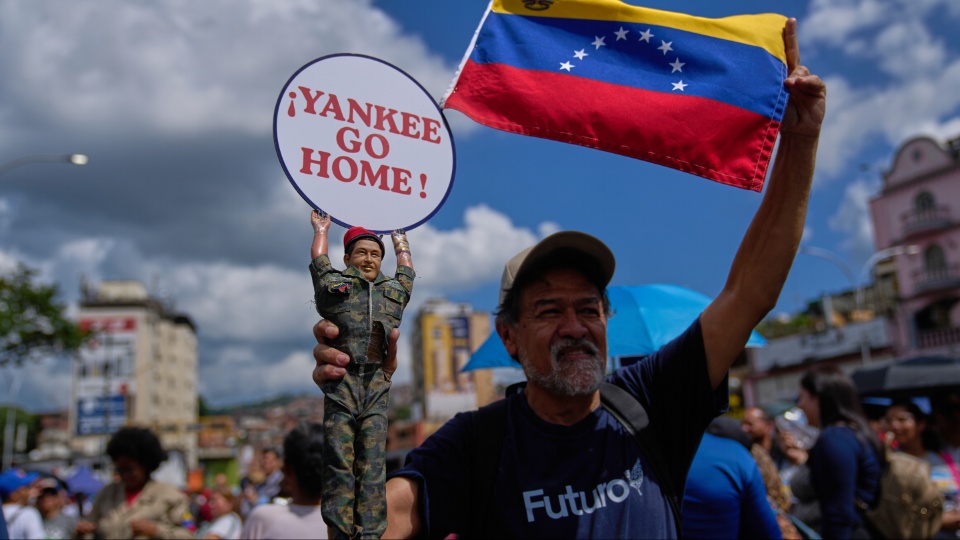
An unlikely bipartisan alliance is forming in the U.S. Senate to halt President Donald Trump’s escalating but undeclared war against Venezuela.
Democratic Sens. Adam Schiff of California and Tim Kaine of Virginia have teamed up with Republican Sen. Rand Paul of Kentucky to force a vote on a resolution that would require the White House to secure congressional approval before launching direct military attacks against the South American country.
The Senate resolution (S.J. Res. 83), also backed by Sen. Bernie Sanders, Ind.-Vt., is the sister to a similar measure already introduced in the U.S. House (H.Con.Res. 51) by Reps. Ilhan Omar, D-Minn., Greg Cesar, D-Texas, and Jesús “Chuy” Garcia, D-Ill.
Though both the Senate and House are in MAGA hands, with Trump pulling the strings of Republican leaders in the two chambers, the ranks of lawmakers resisting the legislative branch’s total abdication of war authority to the president is growing, thanks to mass public pressure.
Killing fishermen as prelude to war?
The exact number of U.S. attacks carried out so far against what Trump alleges are drug boats in the waters off Venezuela is uncertain, but at least 21 people are believed to have been killed since the first confirmed sinking in early September.
Bragging about the latest hit last week, Trump seemed to signal that direct military strikes on the Venezuelan mainland could be coming soon. After thanking the U.S. Navy for “blowing the cartel terrorists out of the water,” the president shifted, saying: “They’re not coming by sea anymore…now we’ll have to start looking about the land because they’ll be forced to go by land.”
Though Trump and his “Secretary of War,” Pete Hegseth, continuously allege the boats sunk by the U.S. are carrying drugs eventually bound for the U.S., their claims are being challenged. Investigations by several major news outlets, including the New York Times, have suggested some of those on board the sunken vessels were simply fishermen or migrants—not drug runners.
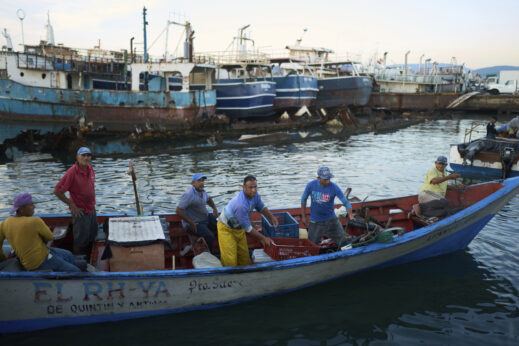
The wife of one victim, from the Paria Peninsula in Venezuela, testified that her husband was a fisherman who “left one day for work and never came back.” She is now struggling to raise their four children alone with no income.
If the woman’s story is true, it would not be the first time that the U.S. military has murdered innocent fisherman while carrying out Trump’s orders. In September, a Times exposé revealed that U.S. Navy SEALs shot and killed several North Korean civilians in 2019 during a failed mission to plant a spy device for listening to the communications of Kim Jong Un.
When a group of Korean fishermen accidentally stumbled upon the special forces team, the U.S. soldiers filled them with bullets and dumped them into the ocean, first puncturing “the boat crew’s lungs with knives to make sure their bodies would sink.”
Target: Venezuela
While that botched raid was part of an effort to gather intelligence during U.S.-DPRK nuclear negotiations, the recent attacks in the Southern Caribbean appear to be laying the groundwork for a broader war and the possible overthrow of the Venezuelan state.
The U.S. government has targeted Venezuela for decades, ever since the late President Hugo Chávez took office in 1999. Chávez declared himself an “anti-imperialist,” re-nationalized the previously privatized oil industry in his country, launched massive social welfare missions, built strong trade ties with Cuba, and declared Venezuela would pursue a path of socialist development as part of a “Bolivarian Revolution.”
In 2002, the administration of George W. Bush backed a military coup that temporarily removed Chávez from office before mass public protests restored him to power. U.S. sanctions followed.
Though there was a slight let-up of U.S. pressures during the Barack Obama presidency, hostility increased following Trump’s first takeover of the White House. Another coup attempt in 2019 saw the U.S. recognize opposition lawmaker Juan Guaidó as the supposed “interim president” of Venezuela. The failed scheme was part of a long-running effort to unseat Chávez’s successor, President Nicolás Maduro, who assumed office in 2013.
Start-stop negotiations and a partial easing of sanctions defined the Biden administration’s approach, but pressure on the Venezuelan economy was kept up, making life more difficult for the people there and further aggravating outward migration.
Trump’s return to power brought a return to outright hostility under the theme of illicit drug trafficking, with a $50 million bounty put on Maduro’s head for allegedly running a cartel that no one has been able to prove even exists.
Since late summer, however, the Trump administration’s squeeze on Venezuela has become much more militaristic and menacing. U.S. warships, surveillance aircraft, and at least one attack submarine have been stalking the waters near Venezuela since August and executing the attacks on the supposed drug boats.
The Southern Caribbean region, especially with its oil reserves and strategic location for global navigation, is becoming a major part of the repartition of the world pursued by U.S. imperialism. Trade relations between China and Russia and countries like Venezuela, Brazil, and others stand as a barrier to U.S. dominance of Central and South America.
The overthrow of Venezuela’s socialist-oriented state and the isolation of progressive governments like that of Brazil’s President Lula da Silva via tariffs fit with the U.S. imperial strategy of squeezing Chinese trade out of the Western Hemisphere and restoring U.S. corporate control of these countries’ economies.
Late last week, Trump sent the strongest signal yet that a bigger war may be coming. The White House dispatched a memo to Congress declaring that a “non-international armed conflict” was now underway against narco-trafficking.
Legal experts saw the wording as an attempt to evade the War Powers Act, a U.S. law that specifically reserves the authority to declare war against another country to Congress. By designating possible military strikes in Venezuela as attacks against a “non-international” entity like a drug cartel, the administration hopes to cut Congress out of having a say over anything Trump may order the armed forces to do.
Restraining Trump
Short-circuiting that tactic is what’s partially motivating the move in Congress to reassert constitutional checks and balances. The Senate and House war powers resolutions would override the Trump memo and return war-making power to the legislative branch.
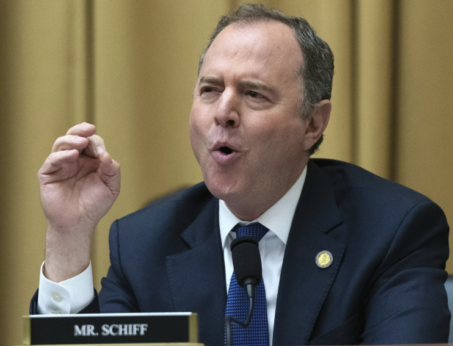
“Congress alone holds the power to declare war,” Schiff said when introducing the resolution in September. While neither an opponent of U.S. imperialism overall nor a friend to the Venezuelan people, the Democratic lawmaker took a constructive position, saying that “blowing up boats without any legal justification risks dragging the United States into another war and provoking unjustified hostilities against our own citizens.”
Putting forward the resolution is also a response to the fact that Congress has been flooded with tens of thousands of messages from constituents demanding it act to restrain Trump.
Grassroots group Demand Progress is spearheading a campaign that has so far inundated lawmakers with at least 80,000 letters and emails urging them to support the Senate and House resolutions on Venezuela.
Cavan Kharrazian, the senior policy advisor for Demand Progress, said “Congress must not let the Trump administration drag us into another unauthorized war,” in a statement provided to People’s World.
“The recent illegal killings in the Caribbean have received zero congressional oversight or authorization and put us on a course toward a regime change war in Venezuela,” Kharrazian said. He pinpointed the narco-trafficking excuses being deployed by Trump as an expansion of the U.S.’ failed militarized drug war policies across Latin America.
“Lawmakers have a constitutional duty to reassert their war powers to stop this escalation before it spirals into a wider conflict,” Kharrazian declared, “and make clear that no president can unilaterally decide when and where the United States goes to war.”
The Communist Party USA went further in an Oct. 2 social media post, saying that the strikes on boats in the Caribbean are a prelude to a bigger campaign to restore U.S. capitalist economic and political domination of Venezuela.

“The White House continues to boast about plans to further escalate the attacks in an attempt to threaten the sovereignty of the Venezuelan people and take control of their natural resources,” the CPUSA said.
The party said the slogan at this moment must be: “No More Wars for Oil! No to imperialist aggression! Hands Off Venezuela!”
We hope you appreciated this article. At People’s World, we believe news and information should be free and accessible to all, but we need your help. Our journalism is free of corporate influence and paywalls because we are totally reader-supported. Only you, our readers and supporters, make this possible. If you enjoy reading People’s World and the stories we bring you, please support our work by donating or becoming a monthly sustainer today. Thank you!
CONTRIBUTOR


MOST POPULAR TODAY
Trump’s catalog of constitutional crimes: Long and getting longer

Communist Councilwoman from Ithaca: Hannah Shvets defeats landlord candidate

On boycott anniversary, D.C. campaign pickets every Target store in solidarity with Minnesota
Mussolini’s shadow: Italy alarmed as students encouraged to report ‘left-wing’ teachers

Eighteenth Brumaire of Emmanuel Macron repeats an earlier French history