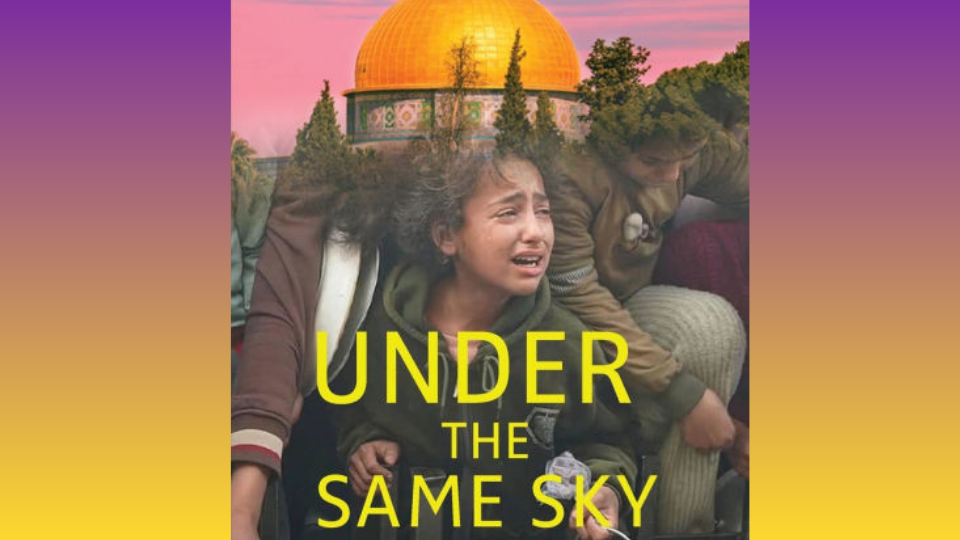
Leila Majaj Kirkconnell’s Under the Same Sky is more than a novel; it is a monumental work of witness and a significant literary achievement. It accomplishes what countless reports and statistics fail to do: It translates a vast, complex geopolitical tragedy into a deeply personal, sensory, and unforgettable human experience.
From its very first pages, the novel grounds itself in a specific reality of Palestinian resistance, signaled by Lisa Suhair Majaj’s poignant epigraph poem, “Gaza Interlude.” The poem expresses the concept of sumud—steadfastness or perseverance—which is about the daily, defiant act of living and finding moments of joy amidst systematic oppression. This is the novel’s heartbeat: the will to endure through the physical experience of its protagonists.
The novel’s great power lies in its refusal to present Gaza as a monochrome landscape of despair. It insists on the coexistence of beauty and horror, making the destruction more profound by contrasting it with what is being systematically erased. The most persistent sensory motif is the juxtaposition of jasmine and phosphorus: Emad’s journey north to his destroyed home is a pilgrimage through hell, yet his most poignant find is the jasmine plant, the one his mother “had nursed from a seedling.”
It is now “gray with dust,” with “one stubborn blossom clinging to a withered stem.” He takes a handful of dirt from its roots, a sensory talisman of a lost world of care and cultivation. This exists alongside the “sickly sweet” smell of “caramelized flesh” after a bombing, a direct reference to white phosphorus. Such juxtaposition—the delicate, fragrant scent of jasmine (memory, home, life) constantly violated by the acrid stench of death—is the novel’s core sensory argument.
The Mediterranean Sea serves as another powerful dual symbol. In the “Then” narratives, it is a source of life, described with the “scent of salt” and the “shimmering” waves at sunrise. In “Now,” it is a barrier. Emad stares at the “horizon where menacing naval ships hide,” and the waves push derelict fishing boats ashore to be used as “fuel for the next meal.” The same sea that once provided sustenance and beauty now symbolizes entrapment, its very nature poisoned by the visible and audible threat of the patrol boats.
Ultimately, the genocide is shown not just as external events, but as a psychological and physiological transformation of the characters themselves. The “insect-like hum vibrating in the back of our teeth before it reached our ears” internalizes the threat. It is a vibration felt in the body, a constant, low-level terror that precedes conscious thought. Characters learn to sleep in the “precise 22-minute intervals” between explosions.
The novel’s “Then” and “Now” structure is the core of the novel’s prosecutorial power. The “Then” chapters—vibrant with fishing trips, university debates, and graduation ceremonies—are evidence, documenting the vibrant, functioning society that existed before its systematic annihilation. This structure forces a devastating before-and-after comparison, revealing the destruction depicted in the “Now” into a criminal act.
We see Emad not just as a survivor, but as Emad the Engineer, the Builder: “My son builds things that can’t be sunk.” “Then,” we witness him sketching bridges and bantering with Karma. “Now,” his engineering textbooks are burned for fuel. Similarly, the brilliant Karma, who “devoured equations” and corrected Emad’s calculations, has her genius seriously harmed by the amputation of her hand. The fishermen of the “Then” narrative, like Baba Younes, operate under the constant threat of patrol boats. “Now,” these same boats rotting on the shore – the logical, brutal conclusion of a long-standing assault.
One of the novel’s striking achievements is its vision, in which survival, memory, and simple caring for one another are the most powerful forms of defiance. Its heroes are the engineers who can no longer build, doctors operating without anesthesia, mothers selling jewelry for baby formula, and children collecting shrapnel. Karma, now a one-handed medic, emerges as one example. Her journey from engineering student to field medic is a metaphor for the siege itself: the work of building a society is forcibly shifted to the desperate work of holding its broken bodies together.
This ethos of resistance extends to the entire community. Khalid, the smuggler, articulates this: “That’s the real resistance. Not just dying well. Living spitefully.” His “operations” to bring in insulin and antibiotics are expressed in the language of militancy, arguing that sustaining life is as strategic as any military engagement. Um Emad, the matriarch, wages her war in the kitchen, her act of sharing her meagre ration. Culture, too, becomes a weapon against erasure, as seen in the dabke dance performed in the rubble, a physical assertion of identity. Karma, Khalid, the returned doctor Issa, the poet Mazen, the matriarch Um Emad, the lost children—each represents a different facet of the Palestinian struggle.
The novel gives us intimate access to their specific experiences: Issa’s return from Germany after his family is killed, a tragic affirmation of belonging; Mazen’s voice, silenced and relegated to the “martyrs’ lists”; and the haunting presence of children like Ahmad, who clings to the drone propeller that killed his parents, and Omar, the 13-year-old donkey cart driver with “eyes older than the olive trees.” All are woven into the fabric of Gaza.
Ultimately, Under the Same Sky offers no illusions. There is no liberation, no lasting ceasefire, no deus ex machina to rescue its characters. The Epilogue presents a vision of ongoing, even intensified, suffering. Yet, to call this novel hopeless would be a profound misreading. Its hope is not rooted in political optimism but in the demonstrated, historical fact of Palestinian sumud. It is a hope built on the evidence the novel itself has meticulously presented: the indestructible will of the people to live, to remember, and to look after each other.
The novel’s final, haunting image is not of defeat, but of continuity: “the faint sound of children flying kites, their laughter rising above the ruins.” This is a poetic and political truth. The children flying kites amid the drones embody the same spirit that led the fishermen to sea during a ceasefire, that led Karma to continue with her left hand, and that allows a community to dance on the rubble.
Under the Same Sky replicates the experience of Gaza within the reader’s senses and mind. Genocide is a physical experience, resistance is a collective practice of care, and hope is a daily, deliberate action. The people are targeted, but, as the epigraph promised, they are steadfast. This book is their witness, and it is unforgettable. Under the Same Sky is a book that does not simply ask to be read, but to be acted upon.
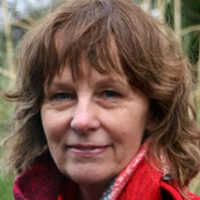
Leila Majaj Kirkconnell is a Palestinian-U.S. author, and all proceeds from the sales of this book will be donated to HEAL Palestine.
Under the Same Sky
By Leila Kirkconnell
ISBN-13: 9798993191508
Publisher Leila Kirkconnell, October 2025. $17.99 USD / EUR 21,98
We hope you appreciated this article. At People’s World, we believe news and information should be free and accessible to all, but we need your help. Our journalism is free of corporate influence and paywalls because we are totally reader-supported. Only you, our readers and supporters, make this possible. If you enjoy reading People’s World and the stories we bring you, please support our work by donating or becoming a monthly sustainer today.
CONTRIBUTOR