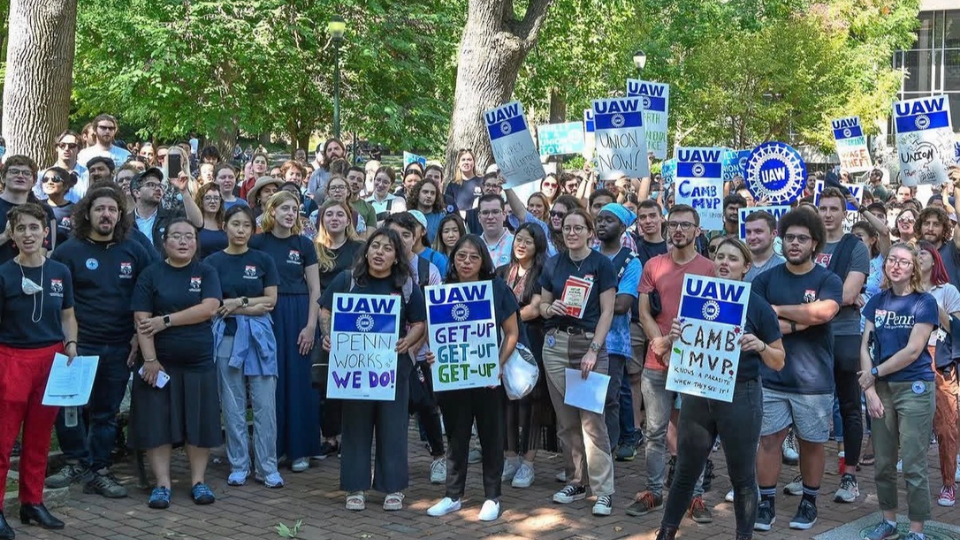
PHILADELPHIA—The University of Pennsylvania filed a lawsuit against the graduate student workers’ union in an effort to exclude hundreds of first- and second-year students from the bargaining unit. This marks a new high in tensions over enforcement of the graduate student workers’ collective bargaining agreement.
The complaint asks the court to declare that first- and second-year students in the Biomedical Graduate Studies program are not “employees” because they do not provide services to Penn until their third year.
Graduate students typically pursue a course of study including coursework, laboratory rotations, and dissertation research in a thesis laboratory. Graduate student research, especially thesis research, constitutes a significant proportion of Penn’s research output. In Penn’s Biomedical Graduate Studies program, graduate students often begin full-time dissertation research before starting the third year of the program.
The university and the union have struggled over including early-year graduate students since the inception of the graduate worker union movement at Penn. The university disputed the inclusion of first- and second-year students from the bargaining unit during the union’s petitions before the National Labor Relations Board (NLRB) in 2017 and 2023.
The issue was also fiercely contested during bargaining. The final bargaining agreement explicitly excluded students on rotations, but did not address early-year students who have already begun their dissertations in detail.
The current dispute arises out of a grievance filed in April by the GETUP-UAW graduate worker union against the university’s decision to exclude students who have begun their dissertations from the bargaining unit. In an email sent to union members, GETUP stated that “the university administration has refused to recognize the inclusion of those of us who have joined a lab and are no longer rotating […] the University is violating the contract by excluding us and denying us our rights.”
After Penn denied this grievance, GETUP filed a request for arbitration. Penn’s lawsuit not only alleges that the grievance is unfounded, but that GETUP does not have the right to arbitration under the collective bargaining agreement.
Notably, graduate students both inside and outside the bargaining unit share the same salary and health insurance benefits, including the advances won by GETUP during bargaining. As such, the immediate benefit to Penn of excluding these students from the bargaining unit is unclear. One revealing comment by a university spokesperson to The Daily Pennsylvanian— Penn’s student newspaper—described how the university’s effort “preserves students’ right to focus on their academic progress during this critical period, as well as the University’s right to make decisions in support of that academic progress.”
This suggests that Penn likely wants to avoid the labor protections that union membership provides. Additionally, with the collective bargaining agreement ending in June 2028, the exclusion of a significant proportion of graduate workers doing research from the unit could decrease GETUP’s leverage in negotiations.
The lawsuit comes amidst other disputes regarding the collective bargaining agreement that went into effect this July. Most notable of these is the university’s recent decision to limit graduate workers to 20 working hours per week.
Although the university attributed the decision to the collective bargaining agreement, per a communication from GETUP to its members: “This is false. Article 15 of our CBA stipulates that Grad Workers may not be required to work more than 20 hours per week. It does not prevent Grad Workers from accepting additional work voluntarily.” An open letter circulated by GETUP describes the effects of this policy as a “growing crisis,” as it denies graduate workers positions and departments autonomy in hiring.
Additionally, because the university treats all required teaching and research positions as 20 hours per week regardless of the actual time required, the letter raises concerns that this could affect international students who rely on these “practical training” hours for work authorization in the U.S.
Incorrectly reported work hours may affect students’ ability to remain in the U.S., given repeated signals from the Trump administration that it plans to eliminate or restrict practical training authorizations.
Penn is also embroiled in other union fights. Penn Libraries employees and Penn Dining employees, both represented by AFSCME, are currently engaged in contract negotiations with the university as the new semester approaches. Postdoctoral researchers and research associates at Penn, represented by RAPUP-UAW, have criticized Penn for delays in their own bargaining process, which has lasted more than a year.
Efforts to make Penn pay PILOTs, or payments in lieu of taxes, to support city government and public schools have also exemplified broader tensions between the university and working-class Philadelphians. Despite widespread criticism and its endowment now exceeding $24 billion, the university refuses to make sufficient contributions to city government funding. Seen in the light of what many call Penn’s anti-union efforts, this can be seen as representing part of a broader attack on working people.
We hope you appreciated this article. At People’s World, we believe news and information should be free and accessible to all, but we need your help. Our journalism is free of corporate influence and paywalls because we are totally reader-supported. Only you, our readers and supporters, make this possible. If you enjoy reading People’s World and the stories we bring you, please support our work by donating or becoming a monthly sustainer today. Thank you!
CONTRIBUTOR