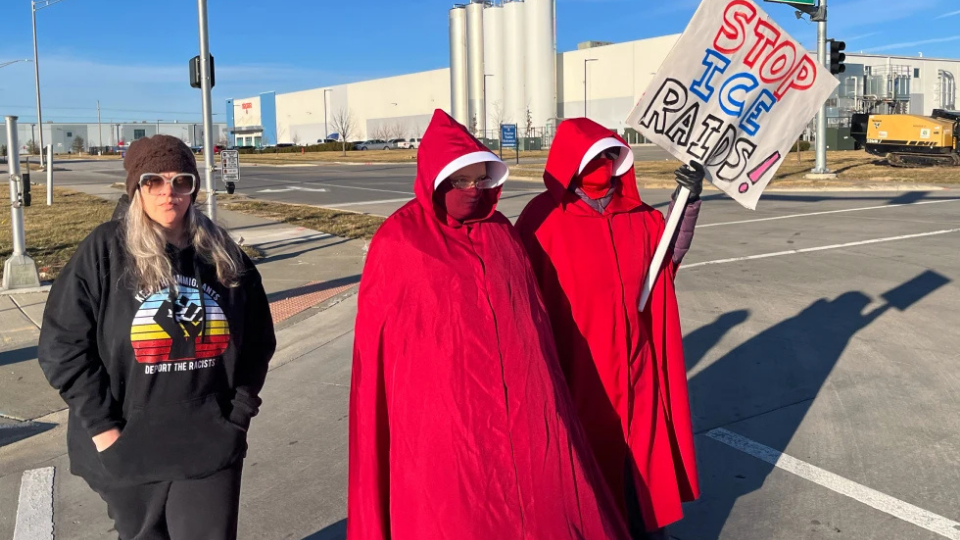
Keeping the pressure on Congress, hundreds of thousands of protesters, in demonstrations across the U.S., plus at least one abroad, hit the streets in the last few days to demand an end to ICE invasions of the nation’s cities. And in deep-red Oklahoma, the mobilizations scored at least one major victory by blocking construction of a warehouse “detention” camp planned for the holding of thousands of raid victims.
There has been a sharp increase in labor participation in all the protests, but particularly in Portland, Ore., where more than 30 local unions turned out for the “Labor Against ICE” rally of 1,000 in a southside park and then marched to a nearby detention center.
ICE agents met the crowd, which included children, babies, people with disabilities, and even pets, with tear gas, flash-bang grenades, and pepper balls, news reports said. People were forced to flee the noxious, eye-stinging fumes.
In Oklahoma City, protesters have focused on blocking the conversion of a huge warehouse into a “concentration camp,” as many activists have called it, to imprison thousands of immigrants rounded up by ICE. As soon as the public found out about the plans to have a company owned by a Canadian billionaire to turn a warehouse it owned into such a camp, they rallied outside, in the streets, and at public meetings.
The city’s mayor, David Holt, said the proposal was scrapped after listening to the protesters and meeting with the Canadian property owners. In a Facebook post, Holt also urged other property owners in Oklahoma City to show similar concern for the community.
“A lot of businesses, especially if the federal government contacts them for something, they’re a little on edge in saying ‘no’ to those type of things, but I think for him to say this is an example for other businesses to follow is important,” said C.J. Webber-Neal, founder of the Neal Center for Justice.
Other red states and suburbs produced a variety of stories in connection with protests at detention centers.
Police arrested 31 people outside the Krome Detention Center near Miami. “I want to live in a country where people don’t have to worry about whether their parents are coming home or not from work,” a marcher told local TV.
Protests at the detention center in Dilley, Texas, where 5-year-old Liam Ramos was held with his father before being released, ended when ICE agents threw tear gas at the crowd and the media, San Antonio TV stations reported.
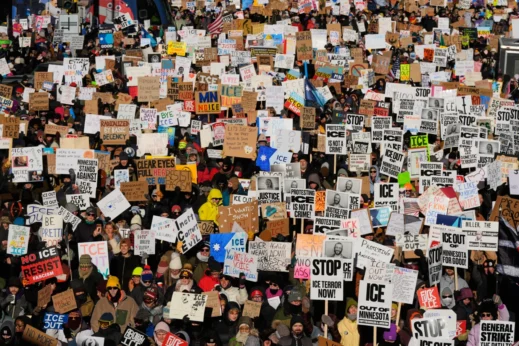
“It’s just a show of force, and it’s only motivating me to come back and fight harder,” one woman who was on the front line told reporters. There was also a protest by detainees inside the Dilley camp, an attorney for one of the families held there by ICE said.
A sign at a protest at a planned detention center in Hanover County outside Richmond, Va., read “Stop ICEWITZ”—a reference to another concentration camp from history. “I’m absolutely appalled at what our country is doing to immigrants,” one woman told local TV.
The protests elsewhere across the country memorialized two Minneapolis residents, Renee Good, an activist, poet, and mother of three, and Alex Pretti, a Government Employees union member and Veterans Affairs Department hospital nurse. In Portland, Geovanna Lopez, a nurse, held up a sign saying “ICE Murders Nurses.”
Federal agents shot Good to death in early January. Later in the month, Border Patrol agents pumped multiple bullets into Pretti’s back after wrestling him to the ground and then removing his legally carried pistol. Pretti was filming their actions against the mass of protesters on his cell phone. He was using his medical training to try to help a woman whom agents tear-gassed.
Shut it down
In the Twin Cities, Portland, and elsewhere, protesters kept the pressure on lawmakers to both evict ICE and shut it down.
Congress didn’t do that, however. The day before, senators severed the money bill funding ICE, the Border Patrol, and the rest of the Homeland Security Department from a group of funding bills for the rest of the government. It approved those overwhelmingly—and stalled on what to do about ICE’s violence.
Lawmakers gave themselves two more weeks to work on a money bill for ICE, the Border Patrol and the rest of the department. Senate Democrats demand conditions—including no masks, mandated search warrants, and no mass sweeps by agents—on that measure. They didn’t demand a complete shutdown of ICE.
As the demonstrations rocked the country, Sen. Bernie Sanders, Ind-Vt., offered an amendment to strip ICE of its extra funding of $75 billion in the money bill. He sought to transfer those dollars to Medicaid to help some of the workers and families who lost medical coverage under Trump’s so-called “Big Beautiful Bill.”
“We do not want, and we do not need what amounts to a domestic army going into region after region, terrorizing the occupants of those communities,” Sanders said. “We do not want or need and must never allow federal agents, people paid by federal tax dollars with masks on their face knocking down doors, ignoring the Constitution, grabbing people, putting them into unmarked vans, taking 5-year-olds away from their parents, putting them in detention centers, shooting American citizens in cold blood.”
But neither the shootings nor Sanders nor the protests in the streets swayed enough senators to cut ICE’s budget. Sanders lost his ICE cut attempt, 49-51. All 45 Democrats, both independents, and Sens. Susan Collins, R-Maine, and Lisa Murkowski, R-Alaska, voted to cut ICE’s cash. The other 51 Republicans voted “no.”
The violence all comes from ICE
The only violence during the protests the past several days has come from ICE and Border Patrol agents, news reports said. Agents tear-gassed the 1,000-plus people in Portland, and pepper-balled Julia Rae, an older woman using a motorized scooter.
Agents arrested 50 people in Los Angeles, a city ICE previously occupied. Churches in both Portland and L.A. rang their bells constantly, in a show of support for the protesters.
“It still kind of hurts, and I’ve been tear gassed before,” Parrish Webber, who attended the Portland march, told Oregon Public Broadcasting. “It has long effects. I’ll be sneezing a couple of days.” Some protesters carried signs declaring “Immigrants are not criminals. Our president is.”
After the agents’ tear gas attack at Portland’s ICE center, Mayor Keith Wilson said that “federal forces deployed heavy waves of chemical munitions, impacting a peaceful daytime protest where the vast majority of those present violated no laws, made no threat, and posed no danger to federal forces.”
“This gathering, the size and energy, is unique,” Portland filmmaker Jackson Casimiro told the New York Times. Dental assistant Derek Boyd told the paper he brought a leaf blower to try repel ICE’s tear gas. “We have to let them know we won’t tolerate this,” Boyd said.
“There are a ton more people than I was expecting,” medical worker Nathaniel Hancock, a Service Employees Local 49 member from Beaverton, Ore., told Oregon Public Broadcasting.
“I don’t know if today is going to change anything necessarily, but I really just hope it builds some community and it builds some connections between people and builds solidarity between the working class.”
A protest in Milan, Italy, was notable because a contingent of ICE agents accompanied the U.S. Winter Olympics team there.
The agents are supposedly in Milan, ICE says, to help with logistics and in an information center watching for threats. But their presence angered even Italy’s right-wing government and the Italian people. Milan’s mayor said they should get out.
Stop the camps
Though demonstrations are breaking out everywhere, those at ICE detention centers remain the most intense. Protesters call the centers “concentration camps” because of extensive reporting on the poor and inhumane treatment of people brought into them.
Rep. Jasmine Crockett of Texas recently described how the treatment of 5-year-old Liam Ramos broke all the rules one would expect would be followed in the U.S. The child, she said, was lifeless for days, pale and refusing to eat as his father held him in his arms for almost a week. Eventually, through her efforts and those of other lawmakers, father and son were released and returned home to Minnesota.
The conversion of empty warehouses into detention centers—as was attempted in Oklahoma City—is picking up pace. There is widespread discussion that the Trump administration is paying back private prison operators who backed his campaign by giving them contracts to carry out these conversions.
Groups like 50501 have joined local communities in “no sleep” campaigns to protest the use of a variety of other facilities, including hotels, as detention centers. The “no sleep” campaigns have targeted centers in Los Angeles and St. Paul, Minn.
Activists point out that the conditions in these existing facilities—bug-infested food and total lack of medical care for prisoners, including children—will be scaled up in the converted warehouses.
The fight to stop the expansion of the warehouse concentration camps is expected to continue and even intensify, as the Trump administration says it intends to use the conversion tactic to hold another 80,000 imprisoned migrants. There are efforts underway now to protest the opening of more such camps in New Jersey and Mississippi. For the private prison industry, the rapid opening of more detention camps offers a highly profitable opportunity to join in the Trump administration’s mass deportation operation.
We hope you appreciated this article. At People’s World, we believe news and information should be free and accessible to all, but we need your help. Our journalism is free of corporate influence and paywalls because we are totally reader-supported. Only you, our readers and supporters, make this possible. If you enjoy reading People’s World and the stories we bring you, please support our work by donating or becoming a monthly sustainer today. Thank you!
CONTRIBUTOR