

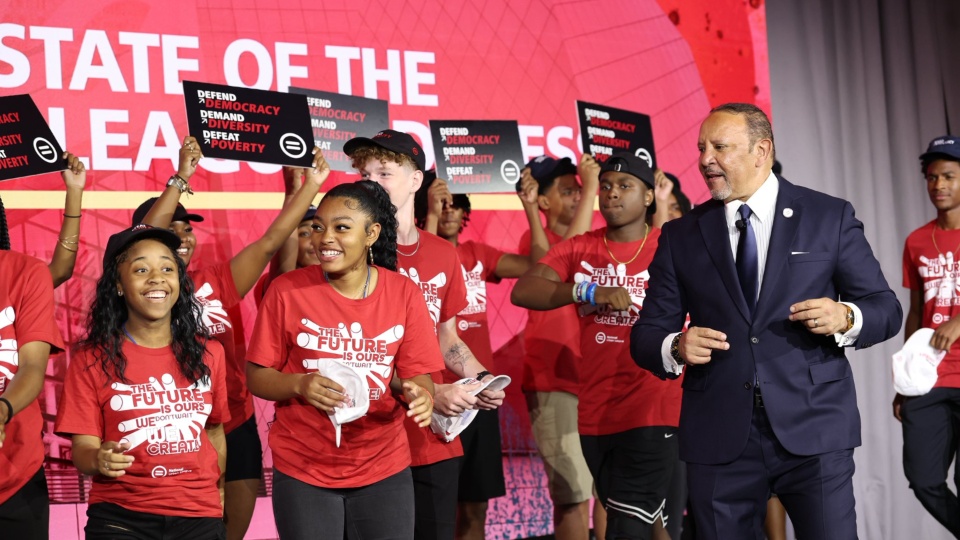
CLEVELAND—The members of the National Urban League emerged from their July 16-19 conference with a battle plan to stop what some argue is the Trump administration’s assault on Black America, on truth, and on American democracy itself.
President and CEO Marc H. Morial kicked off the opening plenary, State of Black America – State of Emergency: Democracy, Civil Rights, and Progress Under Attack, with a dire declaration: “We are in a crisis. One like we’ve never seen before. It is a state of emergency for something much broader than Black America—it’s a state of emergency for American democracy.”
Morial highlighted the organization’s State of Black America report, which puts forward an agenda that is not represented by the current administration. It exposes a systemic collapse of American institutions such as the U.S. Supreme Court and the Civil Rights Division of the Department of Justice, which he said has been “twisted into a weapon” against the Voting Rights Act of 1965 and other gains of the Civil Rights movement.
His historic analysis framed the administration’s dismantling of diversity, equity, and inclusion (DEI) initiatives as an attempt to sacrifice the country’s founding principles. “The root of DEI is equal opportunity—implementing strategies to make the promise of America real in every way. It’s about expanding the table for everyone, not taking away anything from anyone.”
The opening plenary, moderated by Ed Gordon, Emmy Award-winning broadcaster and president of Ed Gordon Media, featured three leaders: Melanie Campbell, president and CEO of the National Coalition on Black Civic Participation; Maya Wiley, president and CEO of the Leadership Conference on Civil and Human Rights; and Kimberle W. Crenshaw, Isidor and Seville Sulzbacher Professor of Law and co-founder and executive director of The African American Policy Forum.
Direct action and civil disobedience
Campbell characterized the current political moment as “desperate” during her opening comments. “People need to be willing to get arrested. We need to be strategic and can’t say publicly everything we’re doing [to resist],” she said.
She sharply criticized carceral projects like “Alligator Alcatraz” and CECOT in El Salvador. “These are not detention centers—these are concentration camps. I’ve never been in a situation before where if I get locked up, I could be sent to El Salvador,” Campbell said.
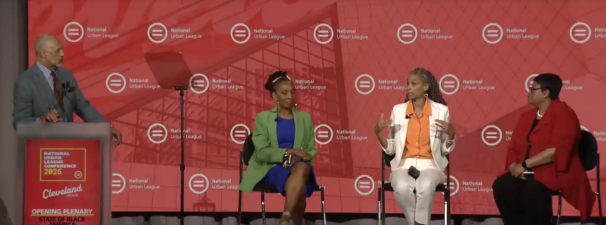
The National Urban League conference came amid increased ICE and National Guard deployments in U.S. cities and the Trump administration’s expanded deportation program, which has drawn criticism for circumventing constitutional rights and threatening to send U.S. citizens to foreign prisons.
Protecting institutions
The heightened danger of mass incarceration parallels other rollbacks of federal protections. Wiley criticized the dismantling of the Department of Education and voiced unwavering solidarity with the National Education Association (NEA), the three-million-member educators’ union resisting attempts to “end and silence them” for advocating on behalf of their members, students, and communities.
Crenshaw expanded this to cultural preservation and the need to protect Black historical memory, including museums and scholarship. “That’s where our strength is,” Crenshaw said. “The reason they’re coming after our institutions is because they’re valuable.”
Campbell localized the call to action: “Save Black history. Save it where you are, not only in D.C.”
These attacks on civil rights institutions, members of the panel argued, are part of the same broader assault on multiracial democracy. Crenshaw directly challenged the racial project at the heart of the “Make America Great Again” agenda.
“America was never great during segregation,” she said in her opening statement. “Anti-Blackness is at the core of the effort to destroy our democracy. [Trump voters] didn’t think they’d be harmed by it; they thought we’d be harmed by it. Anti-blackness is a terrible drug,” Crenshaw said.
She expressed concern over what she described as a “widespread, unspoken consensus to not mention anti-Blackness,” noting that key issues like affirmative action, DEI, and anti-Black policing are increasingly sidelined in the progressive movement’s agenda. “Every time we’re asked to show up without that, it’s a loss of power. We need to demand accountability,” Crenshaw argued.
Electoral power and corporate accountability
The panel strongly emphasized electoral strategy. “Our singular focus needs to be power,” Wiley said, condemning the voter suppression tactics like birth certificate requirements that could disenfranchise 20 million voters.
Campbell added, “We are winning in mayor’s races, but we have to lay out power-mapping on the federal level. We have to go down to the granular local level and see where the power is.” Also, she encouraged new leadership development. “Young professionals need to organize themselves as leaders and run for office.”
The discussion turned to economic pressure, including concerns about its limits. While endorsing targeted boycotts, Wiley noted: “Not all corporations are susceptible to how we spend our money. For tech companies, like Facebook, the gold is our data. That’s their dollars. We just watched Elon walk into the White House and steal a bunch of it. We have to raise our voices on this corruption.”
Campbell issued a broader challenge that reached across class lines: “We need corporations to step up because there is no free market economy without a democracy.”
We hope you appreciated this article. At People’s World, we believe news and information should be free and accessible to all, but we need your help. Our journalism is free of corporate influence and paywalls because we are totally reader-supported. Only you, our readers and supporters, make this possible. If you enjoy reading People’s World and the stories we bring you, please support our work by donating or becoming a monthly sustainer today. Thank you!
CONTRIBUTOR

MOST POPULAR TODAY
As Iran war rages, Netanyahu builds ‘Greater Israel’ from Palestinian and Lebanese land

The other ‘lizard people’: Why the Epstein files are shattering global theory

Europe refuses war script: Spain’s rebuke exposes limits of U.S.–Israeli escalation in Iran

Trump’s Postmaster General says USPS may shut down in a year

The short story of Fred Hampton, assassinated Black Panther leader