Oil, gas, transportation, housing, grocery and most other prices are jumping more rapidly than ever over the last few days, as President Donald Trump orders the stepped-up bombing of energy facilities in Iran. It brings to mind the lyrics of a famous protest song by Pete Seeger from the Vietnam War era: “Waist deep in the Big Muddy and the big fool says to push on.”
The 1967 song, “Waist Deep in the Big Muddy,” was about a platoon leader who forces his men to cross a river even though everyone knew the soldiers would die. Seeger’s tune came to be used against then-President Lyndon Johnson, who built up U.S. forces in Southeast Asia to 500,000 troops, sending them to die in a war most already knew the U.S. could not win.
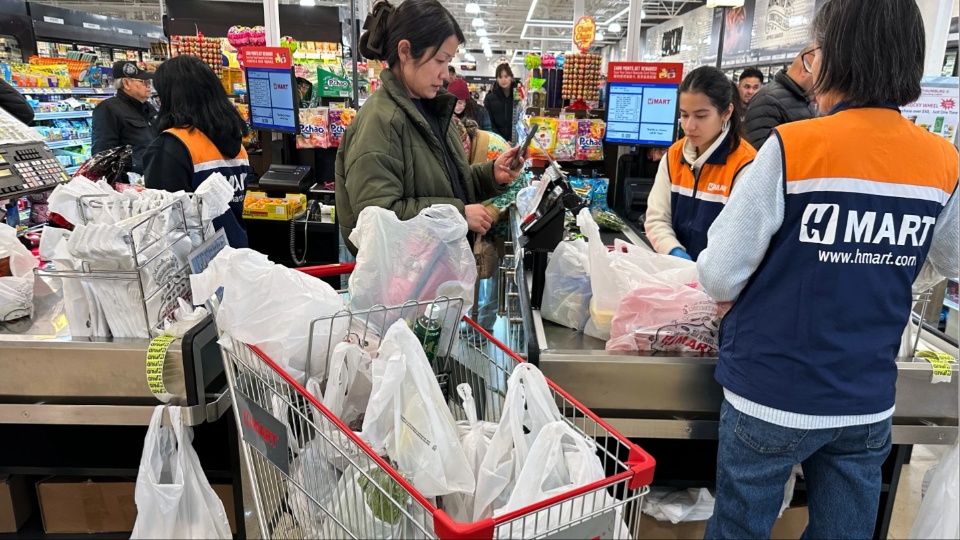
 As the Trump administration announces almost daily how it is “winning” the war against Iran, Americans see the prices of everything, not just gasoline at the pump, skyrocketing. Every time another few hundred targets in Iran are allegedly hit, the prices of fuel, food, housing, transportation, and more skyrocket. It’s beginning to feel as though the entire economy could unravel.
Thursday morning, Federal Reserve Chair Jerome Powell announced that job creation in the nation is “near zero.” Guaranteeing full employment is one of the main purposes of the Federal Reserve Board he heads. But job creation is collapsing at the same time that the cost of living is soaring.
The global price for crude oil is now over $100 per barrel, something that makes U.S. consumers shudder. The only people celebrating are the CEOs of the fossil fuel companies. As Trump has said, “We are making more money than ever because we are the biggest oil producer in the world.” The “we” he is referring to, of course, are the oil corporations, not the American people.
The same phenomena of ballooning prices is appearing all over the world. In India, the exploding price of cooking gas is leading to shortages and leaving hundreds of millions unable to prepare their daily meals. In Thailand, the government has ordered public servants to work remotely to save fuel on their commute and asked the whole nation to turn off their air conditioning.
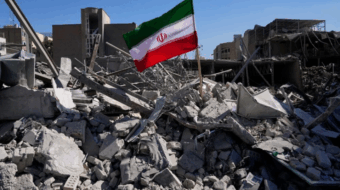
Iranian officials said Wednesday that U.S.-Israeli air strikes have severely crippled natural gas facilities in the country, further hampering exports and putting global energy supplies under more strain.
Train and airline travel is becoming more expensive. Airlines are cancelling flights because they say they can’t pay the higher refueling prices. SAS, the Scandinavian airline, said rising jet fuel costs are grounding their planes, with thousands of flights cancelled all the way out to the end of April.
In Chicago, as of Thursday, it was taking two hours and more for cars just to get into O’Hare Airport, the busiest air hub in the United States, as people scramble to fly before fares rise even more.
Agriculture is being severely affected as U.S. farmers, dependent on shipment of fertilizers that come through the Strait of Hormuz, essentially now blocked by Iran, are cut off.. That will no doubt ripple through the supply chain and send food prices across the U.S. spiking even further.
People in Saudi Arabia and the UAE, both U.S. allies, are fearful of retaliatory attacks from Iran against U.S. bases there. The Iranian military has warned civilians in those countries to stay away, for their own safety, from both the bases and oil and gas facilities.
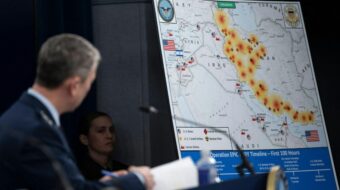
When Trump’s war began, Pentagon spokespeople announced daily how many hundreds or thousands of facilities in Iran had been attacked. After a while, they stopped giving the exact number of targets struck because those numbers corresponded too closely with the increasing economic pain felt by U.S. consumers. The number of Americans realizing that has grown substantially since the beginning of the war.
The attacks on Iran have also backfired, with increased missile attacks by Hezbollah, an Iranian ally in Lebanon, across the border into northern Israel. The U.S. embassy in Iraq has also been hit.
As it did in Vietnam, U.S. imperialism, now under Trump, seems to have severely overestimated the ability of its powerful military to do whatever it wants in around the world. The movement against the war on Iran is growing here in the U.S. and will no doubt be a major part of the No Kings demonstrations at the end of this month.
As with all op-eds published by People’s World, the views reflected here are those of the author.
We hope you appreciated this article. At People’s World, we believe news and information should be free and accessible to all, but we need your help. Our journalism is free of corporate influence and paywalls because we are totally reader-supported. Only you, our readers and supporters, make this possible. If you enjoy reading People’s World and the stories we bring you, please support our work by donating or becoming a monthly sustainer today. Thank you!
CONTRIBUTOR