Ten friends sat close in a few rows of a large, otherwise empty auditorium, watching the recently released Netflix show House of Dynamite.
This finely enacted thriller is not based on a true story, although it could easily be. Related scenarios have actually occurred. In it, the U.S. hovers on the edge of nuclear war. It is a compelling, realistic portrayal of the consequences of a single intercontinental ballistic missile that has emerged from the western Pacific Ocean and is racing toward one large city in the United States. The plot focuses on the reactions of different sectors of the Federal government, if anti-missiles fail to shoot it down, to an impending thermonuclear blast that will incinerate that city and every human life and structure that inhabits it.
All the characters—from the military personnel populating an early warning base in Alaska to the President—understand that they have only 30 minutes to take the actions they have been taught to take to deal with this enormous tragedy. For FEMA, how to evacuate and protect those in the crosshairs. For the President, how to respond, how many missiles to retaliate, and even more vexing, what enemy to respond to?
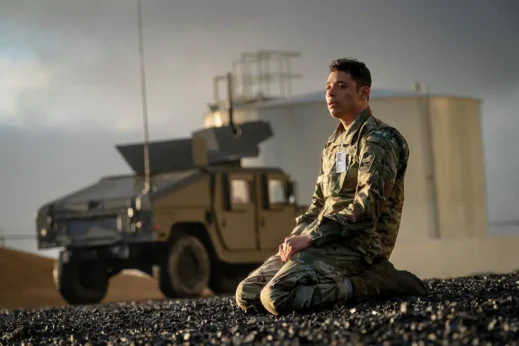
The film was released last fall as the deadline that ended the last nuclear weapons treaty between the U.S. and Russia, the major wielders of nuclear weapons in the world—called New START–rapidly approached. In actuality, unrenewed, the treaty faded into oblivion on February 5.
When the final credits rolled into the ceiling and the lights came on, there were a few moments of silence. Then, one by one, the friends, all but one over the age of 70, reacted to the screening. Nine of us spoke of how realistic the story was, wondering whether people not involved in the peace movement would simply see this as a good thriller and move on or would take to heart the consequences of the actual possibility of nuclear war, and, even more importantly, decide to do something to stop it. But we quickly detoured from discussing the substance of the movie and how it might be used to inform and activate audiences, to telling our stories of growing up under the dark clouds threatening nuclear war.

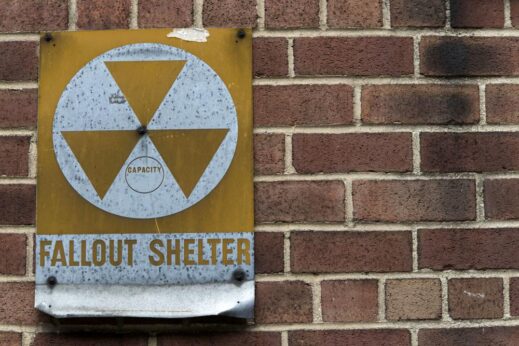
We related our experiences in grade school of “duck and cover,” the drills our teachers took us through on how to protect ourselves from a nuclear blast in our city or town, namely by hiding under our desks and covering our heads with our hands. The rush by some to build private fallout shelters where families would be safe from the blast, heat, and radiation of a nuclear explosion. The public fallout shelters with their telltale three-propeller radiation symbols. The outside emergency alert sirens and Emergency Broadcast System alarms occasionally tested on the radio. The emergency routes that thousands of families would drive from cities to find shelter in some distant rural area, far from the explosions that were vaporizing their homes and everything around them.
We were being conditioned to fear and to hate the Russians, as the Soviets were called by many U.S. leaders then, and to believe our government was somehow protecting us with these drills. All these measures look absurd at this historical distance, as we know they have protected no one from the kind of nuclear strikes that had been tested over Hiroshima and Nagasaki in 1945.
Some remembered the 1980s Fred Small song “Dig a hole in the ground” that mocked the lies our government told to convince us that all-out nuclear war was survivable with a shovel and a door covering. Lies that were intended to immunize us to the fact that our government was stockpiling thousands of these monster weapons. The scary fact is that even the slightest use of them would inevitably lead to escalation and the demise of civilization.
We recalled the Nuclear Freeze campaign during the presidency of Ronald Reagan who at one point claimed he could retrieve a ballistic missile in mid flight, proposed a “Star Wars” anti-missile shield and planned to install Intermediate Range missiles in Europe that would allow the Soviet leaders a handful of minutes to decide if a radar signal was an imminent attack requiring it to launch its missiles or risk losing them, or a flight of birds, or a weather balloon—both situations that actually took place and nearly ended all human life on earth.
Importantly, not everyone was immunized to the government’s lies. In the late 1940s and 1950s, the Ban the Bomb movement gathered tens of millions of signatures to put an end to nuclear weapons. And organized conferences and campaigns to abolish these weapons of mass destruction.
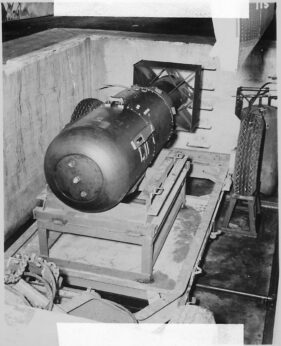
Early August 1945. | U.S. National Archives
In the theater, we spent a little time discussing how concerned citizens could somehow bring the current threat of nuclear war into public conversation.
But then we realized that one of us had all along been silent. The twenty-one-year-old. What did he think? He shocked us.
“Nuclear weapons and nuclear war are of no concern to my friends. We have more immediate fears. Our schools have regular active-shooter drills. Members of our families and friends are being murdered on the streets and in our homes. Some of us don’t have enough to eat, and some don’t even have a home. ICE is kidnapping our parents and us. The possible use of nuclear weapons is far away. Our everyday danger is immediate, nearby.”
Let me pause this picture.
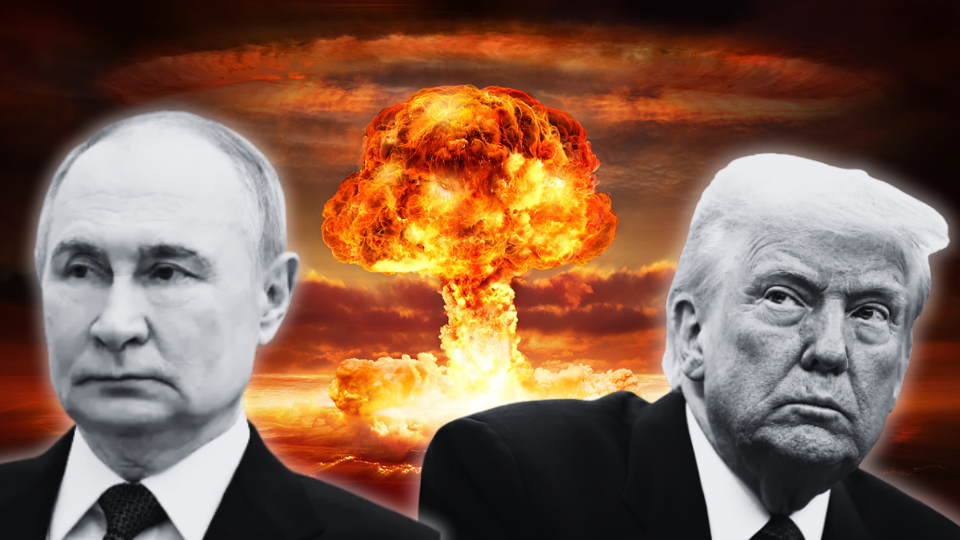
The New START treaty between Russia and the United States terminated on Feb. 5 and was not renewed by the U.S. despite Russian requests. Negotiated under the Obama administration, this treaty obligated the two countries to limit nuclear warheads to 1,550 and also capped the number of delivery vehicles that each country could harbor.
President Putin’s proposal to President Trump to have the two countries continue as if the treaty were still operating for another year has been ignored. The media is rife with speculation that each country will now engage in another nuclear arms race, like the previous one that led to the manufacture of over 60 thousand nuclear bombs. And that the other seven nuclear-weapon states will join the race. And that states currently without nuclear weapons will find more incentives to jump in.
More weapons means more chances for accidents, more likelihood they will be used intentionally, more encouragement for non-nuclear weapons states to obtain them, more enormous transfer of resources away from social needs, and the environment further damaged in the production and storage of these arms.
Two nuclear arms treaties remain: The Nuclear Non-Proliferation Treaty (NPT) of 1970 that embraces almost all the members of the United Nations. It was ratified by the 5 states that held nuclear weapons at the time—Britain, China, France, the United Kingdom, and the United States.
The four other states that have since obtained these weapons of mass destruction (WMDs)—Democratic Republic of Korea, India, Israel, and Pakistan—are not signatories. The DPRK had earlier signed the NPT but, under sanctions and constant threats of aggression by the United States, exited it, and constructed and tested its own nuclear weapons.
Increasingly, states without nuclear weapons are tempted to acquire them as a deterrent to aggression from abroad and threats to use overwhelming conventional or nuclear weapons against them. This direction weakens, if not obliterates, the NPT regime.
Most importantly, the NPT nuclear-weapon states have never abided by Article 6 of the Treaty, which requires them to negotiate complete disarmament of their stockpiles. That Article was an important incentive for non-nuclear-weapon states to join the Treaty in the first place.
The second remaining treaty, the Treaty to Prevent Nuclear War (TPNW, or the Ban Treaty), came into force on January 22, 2021. It bans a comprehensive list of activities involving nuclear weapons. All nine nuclear-weapons states opposed its enactment in the UN General Assembly, and all have boycotted the TPNW. Yet it is a powerful, concrete disarmament measure people can support.
Two other bills in Congress, S.Res.323 in the Senate and H.Res.317 in the House, essentially promote nuclear disarmament and the TPNW. These are concrete measures toward a safer planet that we can demand our representatives co-sponsor and support.
Some of the scientists who opened the nuclear-weapons era, including Albert Einstein and J. Robert Oppenheimer, who proposed, designed, and built the first atomic bombs that destroyed Hiroshima and Nagasaki, Japan, in 1945, came to oppose their continued existence.
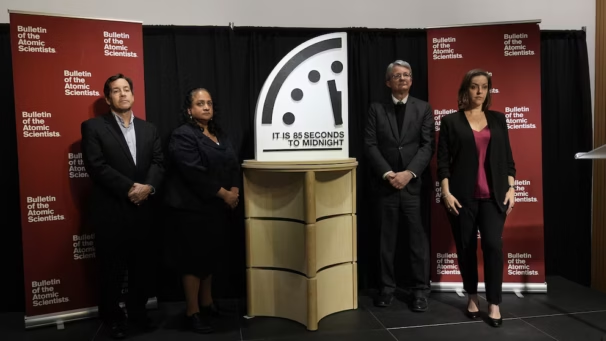
They began publishing the Bulletin of the Atomic Scientists newsletter shortly after the two Japanese cities were obliterated and two years later created the Doomsday Clock, which is a measure of how close civilization is to Midnight, the apocalypse from nuclear bombs and other existential dangers. As of January 26, 2026, the Doomsday Clock has been set to 85 seconds, the closest to apocalypse it has ever been.
The United States has withdrawn from or allowed to lapse and refused to extend nearly all the nuclear arms treaties. The George W. Bush administration’s withdrawal from the Anti-Ballistic Missile (ABM) Treaty in 2002 plays a significant role in House of Dynamite.
Returning to the words of our young friend after the screening of that movie, we must remind ourselves that the perception of existential danger is very different for different age, ethnic, and economic groupings. What connects us is the fact that the dangers are themselves linked.
The wealth created by our working class is being siphoned away from building a prosperous majority into a trillion-dollar-per-year military industry (soon to grow by 50% if Trump has his way) that wildly profits a few industrialists, CEOs, and investors. Its misdirection means the actual net loss of hundreds of thousands of jobs, the loss of affordable housing and health care, a threadbare public education system, and environmental degradation. The small number of oligarchs are profiting to the tune of hundreds of billions of dollars while that transfer of wealth creates the gaping inequality and very conditions that lead to extreme poverty, aimlessness, and communal violence among our people.
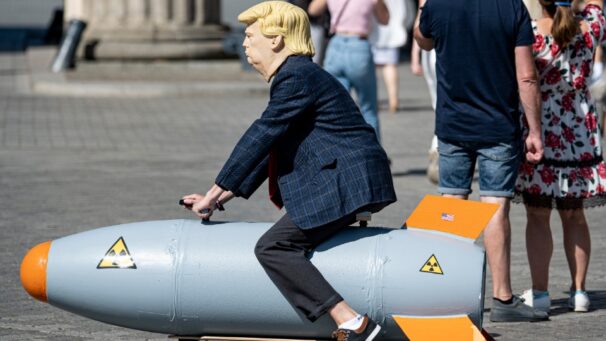
Well over 60% of Washington’s annual budget funds war, and ICE is accelerating the militarization of our surroundings. We cannot reduce the dangers on the streets wrought by handguns, hunger, and hopelessness without addressing Dr. King’s warning that “a nation that continues year after year to spend more money on military defense than on programs of social uplift is approaching spiritual death.”
We cannot address the Doomsday Clock scenario without including the energy and inventiveness of the youth who inherit the world we adults created, or allowed, without simultaneously addressing the wars on our neighborhoods.
The integration of domestic social justice demands with peaceful foreign and military policy demands is starting to emerge, as trade unions and domestic social justice organizations take up the call to end U.S. aggressions around the world. Linking domestic to foreign policy issues has become one of the major slogans for the mainstream, anti-Trump No Kings Day III on March 28, which is being very broadly embraced: “NO thugs terrorizing our neighborhoods. NO troop deployments in our streets. NO imperial wars of conquest. NO KINGS.”
The disappearance of New START by itself does not predict a new nuclear arms race. What governs the future is how successful the people’s movements, young and old, are in uniting for a better life for everyone.
Sharon Rose contributed to this article.
As with all news-analysis and op-ed articles published by People’s World, the views reflected here are those of the author.
We hope you appreciated this article. At People’s World, we believe news and information should be free and accessible to all, but we need your help. Our journalism is free of corporate influence and paywalls because we are totally reader-supported. Only you, our readers and supporters, make this possible. If you enjoy reading People’s World and the stories we bring you, please support our work by donating or becoming a monthly sustainer today. Thank you!
CONTRIBUTOR