Showering your loved ones with a token of affection may not be so easy this Valentine’s Day, as research shows working people are feeling the crunch of high prices and cost-of-living expenses. Analysts at InvestorsObserver report that celebrating Cupid’s day now costs 51% more than it did a decade ago in 2016.
Recent data from various sources paints a picture of a world where many working people feel priced out of financial security. Add to that a new poll showing that Americans feel more economic “gloom” than optimism, and it’s easy to see why the loving spirit may be just out of reach this year.
InvestorsObserver compared the most popular gifts and their costs now compared to ten years ago and found that champagne is so pricey that it’s dropped off the list completely, while a full celebration (including gifts, dinner, and the works) now costs $774.39, up 51% from $512.
The usual suspects—a box of chocolates, dinner for two, and a dozen roses—have all doubled or tripled in price since 2016. Dinner for two used to cost an average of $80.46, but now it has more than doubled to $209. A box of chocolates saw the biggest price jump—more than tripling—from $15.11 to $50.70. And while a bottle of champagne used to be one of the top five gifts during the lovers’ holiday, it has now been swapped out for the more cost-efficient greeting card.
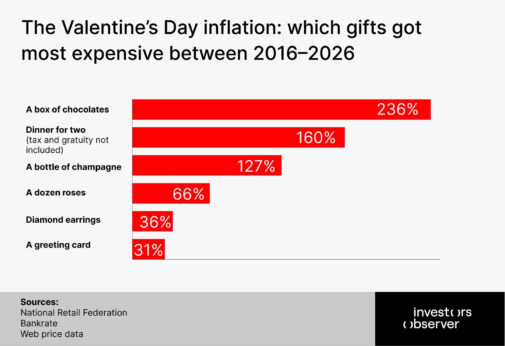
The report notes that the $262.36 gap between 2016’s $512.03 celebration expenses and 2026’s $774.39 price tag “is enough to cover a month of groceries for many households, several tank fills of gas, or a meaningful contribution to an emergency fund.”
“People may be recreating 2016 aesthetics, but not 2016 prices,” Sam Bourgi, a senior analyst at InvestorsObserver, noted in reference to the current social media trend of reminiscing about life ten years ago. “Nostalgia might be trending online, but from a finance perspective, it’s clear romance has got a lot more expensive,” he concluded.
And while the price tag for the indulgence of one day out of the year might not seem significant for some, especially for those of the “single and ready to mingle” variety, it does point to a worsening problem for working people across the country when it comes to the affordability of basic necessities and more in their daily lives.
Numerous surveys and polls from the past year show that people across the United States are struggling to afford essentials like food, child care, and housing. A Wall Street Journal-NORC poll conducted in the fall of 2025 found that nearly 4 in 5 Americans did not expect the economy to improve in the year ahead.
A few months ago, a report from the Urban Institute found that 52% of American families “don’t have the resources to cover what it really costs to live securely in their community.” The report notes that prices for health care, rent, home sales, and child care appear to be rising. And while average earnings have grown by 38% nationwide since 2017, “annual child care prices for two young children have risen by 40%, rents by 50%, and home sale prices by 80%, and the lowest-priced ‘Silver’ health care plan on the Affordable Care Act Marketplace has risen 41%.”
And in reminiscing further about 2016, according to data aggregated by the U.S. Department of Agriculture, grocery prices have increased 30% from ten years ago. According to the USDA’s Monthly Cost of Food Report, the average four-person household spends at least $1,011 a month on groceries, totaling about $12,132 per year. This is a significant jump from the $8,492.40 in 2016.
And while the Feb. 11 jobs report has U.S. Secretary of Labor Lori Chavez-DeRemer claiming in a press statement that President Donald Trump’s “agenda continues to create a Golden Age of economic prosperity for Americans,” other official figures paint a different picture. The economy may look prosperous on paper, but many analysts are highlighting that the “for whom” in that equation is what really matters.
As of Jan. 1, 2026, according to the Institute for Policy Studies’ analysis of Forbes’ Real Time Billionaire Data, the collective net worth of America’s top 12 billionaires is now above $2.7 trillion. The analysis also showed that among more than 700 U.S. billionaires, the five richest—Elon Musk, Jeff Bezos, Bill Gates, Mark Zuckerberg, and Larry Page—saw a 123% increase in their combined wealth during this period. According to Federal Reserve data, the richest 1% own 50% of U.S. stock and mutual funds. This marks a 10% increase from 2002.
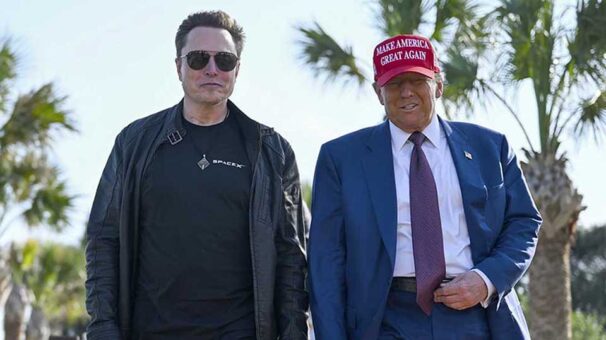
A Wall Street Journal article on Feb. 9 titled, “The Big Money in Today’s Economy Is Going to Capital, Not Labor,” explained that as profits grow, it only seems to benefit those in higher tax brackets, for the rewards “are going disproportionately toward capital instead of labor.” And while profits have climbed 43% since 2020, compensation given to workers is only up by 8%. Working people aren’t reaping much of the value being created in this economy; the vast majority is going to businesses—and those who own them—and the statistics display as much.
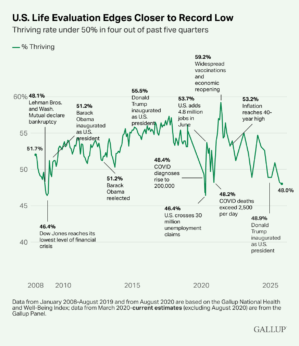
This may be why a Feb. 10 Gallup poll concluded that American optimism has reached a record low. The report that accompanied the poll stated that the percentage of U.S. adults who “anticipate high-quality lives in five years” has declined to 59.2% in 2025. That is the lowest level since measurement began nearly two decades ago. Americans who classified their lives as “thriving” saw a 11-point drop, from 59.2% in 2021 to 48% currently. This marks the sixth-lowest measurement among the 176 recorded periods. The five lower periods were three during the Great Recession of 2008 and two during the early stages of the COVID-19 pandemic in 2020.
During a recent FOX Business interview, Trump proclaimed that the United States had the “greatest economy, actually, ever in history.” Yet one may wonder whether he had the wealthy 1% in mind when he spoke those words. Sen. Bernie Sanders seems to think as much, as he explained in a discussion on the MS NOW show, ALL IN with Chris Hayes.
“The idea that anybody would believe this is a great economy when 60% of our people are living paycheck to paycheck, when the cost of health care is going up, when people can’t afford housing, people can’t afford their basic groceries…. If this is the greatest economy in the history of the world…God help us,” the Vermont senator lamented.
That tracks with data from the Federal Reserve, which shows that wealth inequality in the U.S. has hit its widest gap in nearly three decades. While working people in this country desire a loving relationship with financial security, they’ve been given the cold shoulder instead. Not exactly the “warm and fuzzy” feeling often associated with Valentine’s Day.
We hope you appreciated this article. At People’s World, we believe news and information should be free and accessible to all, but we need your help. Our journalism is free of corporate influence and paywalls because we are totally reader-supported. Only you, our readers and supporters, make this possible. If you enjoy reading People’s World and the stories we bring you, please support our work by donating or becoming a monthly sustainer today. Thank you!
CONTRIBUTOR