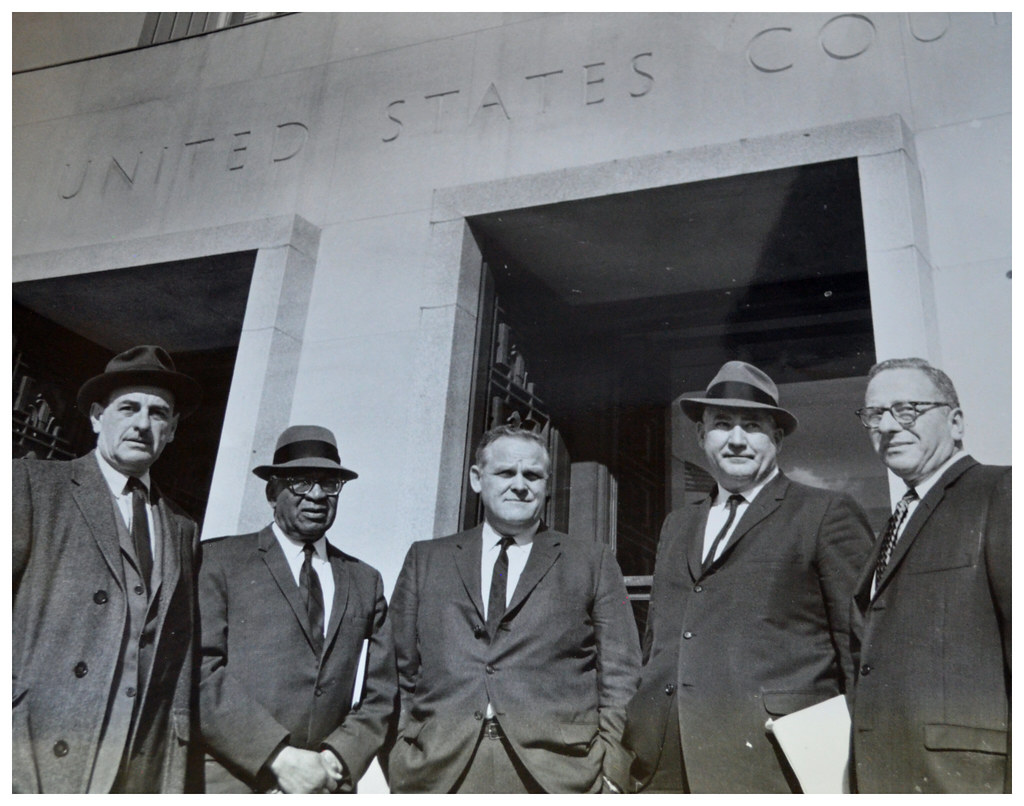
For anyone who knows Tim Wheeler, they also know how much he loves a good story. And with No Power Greater, he’s offered us a whole book full of good stories.
The main narrative follows the life of George Aloysius Meyers from his birth into a mine worker’s family in 1912 to his death in 1999. Other stories intersect with and branch off of Meyers’ story, so by the time we’ve finished the book we realize we’ve read a history of the 20th century American labor movement.
As a boy, Meyers met Mother Jones, the legendary mine worker organizer. As a young man, he worked as a CIO organizer under John L. Lewis. On his travels for the CIO, he met and befriended Florence Reese, the author of the classic labor song “Which Side Are You On?” and her husband, Sam. Later, as Labor Secretary of the Communist Party (CPUSA), he met often with William Winpisinger, the militant president of the Machinists Union (IAM).
Tim Wheeler himself is part of Meyers’ story. Along with his wife, Joyce Provost Wheeler, a teacher and AFT activist, Tim lived just down the street from Meyers in Baltimore. Tim was then the Washington, D.C., Bureau Chief of Daily World newspaper, now known as People’s World.
Will Parry, his wife Louise, and Irene Hull are part of Meyers’ story as well. Hundreds of rank-and-file labor leaders filled Meyers’ life, and they come to life again in the pages of Tim’s book.
George Meyers had a gift for friendship, but not every labor leader was his friend. George Meany, the AFL-CIO president who liked to brag that he’d never walked a picket line, is a looming, hostile presence throughout the later chapters of the book. So is Al Shanker, the divisive president of the AFT.
Did I mention that George Meyers was a Communist? Had he been anything else, a Republican maybe, his life would have been much different.

Meyers joined the CPUSA in 1939. Although he was still young, only 27, he was by then an experienced labor organizer and the first president of the Maryland CIO.
Looking back at Meyers’ early life, it seems natural he would join the CPUSA. His father was a miner who would die of black lung disease. Meyers himself started out working in a textile mill and developed brown lung from breathing in cotton fibers and toxic chemicals.
Labor organizing was a dangerous business when Meyers was young. Mine owners used both Baldwin-Felts “detectives” and the Ku Klux Klan as strike breakers. Meyers remembered that the Klan paraded through their neighborhood every Saturday night, while his family sat on their front porch and taunted them.
Young labor organizers like Meyers faced down those threats to build the CIO, fight for social legislation like the Social Security Act, and against growing fascism. In 1942, Meyers volunteered to fight fascism in World War II.
After the war, with fascism defeated—only temporarily, as we now see—and the USA emerging as the world’s leading capitalist power, the U.S. government abandoned its wartime alliance with the USSR and turned on American communists.
Leftist-led unions were expelled from the CIO, and activists were hunted by the FBI and HUAC (the House Un-American Activities Committee). Meyers served 38 months after a conviction under the Smith Act, allegedly for advocating the overthrow of the U.S. government.
Nevertheless, No Power Greater, is a book full of optimism. After leaving federal prison, Meyers immediately set about rebuilding communist organizations throughout the South. For every George Meany, there’s a hundred George Meyers. For every Al Shanker, there’s a hundred Joyce Provost Wheelers.
According to Tim, we owe this remarkable book to an impulse to “put his affairs in order” after his 82nd birthday. While throwing out old sneakers, Tim discovered a half-forgotten box of Meyers’ papers, all typed by Tim’s wife, Joyce.
“I decided then and there that putting my personal affairs in order can wait,” Tim writes. “I am still of sound mind and body. Before I die, I must write this book.” And so, he did.
The book’s title comes from the labor anthem “Solidarity Forever.”
When the union’s inspiration
Through the workers’ blood shall run
There can be no power greater
Anywhere beneath the sun…
No Power Greater: The Life and Times of George Meyers
By Tim Wheeler
International Publishers, 2024
Available for purchase from International Publishers.
CONTRIBUTOR