WASHINGTON—Facing political fallout and fuming voters, President Donald Trump is supposedly pondering a health care “plan” of sorts. It features—potentially—checks to taxpayers to help pay their insurance premiums and/or extending Affordable Care Act tax credits, due to expire Dec.31, for two years.
It’s not getting rave reviews. Far from it.
Organized labor has yet to weigh in on Trump’s “plan”—understandable because he keeps changing his mind. One day he says he supports extending the ACA tax credits for two more years. The next day, literally, he reverts to declaring he wants to send checks worth thousands of dollars each to individual taxpayers facing steep health care premium increases.
If either version of Trump’s proposal moves ahead, it will not alter the long-term Republican goal of killing off the ACA completely.
All this drama, guaranteed to last past the end of the year and through the midterm elections, also omits one key fact which enrages more than two-thirds of the people, a recent survey shows: U.S. health care is too expensive, inefficient, and doesn’t deliver the best health outcomes.
And even though ACA/Obamacare provided 24 million more people health care—coverage they might lose—Big Pharma and the even bigger insurance industry have been big beneficiaries. They were key players 15 years ago when the ACA was created.
Meanwhile, here are positions of players in the health care game:
- Trump: On the campaign trail last year, he said he had “a concept of a plan.” It’s still just that. The White House says nothing is final until Trump himself signs off.
News reports say his “plan’s” key feature would extend the ACA’s tax credits to help people pay their health insurance premiums, for two years. Without the extension—which the GOP successfully blocked during the 43-day federal shutdown they and Trump engineered—premiums would skyrocket. Even the insurers admit that.
ACA users—the people who signed up on its health care exchanges—would still be covered, but the lowest-income users, who now pay nothing, would pay 2% of their income in premiums, for the lowest-tier Obamacare coverage.
But Trump keeps waffling. On Nov. 25, he returned to his prior idea of checks of several thousand dollars to each person to help them pay for their premiums.
“I’d rather not” extend the ACA, he told a pool reporter from The Hill. “I like my plan the best. Don’t give any money to the insurance companies, give it to the people directly. Let them buy their own health care plan. And we’re looking at that. If that can work. We’re looking at that.”
Unsaid: Buying your own plan leaves you at the insurers’ mercy. The benefit of being in a large pool of buyers in the ACA marketplace to get lower rates would evaporate. It would be the equivalent of a single worker negotiating for higher wages vs. being in a union and collectively bargaining.
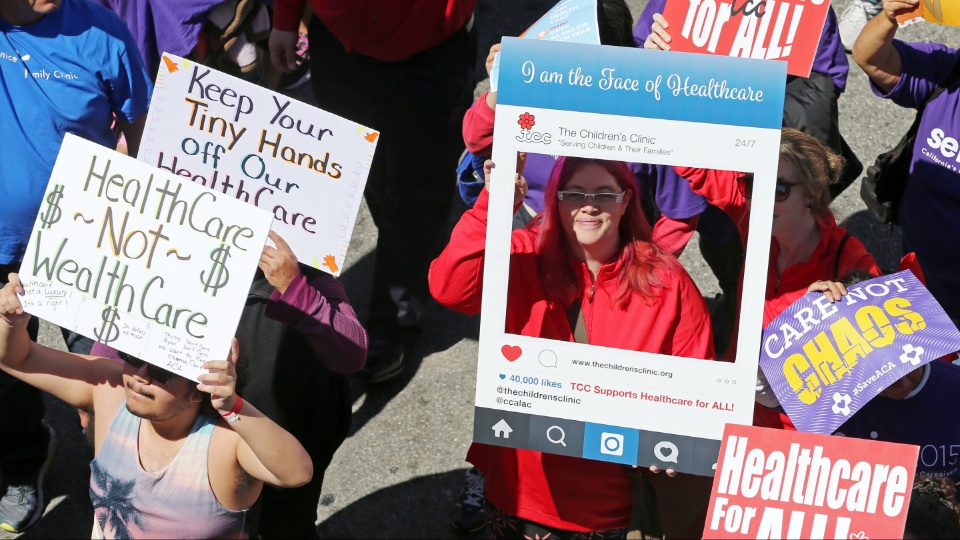
- The voters: They’re upset, worried, facing huge premium hikes or complete loss of coverage—and they bombard lawmakers, especially Republicans, with questions and complaints. Some samples, reported by the Associated Press:
Lisa, of Harford County, Md., told House Freedom Caucus Chair Rep. Andy Harris, R-Md., that her cousin’s disabled son could lose coverage—and her cousin couldn’t pay for increased premiums.
“She’s looking at two or three times the premium that she’s been paying for the insurance,” Lisa said. “I’d love for you to elucidate what the Republicans’ plan is for health insurance?” Harris replied: “We think the solution is to try to do something to make sure all the premiums go down.” He didn’t say what.
Another Freedom Caucus member, Rep. Brandon Hill, R-Texas, told an anguished caller the problem was “waste, fraud, and abuse.”
- Right-wingers, inside and outside Congress: House Republicans hold fast to their determination to kill Obamacare. They have tried, and failed, 60 times, to strangle the ACA since, with organized labor’s strong support, a Democratic-run Congress enacted it 15 years ago. The right-wing crusade continues.
“Government-provided health care is the wrong path and private health care is the right path,” declares Rep. Russ Fulcher, R-Idaho, another Freedom Caucus member. In a U.S. House the GOP barely controls, 219-213, with three vacancies, the 40-member caucus has inordinate power to kill anything—by defecting. But they might not have to defect. They’ve got leadership in their corner.
- Count House Speaker Mike Johnson, R-La., among the ACA’s foes. The tax credits “are subsidizing bad policy,” he told a press conference. Republicans “have a long list of ideas” to address health care costs and are “grabbing the best ideas we’ve had for years to put it on paper and make it work.” He didn’t produce any of them.
“We believe in the private sector and the free market and individual providers,” added Johnson, ignoring the fact that the health care market is hardly “free.”
Between the ACA, Medicare, Medicaid, veterans’ health care, and TriCare for the military, the government pays half of the nation’s health care bills.
- Congressional Democrats: They forced the issue into the spotlight by trying, despite the Trump-initiated government shutdown, to repeal the massive prior GOP-enacted health care cuts—and resulting ACA coverage losses, Medicaid cuts, and high insurance premium hikes.
“Republicans refuse to confront the health care crisis they created,” said Rep. Rosa DeLauro, D-Conn., the top Democrat on the House Appropriations Committee, and its health subcommittee, which is supposed to help set spending levels.
“Instead of working with Democrats in the House to protect the health care of the American people, they have jammed through a bill that will drive up costs, strip health care coverage from millions, and do nothing to rein in President Trump.”
- Defecting Senate Democrats: Seven of them, plus Sen. Angus King, Ind-Maine, deserted from the party’s campaign to keep the ACA tax credits and roll back the GOP’s massive Medicare and Medicaid cuts. They now put hope in Trump’s first statement, about extending the ACA tax credits.
“The fact that President Trump is putting forward any offer at all to extend the Affordable Care Act’s tax credits shows that there is a broad understanding that inaction in this regard will cause serious harm to the American people,” said one of the eight defectors, Sen. Maggie Hassan, D-N.H.
- Progressives, led by Sen. Bernie Sanders, Ind-Vt., and Rep. Pramila Jayapal, D-Wash., accept Obamacare but still really campaign for single-payer government-run national health insurance, Medicare For All. At least a dozen unions, led by National Nurses United, strongly push that idea.
“Health care is a human right, not a privilege. We must end the embarrassment of the United States being the only major country on earth that does not guarantee health care to all of its citizens,” Sanders said when they reintroduced the Medicare for All bill earlier this year.
“It is not acceptable…that over 85 million people today are either uninsured or underinsured. Today, there are millions of people who would like to go to a doctor but cannot afford to do so. This is an outrage.”
- A small band of 13 House Republicans, virtually all of them in vulnerable districts, told Speaker Johnson to find a compromise to keep the Obamacare subsidies and tax credits going. They’re feeling intense pressure from voters angry about rising health costs. His answer, so far, is thumbs down. But they’re meeting to craft a measure of their own. Only if the House’s Democrats agree to their plan will it fly. The rest of the GOP won’t buy it.
“Allowing these tax credits to lapse without a clear path forward would risk real harm to those we represent,” warned the group, led by Reps. Jeff Von Drew, R-N.J., and Jennifer Kiggans, R-Va. “We must chart a conservative path that protects working families in our districts across the country who rely on these credits.”
They claimed—erroneously—that House Republicans as a group and Trump “have been clear we will not take healthcare away from families who depend on it.” On the contrary, the GOP has repeatedly proved that is exactly what it hopes to do.
- A leading interest group on health care issues, FamiliesUSA, says the Trump plan is completely inadequate. Organized labor had no immediate comment on Trump’s “plan,” or lack of it.
“The health care proposal floated by the White House would have produced higher premiums for nearly everyone who buys coverage as an individual and still push or price millions of people off of coverage,” said Families USA Executive Director Anthony Wright.
“The initial draft did not understand the assignment of stopping the spike in premiums coming in a few short weeks…. While the proposal was full of poison pills, the fact that President Trump finally felt compelled to have a proposal at all suggests the calls and cries for help from health care consumers are starting to be heard.”
- The health insurance industry, one of the capital’s most-powerful lobbies. When the ACA was being written, corporate-backed congressional Democrats let them have their way, with few curbs, except for refunds to policyholders for overspending on overhead. Their lobby also killed Medicare for All, the possibility of a “public option” to compete with private insurance, and other weaker variations. Insurers love the tax credit, though. It keeps customers, and, though they don’t say so, profits.
Mike Tuffin, CEO of their lobby, issued a statement after the shutdown ended urging lawmakers to restore the credit, though he didn’t say for how long.
“Maintaining the health care tax credits will bring immediate relief to millions of working families, sole proprietors, small business employees, and rural Americans who face an acute cost-of-living crisis in 2026 if Congress fails to act,” he said.
But the voters blame the insurers, according to a pre-election poll for the nonpartisan non-profit Undue Medical Debt, which lobbies lawmakers for relief. The survey reported 68% said health care is unaffordable, 69% blame the insurers, and 76% agree with the statement: “We need to switch to a different system of health insurance where people can change jobs or become self-employed and not have to worry about losing their health insurance.”
We hope you appreciated this article. At People’s World, we believe news and information should be free and accessible to all, but we need your help. Our journalism is free of corporate influence and paywalls because we are totally reader-supported. Only you, our readers and supporters, make this possible. If you enjoy reading People’s World and the stories we bring you, please support our work by donating or becoming a monthly sustainer today.
CONTRIBUTOR