Diplomatic firestorm has broken out between China and Japan over Taiwan, which has stark lessons for U.S.-China relations and the possibility of war over Taiwan.
Japan’s new prime minister, Sanae Takaichi, addressing parliament in Tokyo on Nov. 7, said that Chinese military action against Taiwan could be regarded as a crisis of national survival and result in Japanese military intervention. This was by far the most aggressive statement yet made by Japan on the Taiwan issue, stepping on China’s “red line” of defending national sovereignty.
Japanese prime ministers had previously said Taiwan was a matter of concern but resorted to “strategic ambiguity” as to Japan’s response in the event of any Chinese action to reunite the island with the mainland.
The Chinese foreign ministry summoned the Japanese ambassador to formally reject Taikai’s comments and call for retraction. Spokesperson Mao Ning said the international community “must stop any attempt to revive militarism” and referred to the horrors of World War II, when some 20-30 million Chinese people were killed in repulsing the Japanese invasion of mainland China.

UN Permanent Representative Fu Cong described Takaichi’s remarks threatening military intervention as brazen and provocative, “a gross interference in China’s internal affairs and serious breach of the one-China principle.” Ambassador Fu wrote a letter to UN Secretary General Guiterrez warning of rising Japanese militarism which was circulated to the UN General Assembly as an official document.
China also took practical measures in response. The education ministry issued a no-travel advisory to Japan, warning of physical danger for Chinese citizens based on recent incidents. 500,000 air tickets to Japan were immediately cancelled, a blow to Japan’s tourist industry.
China’s ban of seafood imports from Japan—put into place in 2023 after Tokyo released radioactive water from the Fukushima nuclear plan into the Pacific despite Beijing’s protests—was extended. Cinema outlets suspended screenings of popular new Japanese anime films, and a meeting to promote cultural exchanges with Japan and South Korea was postponed.
Chinese coast guard vessels also began patrolling waters near disputed islands in the East China Sea. On Nov. 21, China wrote UN General Secretary Guiterrez warning of possible Japanese aggression.
Japan, for its part, claimed that Takaichi’s remarks were in line with long-standing policy and refused to retract them. A diplomat was dispatched to Beijing for discussions; nothing was resolved.
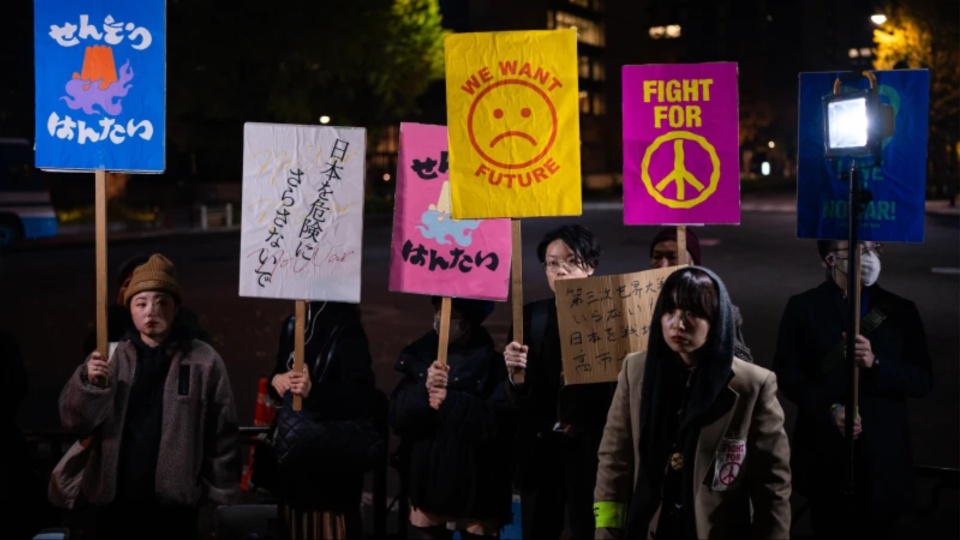
Opposition parties in Japan inside Japan, however, criticized Takaishi’s conduct. The Japanese Communist Party condemned her remarks as a violation of Japan’s pacifist constitution and called for diplomacy, not military threats. The JCP framed the remarks as a broader shift towards militarization adopted by previous Prime Minister Shinzo Abe with U.S. support, a shift that the party strongly opposes.
Lessons for U.S.-China relations
The status of Taiwan is a central issue in the U.S.-China relationship. China agreed to restore diplomatic relations in 1979 on the basis of U.S. recognition of the one-China principle, that the status of Taiwan will be resolved by the Chinese on both sides of the Taiwan Strait with no outside intervention. This is the position taken by the United Nations and most countries in the world.
The U.S. continues to adhere to the one-China principle and does not recognize Taiwan independence; however, the U.S. undermines that policy by selling large quantities of military equipment to the Taiwan authorities. The U.S. also encourages regional allies such as Australia and Japan to become more involved in Taiwan’s defense.
Were Takaichi’s remarks made on behalf of or to please the Trump administration? China’s strong response is sending a clear message to not only Japan but also to those in the U.S. state who may assume that China would quickly fold under U.S. pressure should a crisis arise.
China regularly says it does not want war and is committed to employing all peaceful means possible to achieve reunification with Taiwan, dismissing the issue of an “invasion” by the mainland. People living in Taiwan likewise do not want war, as the island would likely face massive destruction in the event of a U.S.-China war.
U.S. imperialism, however, aggressively keeps the option of military solutions on the table, both for mistaken illusions of empire and the profits of the military-industrial complex. The U.S. economic battle targeting China economy seems to be meeting little success, as China continues to open new markets in the Global South.
The U.S. program of weaponizing sanctions and tariffs also doesn’t appear to be hobbling China all that much. The country is currently enjoying moderate, steady growth of around 5% GDP.
The U.S. ruling class is divided on China policy between the global strategists of hegemony and some large tech firms, for which China is the major opponent and competitor, and other elements of the business community who seek access and profits via increased trade.
We hope you appreciated this article. At People’s World, we believe news and information should be free and accessible to all, but we need your help. Our journalism is free of corporate influence and paywalls because we are totally reader-supported. Only you, our readers and supporters, make this possible. If you enjoy reading People’s World and the stories we bring you, please support our work by donating or becoming a monthly sustainer today.
CONTRIBUTOR