CHICAGO—For decades, the field of communist historiography has been dominated by the paranoid readings of the psychology of “totalitarian dictators” and anticommunist treatises against the socialist countries of the world. The study of communist history has been tainted by bad-faith actors making wildly unfounded claims about hundreds of millions murdered by communism. Among scholars who care a bit more about academic integrity, communist history has simply been swept under the rug—especially since 1991, when liberal institutions unanimously declared socialism dead and buried for good.
Tony Pecinovsky, president of the long-standing Marxist press International Publishers, calls this concerted effort to ignore communist historiography the “Red Taboo.” In recent years, though, more scholars and members of the Communist Party USA (CPUSA) themselves have undertaken the task of unearthing this suppressed history.
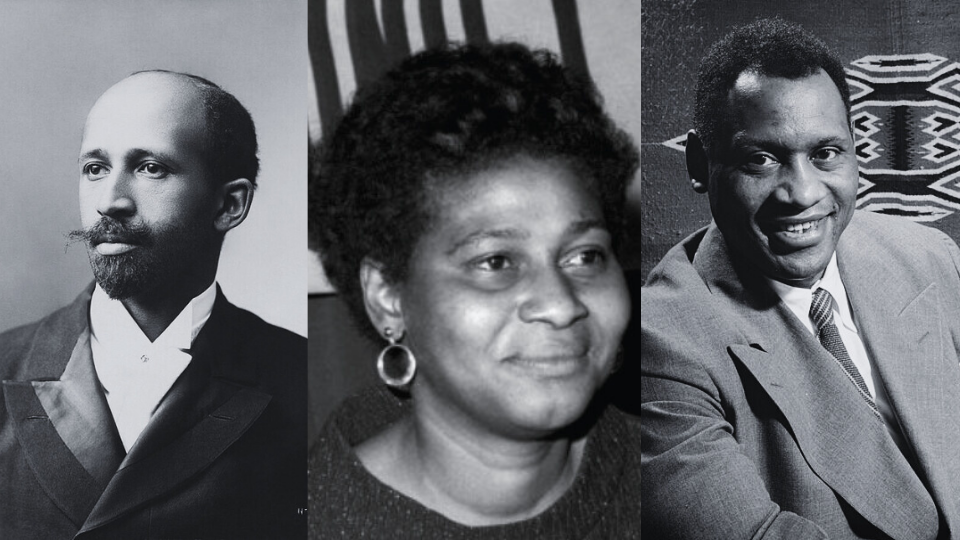
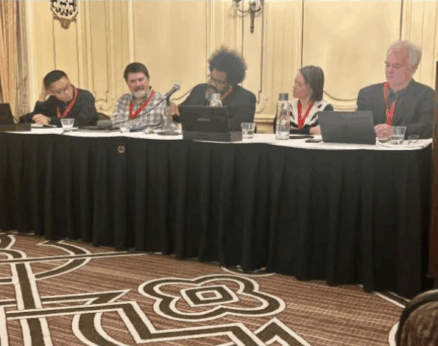
At the American Historical Association’s yearly conference held this past weekend in Chicago, a panel titled “Reading Communist Subversion in the Black Freedom Struggle” centered on the history of the communist movement in the civil rights struggles of the 20th century. Panelists spoke on W.E.B. Du Bois, Paul Robeson, the Scottsboro Nine case, and other famous civil rights legal battles led by the Communist Party, as well as Black American women’s peace mobilizations during the Cold War.
Professor Edward Carson, former state organizer of the Massachusetts district of the Communist Party and current teacher at the Webb School in Tennessee, presented on the lesser researched topic of W.E.B. Du Bois as an organizer of Black farmers. Carson draws upon Du Bois’s earlier works—in particular his essay “The Economic Future of the Negro” and his novel The Quest of the Silver Fleece—to dissect Du Bois’s early socialist inclinations.
Du Bois saw how the economic disenfranchisement of Black people solidified their racial subjugation. He organized alongside the Farmer-Labor Party to fight back against discriminatory practices against Black farmers. When the Great Depression hit, 90% of Black farmers lost their land. Du Bois saw this as an existential threat to Black Americans’ ability to build a secure future for themselves and their families.
Du Bois was a radical thinker and organizer who officially joined the CPUSA toward the end of his life, but Carson’s research also recognizes that Du Bois’s theories of land as liberation relied on a Victorian mythology of the Western frontier as a space for reconstruction and possibility. In some ways, this was true, as exemplified by Du Bois’s attempts to organize farmers in the West and build farming cooperatives. But white farmers often succumbed to racial hatred and fear of losing opportunities to Black farmers, which eventually led Du Bois to conclude that interracial cooperation on this particular terrain was not feasible.
Carson pointed out that progressive and communist spaces have often failed to grapple with the full extent of racial oppression, often sublimating the fight for Black liberation to the labor movement. Carson intends to explore this contradiction further in his upcoming book on W.E.B. Du Bois and the capitalist farming frontier.
Professor Denise Lynn, from the University of Southern Indiana, used the example of the Peekskill riots of 1949, in which white vigilantes attacked attendees of a Paul Robeson concert in New York, to demonstrate the reactionary, fascistic nature of veterans’ groups in the United States during the Cold War. After World War II ended, Lynn argues, veterans’ organizations like the American Legion and Veterans of Foreign Wars became a tool of anticommunist hysteria, racism, and “political gatekeeping” of a narrow ideal of Americanism.
Paul Robeson, on the other hand, represented a different version of what it meant to be an American. A Black Renaissance man and lifelong friend of the CPUSA, Robeson championed civil rights, decolonization, peace, and the international working-class struggle. Lynn pointed out that the smearing campaigns Robeson faced in the press and the concerted stifling of his career, led in part by veterans’ groups, was driven more by his ideology than his race. This was made clear when the NAACP, among many other bourgeois organs, condemned Robeson’s outspoken support for the Soviet Union in 1949.
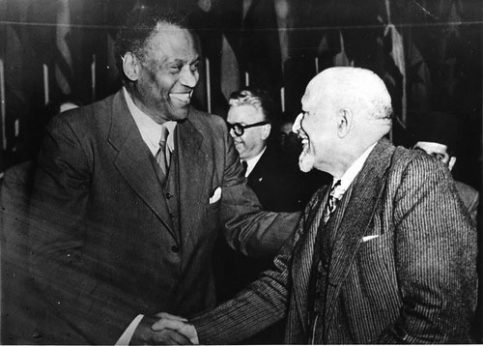
That Robeson was a famous, well-respected Black man made him dangerous to the Cold War status quo. His detractors called him “a symbol of communism itself.” (To some, this might be considered an honorary title.)
Racism and anticommunism are two sides of the same reactionary ideology. The Black liberation struggle has long been depicted as a communist plot to undermine the United States. Tony Pecinovsky’s presentation tracing communists’ involvement in civil rights struggles makes it clear, then, why an alliance between “the black and the red” developed naturally throughout the 20th century.
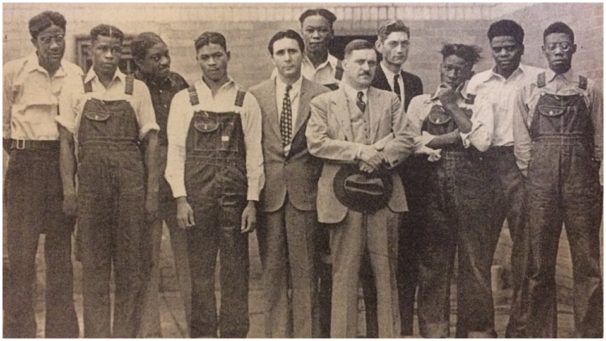
In the case of the Scottsboro Nine, in which nine Black teens were wrongfully accused of raping two white women, the Communist Party stepped in to defend the accused in court and rally international support for justice, primarily through its paper The Daily Worker, the predecessor to People’s World. Despite accusations from liberal civil rights organizations and reactionary politicians alike that the CPUSA was using the cause of racial equality to further its personal political aims, the Scottsboro case was in fact an alliance forged through years of struggle in the streets and in the courts. Pecinovsky argues that the CPUSA’s unique international connections, forged through organs like the Comintern and The Daily Worker, brought to light the terrors of Jim Crow injustice to the rest of the world.
The Party continued to forge this “red-black” alliance throughout its existence, most notably by getting involved in civil rights cases and giving a voice to the victims of legal lynching. Pecinovsky highlights the case of Willie McGee, a victim of rape by a white woman who then accused him of being the assailant. The Daily Worker published accounts from his wife, Rosalee McGee, providing a working-class Black woman the rare opportunity to announce her grief and rage to an international audience.
In 1975, Joan Little became the first woman to be acquitted for killing her would-be rapist in self-defense, an argument that was put forth by Charlene Mitchell and other Communist Party members. Little’s case stands out in the history of civil rights defense stories in that it showed the ways in which Black women, in particular, are targeted by systems of white male supremacy. The international struggle to free Angela Davis, another fight in which the CPUSA was deeply involved, is another example of this expanded focus adopted in the latter half of the 20th century.
Yet Black women’s voices have always been integral in the battle against racial capitalism—as shown in the Scottsboro and McGee cases, in which the mothers and wives of the men accused became key organizers in the efforts to free their families. The Daily Worker and the CPUSA’s legal defense teams amplified these women’s voices when no other predominantly white organization of the time would or could.
Zifeng Liu, of Hong Kong Baptist University, spoke on the ways in which Black communist women crafted a rhetoric around their identities to push an international peace agenda during the height of the Cold War. The communist peace movement decried “bourgeois pacifism” and took a militant anti-war stance. Liu analyzed how Black women organized their communities around “common sense” demands that would relate to women as mothers and wives—which most women were at the time.
But Black communist women also argued that without dismantling systems of racial and gendered oppression, true peace would never be achieved. This stemmed from their experience of the domestic sphere constantly being invaded and attacked by systems of legal lynching and racial and sexual terror. For Black women, the line between public and private was always overlapping in violent ways. Eslanda Robeson, wife of Paul Robeson, was one such woman who made this connection between Black women’s liberation and the world peace movement.
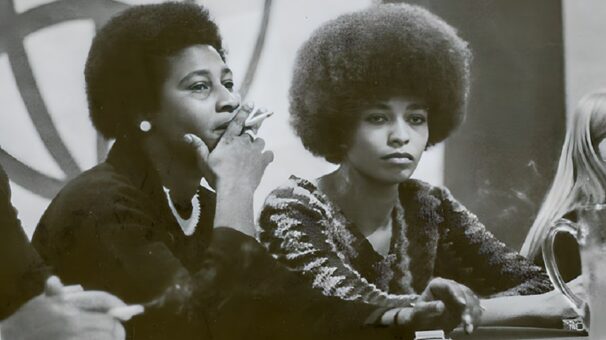
Perhaps contradictorily, this rhetoric both relied on a presumed gendered division of labor and the revolutionary cause of women’s liberation. Nevertheless, Liu posits that this rhetorical position reimagined the ways in which women could become involved in progressive causes. Historically, leftist women have been attacked for “wanting to become men.” But in positioning the battle for peace as a woman’s right to raise a family without fear of losing her husband or son to war—among other demands particular to the domestic front and women’s experiences—communist women were able to present the peace movement to their neighbors and peers in a more relatable manner. Black communist women also pushed their demands further to include liberation from white male supremacy as a primary goal of the peace movement.
This panel, hosted by the AHA, featuring members of the CPUSA and friends of the party, points to a shift in Communist historiography away from the fearmongering and condescension of the Cold War, and toward a more honest and open analysis of the party’s shortcomings and successes. Only in recent years has the Red Taboo lifted somewhat, after decades of scholars brushing aside communist history as defunct. It is no surprise that communists themselves are now leading the charge in making their own historiography.
However, Professor Carson still thinks that we have a long way to go in confronting the nuances of communist history. The field is still dominated by white men, he says, and this is largely in part because communist history has been narrowly shoved into the category of political economy and geopolitics, a field which is overwhelmingly white, male, and chauvinistic. But there are rich social, ecological, and micro histories to be explored as well, as touched upon by the presentations in this panel.
International Publishers has recently released histories of radical Black movements from the 18th to the 21st centuries. Recent and forthcoming titles collate the writings of communist women, and old titles about women in the labor and antifascist movements are being brought back into print after many decades. But histories of anticolonial struggle, Asian American and Latino radical movements, LGBTQ+ history within the CPUSA and the larger communist movement, and women historians are still woefully underrepresented in the field of communist historiography.
Communists are some of the most zealous recordkeepers of their own history, probably because we know that if we don’t do it, no one else will (except maybe the FBI and the CIA). Government records tracking the activity of the Communist Party and its affiliated organizations are being declassified each year, but it takes a discerning eye to cut through the anticommunist hysteria permeating such documents in order to find a true and human story underneath. Meanwhile, elders within the movement—whether they were involved in the fight for civil rights, decolonization, labor, peace, or all these and more—can probably tell you upfront how it all went down years ago.
History can be made and taught by anyone; it is a living practice that must be engaged with consciously and constantly within our movements. The knowledge and experiences of our revolutionary predecessors are what give us the fortitude for the struggles of the present and future.
We hope you appreciated this article. At People’s World, we believe news and information should be free and accessible to all, but we need your help. Our journalism is free of corporate influence and paywalls because we are totally reader-supported. Only you, our readers and supporters, make this possible. If you enjoy reading People’s World and the stories we bring you, please support our work by donating or becoming a monthly sustainer today. Thank you!
CONTRIBUTOR