“Make China Great Again!” That was the headline the European Council on Foreign Relations (ECFR) gave to the analysis of its latest survey on global politics, conducted in November 2025 in 21 countries worldwide.
No, the think tank, which is part of Europe’s foreign policy establishment, was by no means advocating support for China’s historic resurgence. Rather, it was referring to a key finding of its survey: that the first ten months of President Donald Trump’s second term had been enough to damage the U.S.’ global reputation, while the People’s Republic suddenly gained new popularity worldwide.
At least in this respect, the authors said, Trump doesn’t seem to be making “America Great,” but is rather achieving the exact opposite—“Make China Great Again.”
The ECFR was able to trace this in detail using its survey. It showed that in many countries, the proportion of those who viewed the U.S. as an ally with shared values and interests had declined. In Brazil, for example, from 29 to 26%, in South Africa from 23 to 19%, and in the U.K. from 37 to 25%. At the same time, the proportion of those who considered China such an ally increased in Brazil from 24 to 27%, in South Africa from 34 to 37%, and in India even from 11 to 22%.
In all countries, at least half of the respondents were certain that China’s influence would increase in the coming decade, while in almost all countries—with the exceptions of South Korea and Ukraine—more people viewed the People’s Republic as an ally or partner than as a rival or even an adversary. Almost everywhere, a majority also believed that relations with China would remain strong or even become stronger.
Even before the U.S. invasion of Venezuela, the ECFR concluded, Trump’s “aggressive ‘America First’ approach had driven people closer to China.” It is reasonable to assume that the attack on Caracas and the abduction of the Venezuelan presidential couple further intensified this trend.
“The world seems to be becoming more open to China,” the ECFR concluded. With the West, however, things are going downhill: “America’s traditional enemies fear it less than before—while allies now worry about falling victim to the predatory USA.” This is currently evident in Europe in the conflict over Greenland.
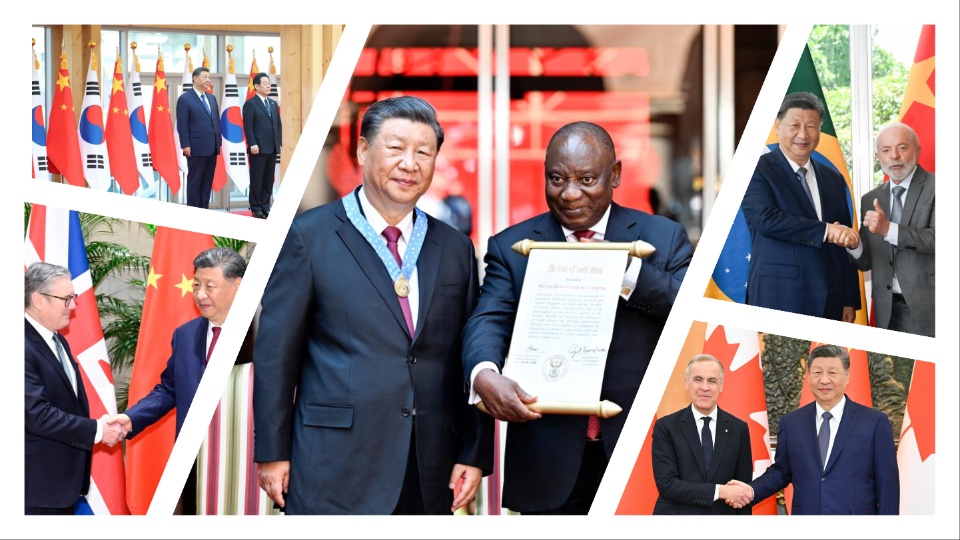
What the ECFR measured in surveys of the populations in a number of countries can now also be verified in the political practice of states. The best example so far: Canada. Prime Minister Mark Carney was in Beijing on Jan. 16 to conclude a “new strategic partnership” with the Chinese government.
Both sides agreed, among other things, to reduce tariffs on imports of Chinese electric cars into Canada from 100 to 6.1%. In return, China is reopening its market to Canadian agricultural goods. Carney also announced that his country wanted Chinese investment not only in its electric vehicle sector, but also in renewable energies and energy grids—in other words, in critical infrastructure. This was almost the opposite of what the U.S. is pushing its allies from North America to Europe to do.
And the Canadian example is not an isolated case. “President Xi Jinping welcomes a whole procession of heads of state and government seeking to improve their relations with China.” This was the headline of a Bloomberg article in mid-January, which pointed out that South Korean President Lee Jae-myung had already visited Beijing before Carney, becoming the first South Korean leader to do so since 2019. At the end of January, Keir Starmer will be the first British Prime Minister to travel to the Chinese capital since 2018, and German Chancellor Friedrich Merz is also expected there soon.
Given an “aggressive and unpredictable” U.S. policy, many are concluding that they must “at least have good relations with China,” Bloomberg quoted political scientist Alexander Dukalskis of University College Dublin as saying. He described China’s current approach: “When your enemy is busy hurting itself, just sit back and enjoy the show.”
Unsere Zeit
We hope you appreciated this article. At People’s World, we believe news and information should be free and accessible to all, but we need your help. Our journalism is free of corporate influence and paywalls because we are totally reader-supported. Only you, our readers and supporters, make this possible. If you enjoy reading People’s World and the stories we bring you, please support our work by donating or becoming a monthly sustainer today. Thank you!
CONTRIBUTOR