WASHINGTON—On March 4, the Senate ignored its constitutional responsibility by failing to pass a War Powers resolution to constrain President Donald Trump’s military hostilities against Iran. The House votes next, but even if the War Powers Act remains sidelined, anti-war forces in the U.S. say they still have leverage they can use in the struggle for peace.
By a 47-53 vote, senators defeated a War Powers resolution which ordered Trump to cease participation immediately in the joint war that the Republican president is carrying out with his ally, Israeli Prime Minister Benjamin Netanyahu, and withdraw U.S. forces.
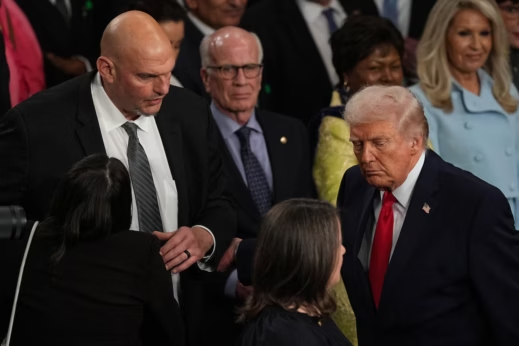
With two exceptions, the vote fell strictly on party lines. Only one Republican, Sen. Rand Paul, R-Ky., defied Trump and voted to end the U.S. participation in the war, while the other 52 Republicans voted for war. Both independents and 44 Democrats voted against the war, but John Fetterman, D-Pa., an outspoken supporter of Netanyahu, defied them and voted for the war.
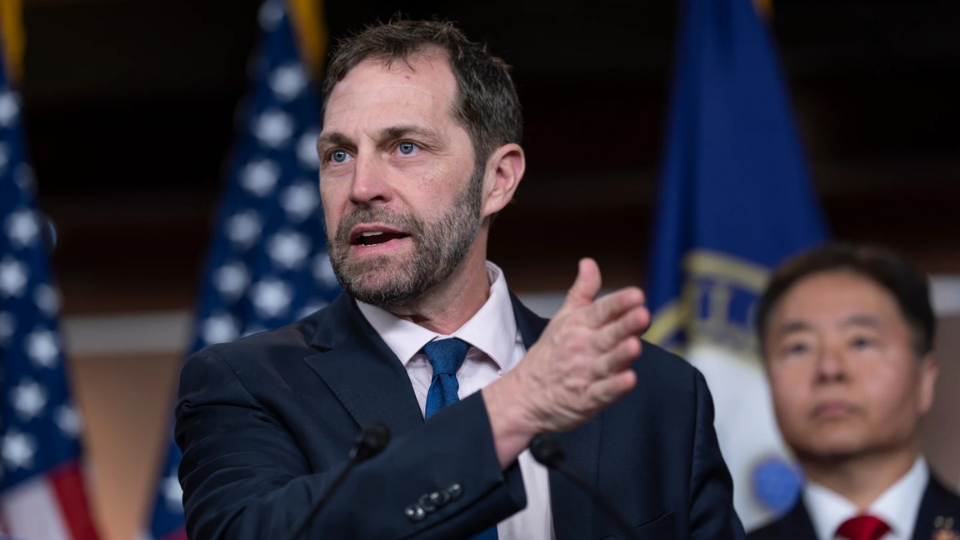
Sen. Tim Kaine, D-Va., the measure’s sponsor, challenged his colleagues to stand up to the president. The majority failed to do so—even as Pete Hegseth, Trump’s “War” Secretary, predicted the war would accelerate.
In the immediate aftermath of the vote, that prediction came through as the war spilled over outside the Middle East, threatening to involve NATO, European countries, and even spread to South Asia. Missiles were intercepted over Turkey, a NATO country that holds a U.S. military base, and an Iranian ship was sunk near Sri Lanka in the Indian Ocean.
Civilians in countries throughout the region in the Middle East that have U.S. bases are fearful as Iranian drones reach airports, luxury hotels, and other locations.
Meanwhile, there is intense fighting and bombing by Israel in southern Lebanon, with Israel saying those actions are needed to protect Israel against possible pro-Iranian attacks coming from those areas.
Ukrainian President Volodomyr Zelensky announced he’s considering sending Ukrainian drones to the region to be used in the war against Iran.
The war is also taking on an increasingly economic impact worldwide, with prices of oil and natural gas, for example, surging everywhere, including in the U.S.
Pleading with his colleagues in the U.S. Senate, Kaine said, “If you don’t have the guts to vote yes or no on a war vote, how dare you send our sons and daughters into war where they risk their lives?”
“We are at war,” declared Sen. Adam Schiff, D-Calif. “We are at war with no debate and no deliberation by Congress—a power that was explicitly given to Congress by our founders, to declare war.”
“The founders understood that the executive branch acting alone would grow too fond of war. We are seeing that fear materialize before our eyes.”
Confirming the carrying out of a real war as opposed to a quick reaction to a threat to national security, Secretary of Defense Pete Hegseth said, “We are accelerating, not decelerating. Iran’s capabilities are evaporating by the hour, while American strength grows fiercer, smarter, and utterly dominant. More bombers and more fighters are arriving just today.”
Defeat of the War Powers Resolution in the Senate, and even if it is repeated in the House, is by no means the end of the road for proponents of peace. The peace forces have leverage not just because they can reintroduce the legislation as things worsen, but because, according to recent polling, the majority of the population is opposed to the war. In addition, the mid-term elections are upon the country, and as the damage the war is doing to the U.S. economy becomes an issue in those elections, Republicans will come under increasing pressure to abandon support for Trump’s war.
The next No Kings demonstrations coming up may draw as many as 11 million people nationally, adding to the pressure on the administration.
As the war began, Sen. Bernie Sanders, Ind.-Vt., who was arrested while in college for protesting the Vietnam War, condemned Trump’s war and pushed the War Powers resolution. Last year, Sanders tried three times, unsuccessfully, to invoke U.S. arms sales law and cut off military aid to Israel due to its war on the people of Gaza.
Trump began an “illegal, premeditated and unconstitutional war,” Sanders said. “Trump is gambling with American lives and treasure to fulfill Netanyahu’s decades-long ambition of dragging the United States into armed conflict with Iran.
‘The U.S. Constitution is clear. It is the Congress that declares war, not a president acting unilaterally. The Senate must…vote on a pending War Powers Resolution, which I will strongly support.”
The House vote on the war is scheduled for March 5, but debate started on the 4th. Rep. Thomas Massie, R-Ky., the GOP co-sponsor of the War Powers resolution there, told his colleagues that “this administration can’t even give us a straight answer for why it launched this pre-emptive war.”
And after reminding his Republican colleagues that “we swear an oath to the United States Constitution,” House Minority Leader Hakeem Jeffries, D-N.Y., added, “We don’t swear an oath to a king, to a political party or to a man bent on desecrating the Oval Office,” Trump.
The Senate voted for the war despite public opinion. Poll numbers showed only 27% support for the war. Interviewers for a CNN poll asked about support for sending U.S. ground troops into Iran. Only 12% supported that, and 60% opposed it.
Trump and his Cabinet produced conflicting reasons for the intense U.S. and Israeli bombing of Iran, which began at 1:15 a.m. on February 28. They ranged from escalation of the Iranian nuclear threat—which Trump and Netanyahu claimed to have knocked out last year and which is proven to be non-existent—to Secretary of State Marco Rubio saying Netanyahu forced his hand by planning to bomb Iran even without the U.S. alongside. Trump later said it was he who forced Netanyahu’s hand, not the other way around.
The War Powers Act, which the Senate resolution invoked, says a president has up to 60 days after he launches unilateral military action before he must come to Congress for an OK, either by a declaration of war—which hasn’t happened since the Japanese bombed Pearl Harbor in 1941—or by a so-called “authorization of use of military force.” But this War Powers resolution demanded an immediate end.
Republican President George W. Bush sought and got that authorization when he invaded Iraq in 2002, as Schiff reminded senators. Before the War Powers Act existed, Republican President Richard Nixon, on his own, widened the Vietnam War into Kampuchea, then named Cambodia, in 1970.
And at least current Majority Leader John Thune, R-S.D., recognized that 60-day limit, even as he led the GOP in backing Trump. Asked if Trump could legally continue the war after the fighting reached the deadline, Thune answered “no.” But Trump has shown, especially in this first year of his second term, complete disregard for such legal and constitutional barriers.
Tension over the war erupted outside the Senate, too. U.S. Capitol Police manhandled and arrested a Marine Corps combat veteran, Brian McGinnis, for interrupting an Armed Services Committee hearing by loudly protesting Trump’s war.
Aided by Sen. Tim Sheehy, R-Mont., the police dragged McGinnis out. His arm was caught between the heavy door and its frame, and broke.
Many top Iranian leaders have also been killed in targeted strikes—so many that Trump didn’t know who could run Iran now. “We killed them all,” he said of lower-level Iranian leaders.
We hope you appreciated this article. At People’s World, we believe news and information should be free and accessible to all, but we need your help. Our journalism is free of corporate influence and paywalls because we are totally reader-supported. Only you, our readers and supporters, make this possible. If you enjoy reading People’s World and the stories we bring you, please support our work by donating or becoming a monthly sustainer today. Thank you!
CONTRIBUTOR