RICHMOND, Va.—In a drastic but politically consistent move to disenfranchise voters, the Republican National Committee is trying today, April 27, to convince the Virginia Supreme Court to throw out the congressional redistricting plan, which state voters approved on April 21.
The committee’s lawsuit against that referendum result is in keeping with one of its top goals: To keep or expand its thin GOP U.S. House majority, now 217-212, this November. There are five vacancies—three Democratic-held seats and two GOP-held seats–and one Republican-leaning independent. So flipping Virginia is key to the fall outcome nationally.
Virginia voters, by a 51.4%-48.6% margin, OKd a new map to turn the state’s delegation from 6-5 Democratic to 8-1 Democratic, with two other leaning-Democratic districts, starting this year and through the 2030 election.
Keeping Congress under Republican control would protect the radical right-wing Donald Trump regime from Democratic-led investigations and success in halting its tyrannical agenda—everything from voter repression to tax cuts for the rich to the Iran War.
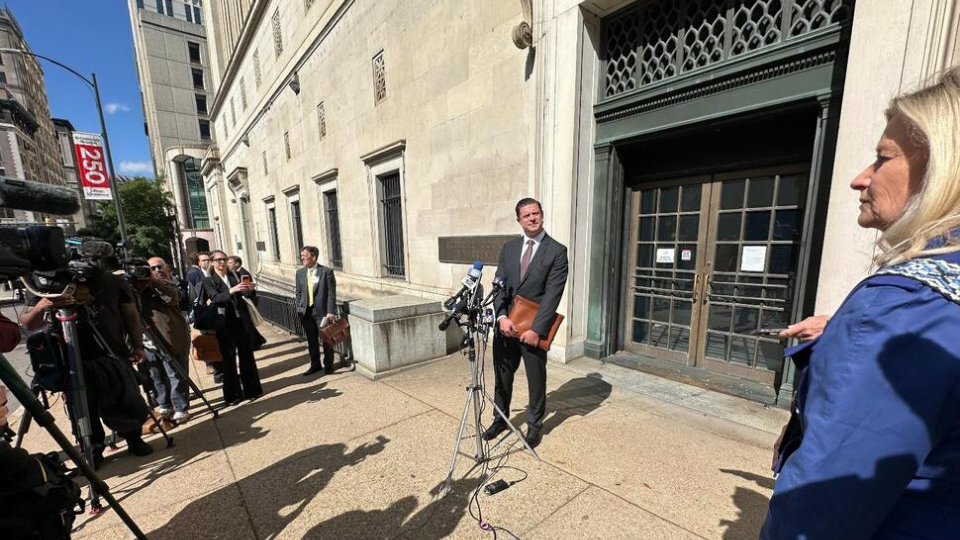
“The first concern is the integrity and finality of elections. More than three million Virginians cast ballots in the April 21 referendum,” Virginia Attorney General Jay Jones, a Democrat, wrote to the state Supreme Court, defending the referendum results and their constitutionality.
Jack Hurley, the Republican-appointed chief circuit judge in deep-red rural Tazewell County, had sided with the GOP and ruled the referendum results should be tossed because the Democratic-run state legislature allegedly did not follow constitutional rules covering referendums.
“When a court nullifies a statewide vote on the basis of a disputed legal theory, the consequence is not neutrality. It is erosion of the most basic premise of self-government,” Jones countered. The suit the justices heard on the 27th is the first of several GOP challenges to the referendum results.
Trump launched the national redistricting tumult last year by ordering deep-red and gerrymandered Texas to redraw its congressional lines, potentially flipping five of the remaining Democratic seats to the Republicans. State lawmakers dutifully followed. The Texas U.S. House delegation is now 24-13 GOP, with one vacancy. One of the endangered Democrats is Greg Casar, a longtime union organizer.
California countered with its own referendum, a landslide win for a Democratic-drawn remap, which could flip five GOP-held seats. The Golden State’s delegation is now 42-7 Democratic, with two GOP vacancies and the GOP-leaning independent.
Other states—Ohio, Missouri, North Carolina, Utah, and now Virginia—jumped into the redistricting fray. Pre-Virginia, the result, independent analysts say, is a wash. In four of the seven states, except Virginia and California, the lawmakers chose their voters, not the other way around. The Utah Supreme Court, upholding a prior referendum, redrew its state map, netting a leaning-blue seat by unifying Salt Lake City, which had been split four ways.
The GOP’s other aim, unspoken in this specific lawsuit but a subtext for all its election-oriented actions in Congress, the states, and at the U.S. Supreme Court, is to permanently cement its hegemony, as Trump once voiced.
It would rob voters—people of color, workers, women, LGBTQ people, and the differently abled among them—who don’t conform to the party’s white nationalist dogma and stereotype.
That’s the object of the GOP’s Save Act, now marooned in the GOP-run U.S. Senate, which would restore Jim Crow, or worse, nationally. It’s also the object of a national GOP lawsuit, pending before the GOP-named majority of the U.S. Supreme Court, to gut what’s left of the 1965 Voting Rights Act.
And on a smaller scale, it’s the object of a bill from a right-winger, Rep. Richard McCormick, R-Ga., to overturn the referendum result by throwing 250,000 Northern Virginia voters—pluralistic, politically active, vote-rich and heavily Democratic—into Washington, D.C.
That area in Arlington and Alexandria was originally part of D.C., but Congress gave it back in 1846 so slave-holders could continue to enslave African-Americans. Even in 1846, a majority of D.C. residents opposed the slave trade.
McCormick explains the U.S. Constitution sets aside a district “not to exceed 10 miles square,” i.e., with 10-mile boundaries on all four sides, as the Nation’s Capital, under congressional control. That included Northern Virginia.
Transfer would not only take voters off Virginia’s rolls, but would entirely deprive them of congressional representation, joining them with D.C.’s current 710,000 residents who have no voting voice in Congress. McCormick’s “solution” also makes a mess of the new congressional district map. Five of the new districts are centered in Northern Virginia.
“Absent the vote of D.C. bureaucrats,” Virginia “would have a substantial Republican majority,” McCormick contends, using another common GOP stereotype. “The retroceded areas of Arlington and Alexandria alone contribute roughly 250,000 D.C. votes in Virginia statewide elections, votes that belong to Washington, D.C.
People’s World is in the midst of its annual fund drive, trying to raise $140,000 by May Day. To support working-class journalism, please consider make a donation or become a monthly sustainer. Thank you.
CONTRIBUTOR