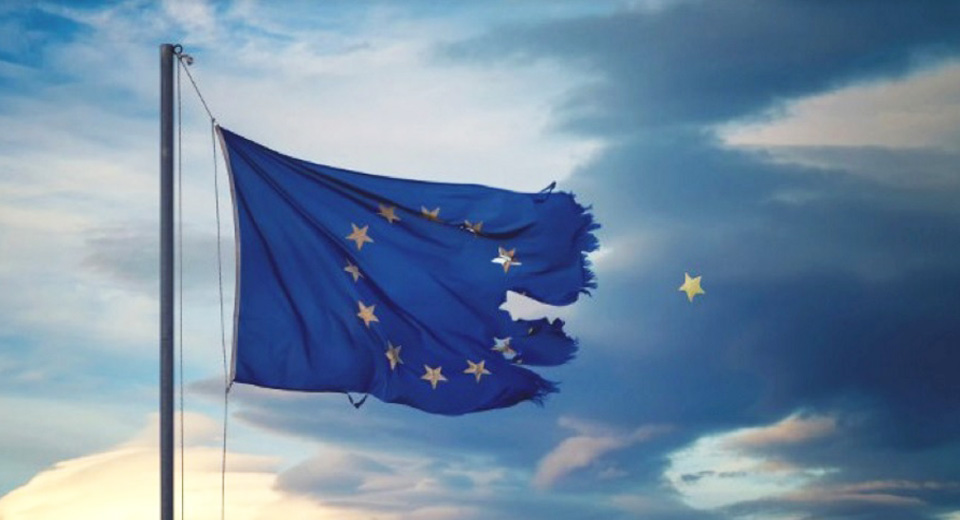
The European Union presents itself as a beacon of press freedom and human rights, a façade that is crumbling rapidly: the EU is now using its formidable sanctions machinery against journalists and publicists who dare to report outside the boundaries of the establishment narrative—with devastating consequences for their livelihoods, their families, and their most basic civil rights.
The cases of the German nationals Hüseyin Doğru (journalist), Ulrich Heyden (correspondent), Patrik Baab (publicist), and the Swiss military analyst Jacques Baud reveal a chilling reality: in today’s Europe, journalists who deviate from the establishment narrative can be reduced to destitution, stripped of their livelihoods, and effectively declared non-persons–all without being convicted of any crime, often without any formal charge, and sometimes even after a court has vindicated them.
Hüseyin Doğru: Reduced to zero in the heart of Berlin
On May 20, 2025, Hüseyin Doğru—a German citizen of Turkish-Kurdish background, a father of five (including two infants), and a journalist based in Berlin—discovered that his name had been added to the EU sanctions list as part of the 17th sanctions package against Russia. The official justification: Doğru’s pro-Palestinian reporting and his work on the media platform Red Media allegedly constituted “spreading ethnic, political and religious discord,” thereby supporting “Russia’s destabilizing activities.” No evidence of any connection to Russian state actors has been made public.
The consequences have been nothing short of catastrophic. Doğru’s bank accounts were frozen. A Europe-wide travel ban was imposed. A de facto professional ban came into effect—he is forbidden from pursuing any gainful employment, including freelance journalism. When the daily newspaper Junge Welt attempted to hire him, Germany’s federal bank warned that this would constitute a prohibited economic contribution. In March 2026, German authorities escalated their repression: the Central Office for Sanctions Enforcement (ZfS) seized the bank accounts of Doğru’s wife as well, arguing that the family car insurance—which she had taken over after his policy was canceled— constituted evidence of “sanctions evasion.” The family now survives on just 104 euros and faces imminent homelessness.
Alexander Gorski, Doğru’s lawyer, has stated that even a neighbor bringing bread to the family could theoretically be prosecuted. “This repression,” Gorski says, “contradicts the human dignity of the family and is unacceptable in a rule-of-law state.”
A legal opinion commissioned by the European Parliament, authored by former European Court of Justice judge Ninon Colneric and international law professor Alina Miron, concluded that the EU’s sanctions regime against individuals for alleged disinformation violates fundamental rights— including freedom of expression, freedom of the press, the right to property, and the right to a fair trial. The authors speak of a de facto “civil death” of those affected.
Ulrich Heyden: De-banked for living in a “high-risk country”
Ulrich Heyden, a 72-year-old German journalist who has lived and reported from Moscow for over three decades, received a different but equally devastating blow. In March 2026, the Hamburger Sparkasse—his bank since the 1990s—informed him that his account was being closed. A bank employee explained to Heyden that the termination was due to EU sanctions against Russia, adding that he was living in a “high-risk country.”
Yet, Heyden is not on any sanctions list.
His crime, it seems, is simply reporting from Russia with “understanding and not foaming at the mouth”—as he put it in an open letter to German President Frank-Walter Steinmeier. Heyden points to a glaring double standard: “Projects of Russian opposition figures and journalists living in Germany are supported through funding programs of the Foreign Office, yet a German journalist like me, who lives in Moscow and has been delivering information and background reports from Russia, Ukraine, Central Asia, and the Caucasus for thirty-four years, is having his livelihood taken away.”
His decades-long career included contributions to Deutschlandfunk (Germany’s national public radio), the Sächsische Zeitung, the Tagesspiegel, and the Financial Times. But because he now writes primarily for independent online outlets, his bank—acting in what the left-wing daily Junge Welt calls “preemptive obedience”—has decided that his work is too risky to be associated with.
Jacques Baud: The analyst who became an “unperson”
Perhaps the most surreal case is that of Jacques Baud, a former Swiss colonel, former NATO official, and former UN peacekeeping expert who has written extensively on military strategy. In December 2025, Baud learned from a phone call with a journalist that he had been placed on the EU sanctions list. He has never been formally informed of the reasons. A petition in Baud’s support has been signed by thousands, but the Swiss government has been unwilling or unable to protect its citizen.
The result of Baud’s designation is total: he cannot access his bank accounts, use credit cards, pay rent, buy food, or even travel from his house in Brussels to his home country, Switzerland. As the Morning Star notes, “In the age of electronic payments and online tracking, this is in effect a prison sentence without any charge, trial, or right to represent oneself against false accusations.” A humanitarian exemption was eventually granted, allowing Baud minimal access to funds for necessities—but only after weeks of living in limbo.
A systematic assault on the Fourth Estate
These are not isolated incidents. Since May 2025, a total of fifty-nine individuals have been placed on the EU’s sanctions list for alleged disinformation, including bloggers Alina Lipp and Thomas Röper. The criteria for listing have been progressively broadened: an EU Council decision from October 2024 allows sanctions against anyone who plans or supports “information manipulation”— originally, this required proof of coordination (belonging to an organized, state‑linked network). In May 2025, the EU removed even that requirement.
Now, a journalist can be sanctioned for their individual statements alone, without any evidence of belonging to a coordinated campaign. In practice, this means that any critical political statement can now be reclassified as sanctionable disinformation. The chilling effect is already palpable. Which journalist will risk reporting critically on the Gaza war, on pro-Palestinian protests, or on the sanctions policy itself when the consequence could be the complete destruction of their economic existence? As Doğru’s lawyer notes, the sanctions create a “civil death”—a status so total that even accepting bread from a neighbor becomes a potential criminal offense.
Patrik Baab: The extra‑legal witch‑hunt that prefigures sanctions
Repression doesn’t begin with an EU sanctions list. It starts earlier—through a parallel machinery of denunciation: state-funded academics, compliant public broadcasters, and coordinated media campaigns that dismantle journalists’ reputations and livelihoods before any formal sanction is imposed. The case of Patrik Baab is a clear example.
Unlike others who were never charged or given a chance to respond, Baab did make it to court—and won. In 2022, he traveled to eastern Ukraine to research a book. For that, his university, Kiel’s CAU, terminated his teaching position, citing false media claims that he had acted as an election observer for Russia. Baab sued. In April 2023, the Schleswig-Holstein Administrative Court ruled the dismissal unlawful and a violation of academic freedom. The university did not appeal. But the verdict came too late to undo the damage. His reputation had already been smeared. His job was gone. MDR, he says, aired a one-sided piece that omitted his responses. Local politicians pressured venues to cancel his events. Baab’s case shows how reputational destruction precedes formal punishment. By the time sanctions arrive, the groundwork has been laid. He won in court—but the signal to other journalists was unmistakable: step out of line, and your career can be ended long before any judge has a say.
Francesca Albanese: A parallel war on free speech
The same dynamic is visible in the coordinated campaign against Francesca Albanese, the UN Special Rapporteur on human rights in the occupied Palestinian territories. In February 2025, two events where Albanese was scheduled to speak were canceled in Berlin and Munich after political pressure from the Israeli ambassador, the German-Israeli Society, and local politicians. Berlin’s Free University cited an “unpredictable security risk”—even though there had never been any security incidents at Albanese’s previous events. Shortly thereafter, the foreign ministers of France, Germany, Italy, Austria, and the Czech Republic called for her removal based on a deliberately truncated video clip that misrepresented her remarks. Amnesty International’s secretary general, Agnès Callamard, condemned the ministers for spreading disinformation themselves while attacking a UN expert for telling uncomfortable truths.
Albanese—who has been sanctioned by the U.S. administration—describes the treatment she received in Germany as part of a broader pattern of silencing. “I was really surprised,” she told LeftEast, “when just a few days before coming to Germany, I learned that the event in Munich had been canceled. I started thinking: Is academia also caving under pressure so easily?” Her question resonates far beyond academia. If the EU and its member states can silence a UN rapporteur, destroy the livelihoods of journalists, and freeze the assets of analysts—all without due process – then what remains of the democratic values Europe claims to defend?
For the left, the stakes could not be higher. The EU’s sanctions regime represents a fundamentally authoritarian logic: that the state is entitled to define which speech is permissible, and to impose extrajudicial punishment on those who deviate. This is not the defense of democracy; it is its erosion from within. Silence in the face of these attacks is complicity.
We hope you appreciated this article. At People’s World, we believe news and information should be free and accessible to all, but we need your help. Our journalism is free of corporate influence and paywalls because we are totally reader-supported. Only you, our readers and supporters, make this possible. If you enjoy reading People’s World and the stories we bring you, please support our work by donating or becoming a monthly sustainer today. Thank you!
CONTRIBUTOR