DETROIT—More than 150 community, labor, and youth activists packed a Southwest Detroit hall on Saturday, March 7, for a powerful and emotional display of cross-coastal solidarity as a direct response to the Trump administration’s escalating attacks on working-class people both at home and abroad.
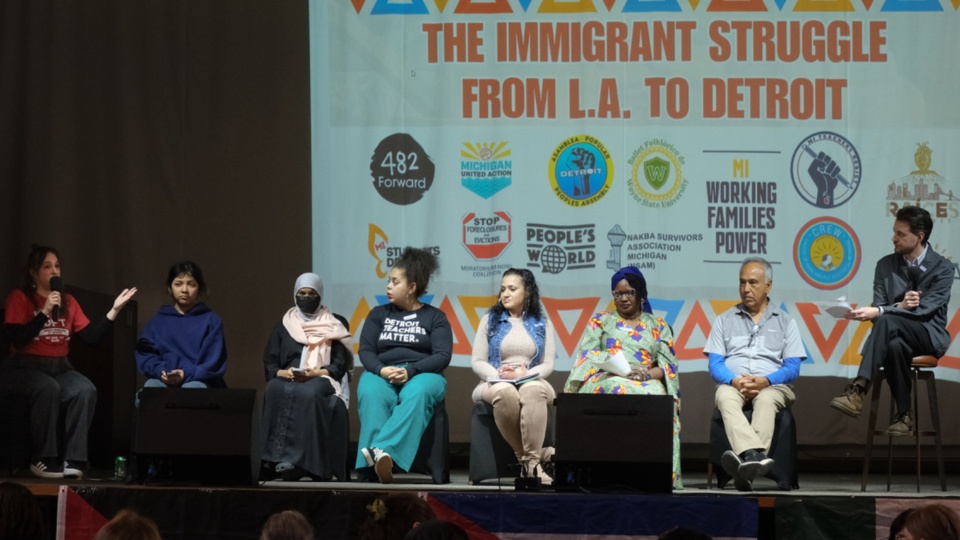
As winter thawed into spring, a broad coalition of organizations hosted “The Immigrant Struggle: from L.A. to Detroit” in one of the city’s most prominent immigrant and working-class neighborhoods. With flags of Palestine, Mexico, and Cuba on stage, the event opened with a statement of solidarity for all oppressed peoples and a specific call to end the U.S. blockade on Cuba.
The stage featured speakers representing major fronts in the immigration fight: trade unions, community organizations, and youth leaders. The lineup included representatives from the Detroit Federation of Teachers, RAICES Detroit, the African Bureau of Immigrant and Social Affairs (ABISA), Michigan Students Dream, the Peoples Assembly of Detroit, Michigan United Action, Michigan Working Families Power, Moratorium Now Coalition, and the Latino Youth Council.
The event was moderated by People’s World Michigan.
The diverse, multigenerational audience experienced an event that went beyond political speeches to capture the human essence of the struggle. Many speakers shared personal, anecdotal stories that brought the crowd to tears.
Keynote speaker Rossana Cambron, a longtime Los Angeles organizer and co-chair of the Communist Party USA, connected the fightback against Trump and the billionaire class to the working-class legacy of the immigrant rights movement in L.A. She framed the current attacks as a familiar chapter in U.S. history.
“This is what political scapegoating looks like in real life,” Cambron said. “It’s not just headlines. It’s children going hungry. Families are uprooted. It’s trauma that lasts generations.”

Cambron noted that while federal raids in L.A. were meant to “set an example” for ICE operations elsewhere, communities were ready to confront them. People “aren’t strangers to each other anymore. They are a part of the fabric of the community,” she said. “Fear can spread quickly, but so can solidarity.”
That solidarity was echoed by Veronica Rodriguez, a Southwest Detroit community member with the Peoples Assembly. She described how neighbors unite daily to face ICE agents in the streets.
“We go wherever we’re needed,” Rodriguez said. “The Peoples Assembly doesn’t limit ourselves; we see the broadness of everything. It’s community members who show up, even if it’s strangers helping strangers.” Holding up a whistle kit—a tool used in cities nationwide to warn of ICE presence—she declared, “This has been helping to wake our community up!”
Lakia Wilson-Lumpkins, president of the Detroit Federation of Teachers, highlighted the fight in schools. “Our students are afraid to attend school, and our families are living with uncertainty,” she said, describing the agonizing choice families face between sending kids to school or “self-deporting.”
She insisted that schools “should be places of trust, not places of fear” and credited teachers with pushing the fight to make schools “ICE-free zones.” She added, “We know something powerful here in Detroit: that when we organize and mobilize, we WIN!” The room erupted in chants of “Stand up, fight back!”
Laura Chavez, founder of the Detroit-based organization RAICES, detailed the compounded devastations facing Southwest Detroit’s immigrants, which include not only ICE attacks but also the February 2025 watermain break that destroyed homes and infrastructure.
“There are so many of us working together with other organizations and allies,” Chavez said. “Allyship is one the key things we need to have, as well as representation. We hold the power of our stories.”
She stressed the need for mental health support, saying, “We can’t ever erase the trauma of seeing a parent be detained and not knowing what’s going to happen afterwards.” She reminded the audience that immigrants live throughout Detroit, “and it’s not just Latino immigrants. We need everyone to unite.”
Adja Ndoye of ABISA, which advocates for Black and African migrants, addressed the specific challenges faced by these often-overlooked communities. “Trump sets out to dehumanize those who look like me, after insulting African countries,” Ndoye said.
“Let’s not forget the Afro-Latino communities. When the African met the Honduran during migration, they worked together, and crossed together, and stayed together. There was already solidarity.” She stressed the critical need for language accessibility, noting that a lack of interpreters for languages like Wolof, the main language of Senegal, in ICE offices leads directly to deportations.
The event was punctuated by a cultural performance from Ballet Folklorico de Wayne State University, whose traditional Mexican dances illustrated the link between resistance and culture.

Arturo Cambron, an organizer and cultural worker from Los Angeles, expanded on this. “The way people express themselves is an act of resistance,” he said, recalling anti-fascist activists in L.A.
“When the military was there with guns trying to intimidate us, people were not just marching, but they were dancing and they were singing. That was defiance.” He added, “Propaganda pamphlets go to the brain, but art reaches the heart. What better way is there to express a shared struggle?”
Perhaps the most powerful voices came from Detroit’s youth. During a panel, two students from Cass Tech High School and MI Students Dream, Valery and Fatima, spoke through tears about losing family and friends to deportation and violence.
They channeled their grief into a call to action. “We are the generation to make change,” declared Valery. “We’re the ones who are holding up this society, and who’ve built this society with our own hands.”
Fatima challenged the crowd, asking, “If they come for me, who else will stand up and fight for me if it’s not our own community? We’re the ones who have to stand up and take action. Because if we don’t, who will?”

The event closed with speeches from local political leaders, including Michigan Senate candidate Abraham Aiyash and Sara Habbo, a campaign director for the Working Families Party running for Southfield City Council, as well as Abayomi Azikiwe from the Moratorium Now Coalition and Adonis Flores from Michigan United.
Aiyash gave a passionate speech on working-class resistance, declaring that “government has to be the mechanism that we continue to push into so that our people and our communities can fight for a greater justice.” He followed with calls for a liberated Palestine, the abolition of ICE, and an end to the bombardment on Iran.
Habbo and Flores urged the crowd to use every means available, stating, “If we don’t use every tool that we have access to, then we aren’t helping the people the way that we could.”
The connection forged between Los Angeles and Detroit at the event served as a reminder that while the attacks on immigrant communities are national in scope, so too is the solidarity to confront them. In the face of fear and uncertainty, those gathered in Southwest Detroit reaffirmed that the power to fight back lies not in any single leader or organization but in the unity of everyday people committed to protecting one another and fighting forward.
We hope you appreciated this article. At People’s World, we believe news and information should be free and accessible to all, but we need your help. Our journalism is free of corporate influence and paywalls because we are totally reader-supported. Only you, our readers and supporters, make this possible. If you enjoy reading People’s World and the stories we bring you, please support our work by donating or becoming a monthly sustainer today. Thank you!
CONTRIBUTOR