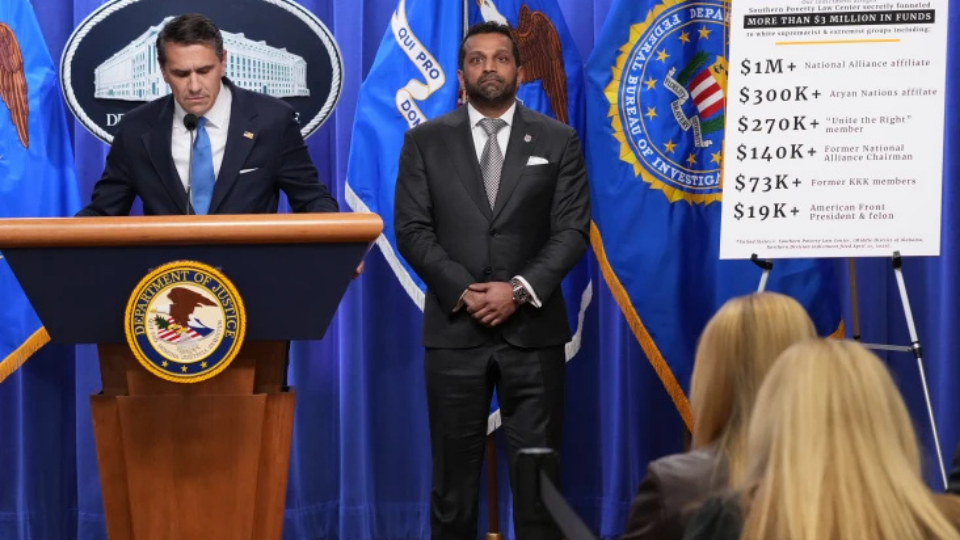
The Justice Department has indicted the Southern Poverty Law Center, claiming the civil rights group tricked its financial contributors by spending their money to infiltrate extremist hate groups.
First, it is important to note that a right-wing administration would likely want to eliminate a group like the SPLC, which, since its inception, has been devoted to tracking right-wing hate groups. The organization was founded in 1971 in Montgomery, Ala., by Morris Dees, a practicing lawyer.
His stated goal at the time was to protect civil rights and battle hate groups. He succeeded in a civil rights suit that actually bankrupted the Klan in Alabama in 1981. The SPLC later expanded into monitoring white supremacist groups and right-wing extremist groups other than the KKK.
There are 11 counts in the indictment against the SPLC, including wire fraud, false statements to a bank, and conspiracy to commit money laundering. The indictment alleges that the SPLC defrauded its donors by telling them that the group was working to dismantle extremist groups but was, in fact, using donated money, the DOJ says, to fund extremist groups.
Court papers say that between 2014 and 2023, the SPLC paid around $3 million in total to informants affiliated with several hate groups, including the KKK.
It says the SPLC set up bank accounts in the names of fake entities to pay these informants, the reason being to hide that the money was coming from the Southern Poverty Law Center. But the indictment says that in setting up these accounts, the SPLC was making false statements to the banks.
The SPLC launched a spirited response to the Justice Department claims even before the announcement of the indictments this week. They put out the news, letting the public know they were under federal investigation.
Bryan Fair, the group’s CEO, defended the payments. The argument by SPLC is that the people who were informants risked their lives carrying out a job that benefited the American people.
The group was, in fact, gathering information about very real threats of violence coming from the right-wing extremists. Fair pointed out that the information gathered was shared with local, state, and federal law enforcement, including the FBI itself, and that the work done saved lives.
Joyce Vance, a former federal prosecutor from Alabama and a current MSNow news analyst, said Thursday morning that this, plus the fact that leading figures in the Justice Department are coming forward to personally push these indictments, shows the political nature of this attack on the SPLC.
Right-wing groups have been attacking the SPLC for decades because of the success it has had in exposing them and crippling their work. That, the organization’s defenders say, is the same motivation for the operatives in the Trump administration who are pushing the indictments.
The SPLC has, for example, labeled Turning Point USA as a “case study of hard right organizing in the country.” When that group’s leader, Charlie Kirk, was assassinated, the FBI ended its policy of checking in with the SPLC when it wanted intelligence on right-wing operations in the country.
The FBI, which itself was at least sometimes recognizing that right-wing groups pose a threat in the U.S., has now done a complete about-face. Director Kash Patel now calls SPLC, a group agents worked with in the past, “a partisan smear machine.”
Vance was particularly sharp in her criticism of the FBI in this case. She said, from her experience as a prosecutor in the South, the SPLC had information that even law enforcement at times did not possess on right-wing extremist groups, and she pointed out that the SPLC was a major supporter of and supplier of information to groups like KlanWatch. She said the information coming from SPLC was widely viewed, even in some Justice Department circles, as “very useful.”
Vance said the SPLC’s success in taking down extremist groups, however, has not endeared itself to those now in powerful positions at the DOJ and in the administration generally. “It is obvious that the SPLC was not involved in enriching extremists,” she said, “but in gathering the information needed to limit their influence.”
The indictments are also seen as a warning by the administration to all groups fighting for civil rights and justice that they would do well to lie low, at least for the time being. Groups like the SPLC and its supporters indicate they have no plans to relent on their issues, however. If anything, they are likely to step up their activities.
“We will not be intimidated into silence or contrition, and we will not abandon our mission,” Fair said in response to the indictment. “We will vigorously defend ourselves, our staff, and our work.”
People’s World is in the midst of its annual fund drive, trying to raise $140,000 by May Day. To support working-class journalism, please consider make a donation or become a monthly sustainer. Thank you.
CONTRIBUTOR