

PITTSBURGH—On Feb. 18, 2:45 p.m., dozens lined up to stand watch outside Turner Intermediate School in Wilkinsburg, PA. They were on the lookout for ICE, which had kidnapped a minor that morning, less than three blocks from the school.
Among the attendees was Amanda Barber, President of the Wilkinsburg School Board. “We were notified that there was ICE activity at a local corner store. When we arrived, we spoke with the crossing guard and two parents that were witnesses to what happened.” After hearing the news that morning, Barber mobilized the community.
She and other volunteers spent hours on the phone, alerting parents and working with community leaders to coordinate a response. Frontline Dignity, a rapid-response network operating in Southwest PA, was alerted. So was Casa San Jose, a local immigrant services and advocacy organization. Other community members were activated, including the Pittsburgh Club of the Communist Party USA.
“Whistle kits” were assembled that morning and distributed in the afternoon. Local organizers had been making them for several weeks, but demand was about to soar. These kits contained a 3D-printed whistle for alerting your neighbors to ICE activity. They came with a know-your-rights card and a booklet created by Frontline Dignity with their rapid-response hotline phone number.
Towns and schools oppose ICE throughout the county
Rumors of local ICE activity had been swirling for weeks, causing many K-12 students to stay home from school out of fear. These concerns had become so common that 250 students walked out of a nearby high school that very same day, responding to a completely different instance of suspected (at the time) ICE activity.
The activity has prompted the Wilkinsburg school district to restate its policy that ICE agents may not enter school facilities “without a valid judicial warrant.” Some nearby districts are adopting similar policies, though not all.
Four days earlier, protesters in Springdale, PA, gathered to denounce the recent arrest of Randy Cordova Flores, a Peruvian immigrant with no criminal record who was pulled over for a traffic violation. The arrest has devastated his fellow community members, around 200 of whom came out on Valentine’s Day to express their concern about the borough’s collaboration with immigration authorities. This collaboration was cemented last Fall by the 287(g) agreement that Springdale passed without public discussion.
A month prior in nearby Oakmont, PA, Jose Flores was preparing to take his daughter to school when he was arrested by two plainclothes ICE agents. Flores’s arrest led the school district to pass a student safety plan and the Oakmont council to pass a resolution barring the kind of non-criminal immigration enforcement that Springdale practices. Both of Oakmont’s resolutions passed unanimously.
Finally, the Allegheny County Council voted in early March to ban county employees from cooperating with ICE and other federal immigration authorities. The bill was introduced in January, and local organizers had since been mobilizing their neighbors to contact their county reps. It ended up passing 11-3.
Locals build long-term organizing capacity
Since Feb. 18, the Wilkinsburg community has continued to protect its schools. Formal school patrols were organized by a volunteer network that shows up to drop off and pick up, and to monitor any suspicious activity.
In addition to the school patrols, community members have created autonomous groups of Walking Clubs to monitor vulnerable areas, including construction sites and local food distribution centers.
In Pittsburgh, organizers in East Liberty and Highland Park have been assembling and distributing rapid-response kits for weeks. People are running their own 3D printers 24/7, turning out hundreds of whistles per day. Locals are coming to “whistle kit parties” to meet their neighbors and join neighborhood-wide Signal chats.
This work is part of the Neighborhood Assemblies, a Pittsburgh project inspired by the local organizing efforts in Minneapolis and Chicago. Pittsburgh is a city with 90 neighborhoods, which provide natural local units to organize. Some Assemblies, such as the East Liberty/Highland Park group, have over a hundred people involved. Others, like the Bloomfield/Garfield/Friendship group, are just getting started.
The goal is to combine local and city-wide organizing efforts. An Assembly Coordinating Committee is being put together, made up of representatives from each Assembly. There’s a newsletter on the way, for communicating between neighborhoods and with those who haven’t yet joined up.
Frontline Dignity has been holding Legal Observer Trainings, many of which have had over a hundred attendees each. These serve the acute need for documenting ICE activity at the local level. Having a dense network of local observers is especially critical because the kidnappings around town are usually over in five minutes. If there’s nobody nearby, help won’t make it in time.
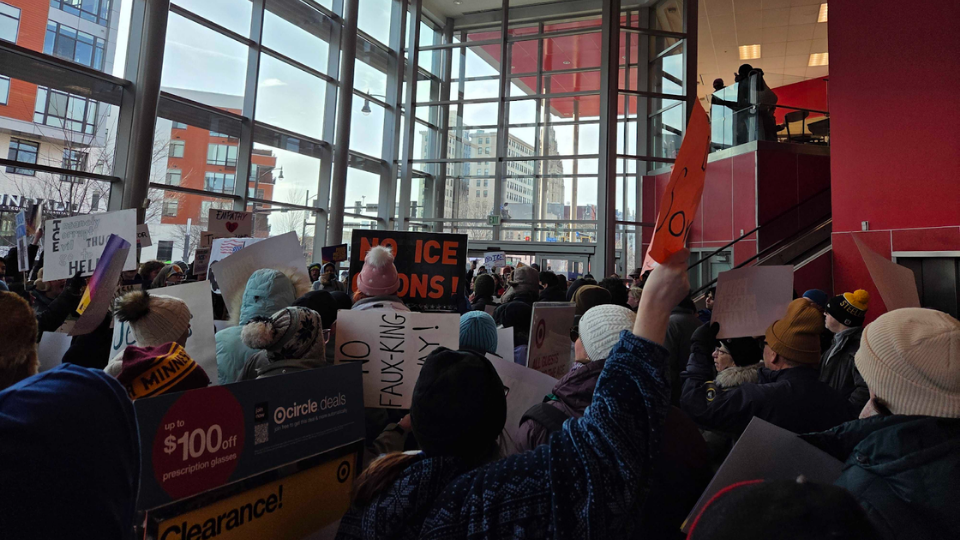
Frontline Dignity is also building rapid-response networks for immediate action, while Casa San Jose has been providing the longer-term immigrant support. Other community members have been holding know-your-rights training and skill-share sessions. Some organized a protest against the Target in East Liberty (see cover photo), calling out the company for collaborating with ICE. Still others are strengthening mutual aid networks.
ICE activity is growing in Pittsburgh and across Allegheny County. To resist, locals are talking to their neighbors and building the foundations of working-class institutions.
Amanda Barber contributed to this story.
We hope you appreciated this article. At People’s World, we believe news and information should be free and accessible to all, but we need your help. Our journalism is free of corporate influence and paywalls because we are totally reader-supported. Only you, our readers and supporters, make this possible. If you enjoy reading People’s World and the stories we bring you, please support our work by donating or becoming a monthly sustainer today. Thank you!
CONTRIBUTOR




MOST POPULAR TODAY

Credible sources say Trump readies to steal the midterm elections

Leonard Peltier, longest serving U.S. political prisoner, should be free

How the bad science of AI doomerism is good for big business

Dark day for Hollywood labor: Paramount-Warner Bros. mega merger approved

Controversial ‘God made Trump’ campaign ad produces bipartisan uproar