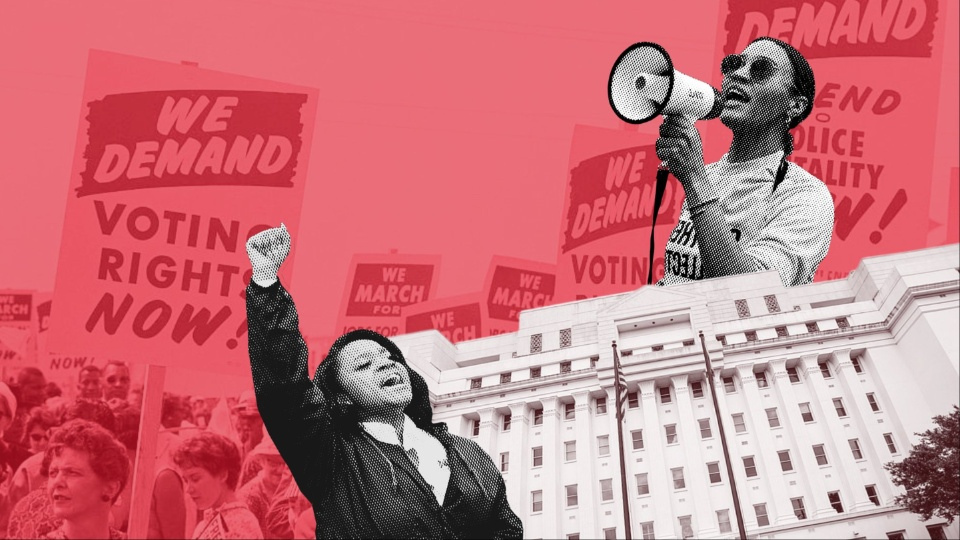
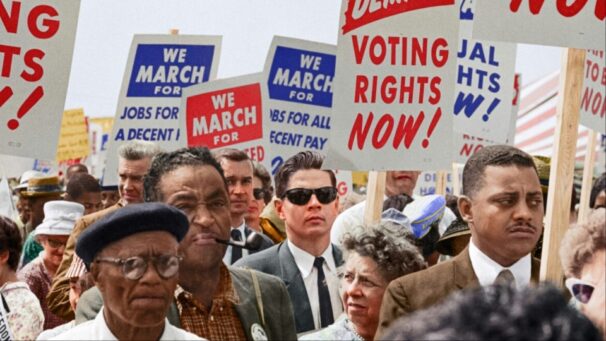
SELMA, Ala.—Shades of Selma, Ala., in 1965: Faith leaders, labor and civil rights groups will lead a mass march here across the Edmund Pettus Bridge—on May 16, as the centerpiece of an “All Roads Lead To The South: National Day of Action” for voting rights.
This time, of course, the marchers will be missing the late Rev. Dr. Martin Luther King Jr., the civil rights icon, Rep. John Lewis, D-Ga., the famed African-American labor leader A. Philip Randolph, who marched by King’s side, and noted African-American organizer Bayard Rustin, among others.
Hopefully, there will be no Alabama police dogs and state troopers wielding high-pressure fire hoses to attack marchers, as occurred 61 years ago.
And, yes, after their 9 a.m. march in Selma, they’ll continue to the state capital of Montgomery, which was the capital of the Confederacy, just as Dr. King and his marchers did 61 years ago when, protected by Democratic President Lyndon Johnson’s U.S. marshals, they resumed their trek.
Organizers, including Black Voters Matter, which put together this march, along with the NAACP, Public Citizen and No Kings, say it will show determined opposition in defense of the gains of the civil rights era, especially restoring the clout of the Voting Rights Act. Bus caravans to Selma and Montgomery are being organized from as far away as Charlotte, N.C.
Prompted by white nationalist GOP President Donald Trump and aided by the GOP-named majority of the U.S. Supreme Court, white nationalists and MAGA supporters are gerrymandering African-American legislative seats—and lawmakers—out of existence. People of color, and their allies from across the entire multi-racial, multi-national working class, are not taking the attacks on voting rights lying down. Reflected in the march here in Selma is the understanding that attacks on voting rights for Black people mean weakening all the fights for economic progress and justice. 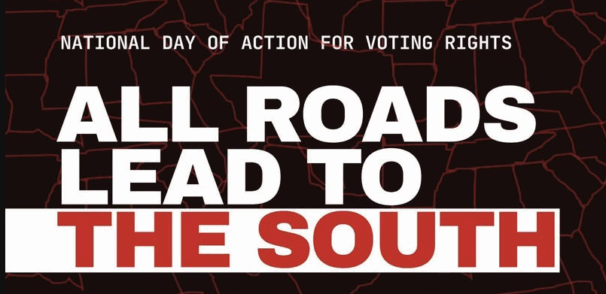
The Supreme Court’s six-justice majority gutted what was left of the Voting Rights Act in its recent and controversial Callais v Louisiana decision. The justices, three of them named by Trump, ruled Louisiana’s congressional district map violated the law by discriminating against whites in drawing a second majority-Black district stretching from Shreveport to Baton Rouge.
White right-wingers sued the state and won, setting off a “race to the bottom” to eliminate African-American-held seats. Florida’s GOP-gerrymandered legislature eliminated two Black-held Democratic seats and two Jewish Democrats, turning the delegation to 24-4 GOP.
Also axed: Single African-American held seats in North Carolina and Kansas City, Mo., plus a majority-Black district in Memphis, Tenn., held by white progressive Democrat Steve Cohen. Previously, deep-red Texas converted five seats to the GOP.
Democrats occupy all the eliminated seats, and the justices ruled that partisan gerrymandering is constitutional, but openly racist gerrymandering is not, disregarding the obvious linkage between race and partisan voting in much of the U.S., but especially the South.
Analysts estimate up to 19 of the Congressional Black Caucus’s 62 members could lose their U.S. House seats, along with more than 160 state and local officeholders throughout the South. All of the CBC’s members are Democrats.
“You’ve got a president that’s taken Black folks out of everything,” former House Majority Whip Jim Clyburn, D-S.C., told NBC News, citing Trump’s ban on diversity, equity, and inclusion initiatives. “So I don’t want us to just look at this voting case in isolation. No, this is a comprehensive attempt on the part of this administration to redeem Jim Crow. He’s trying to turn the clock back.”
Absent any coming upsets, the House GOP will be lily-white next year regardless of the election’s outcome. Two of its four current African-American members are seeking higher office, Texan Wesley Hunt lost the U.S. Senate primary, and Rep. Burgess Owens, R-Utah, is retiring.
“Sixty years after Bloody Sunday, we are once again being called to meet this moment with collective action. The attacks on voting rights across the South are not isolated incidents, they are part of a coordinated effort to weaken Black political power,” said Cliff Albright and LaTosha Brown, Co-founders of the Black Voters Matter Fund.
“We faced these challenges before, and we know our power. Alabama has always been sacred ground in the fight for freedom, and this moment demands we rise together once again. We are proud to stand with the No Kings coalition and people across the nation to make clear our communities will not be pushed backward, our voices will not be silenced, and our power will not be denied.”
“A king rules without the people’s consent, and this administration and his enablers want to rule over us. But this is America, and we are not going back. True power belongs to the people—not to wannabe kings,” the No Kings Coordinating Committee said.
But even before this Selma march, it appears that at least some “red” state lawmakers are paying attention. Georgia put off legislative action on redistricting until next year, and South Carolina lawmakers scrapped the idea altogether. The rightist remap there would have eliminated Clyburn.
But State Senate Majority Leader Shane Massey, R-Edgefield, led five Republican colleagues to oppose the remap on both political and moral grounds—and said he told that to Trump’s team. The senatorial turnabout sank the map.
Politically, Massey said redrawing the South Carolina lines to eliminate Clyburn will “motivate Black turnout,” and could put state’s six GOP-held U.S. House seats in play as well as change down-ballot results. South Carolinians, Massey said, vote conservative, but they’re not rabid, he claimed.
Morally, Massey called the new map an abuse of power against the minority.
Mississippi GOP Gov. Tate Reeves canceled a special state legislative session he called to redraw the state Supreme Court justices’ district lines. Solons there could have seized it to redraw the congressional map, too. But after consulting with Trump, and noting Mississippi’s filing deadlines have passed, Reeves put the session off until next year.
“It is not a question of if, it is a question of when” his state redraws the lines, Reeves told a right-wing radio network. His target date now is before the off-year elections of 2027. Those votes involve local and municipal races, and are vulnerable to racist remapping, too.
But his real object is to carve up the Delta district of the state’s sole African-American lawmaker, veteran Rep. Bennie Thompson (D), who chaired the former House Select Committee to investigate the MAGAites’ Jan. 6, 2021, U.S. Capitol pro-Trump attack and coup attempt.
On the other hand, Alabama GOP Gov. Kay Ivey rescheduled the state’s primary for mid-August. That gives lawmakers time to redraw their 2023 congressional map, which, obeying the 1965 Voting Rights Act, yielded two African-American-held—and Democratic—U.S. House seats.
The U.S. Supreme Court approved that map several years ago, but just gave Alabama a “go” signal to redraw its lines again. Lawmakers there want to eliminate one of the Democrats, if not both.
In the remap war Trump set off by demanding red-state Texas switch five U.S. House seats from blue to red, which its lawmakers did, two key states, deep-blue California and purple Virginia, fought back. California voters approved a new map there, virtually canceling the GOP’s Texas gains.
Virginians voted 52%-48% for a new map to change the state delegation from 6-5 Democratic to 8-1 Democratic with two leaning Democratic seats, but the Virginia Supreme Court, by a 4-3 margin, restored the old map in a case the Republican National Committee brought against the referendum. Democrats are appealing that ruling to the U.S. Supreme Court.
House Minority Leader Hakeem Jeffries, D-N.Y., vowed to do everything possible to electorally reverse the GOP gains. The whole point of the remap war is to either preserve (Republican) or overturn (Democratic) the GOP’s current 217-212 U.S. House majority. There’s one pro-Republican independent, from California, and five vacancies, three of them Democratic.
Other blue states, many of whom have switched to non-partisan redistricting commissions, are now being urged to do what California did, and Virginia tried, and override those panels. If that can’t happen now, do it next year for 2028, some Democrats urge. Rep. Alexandria Ocasio-Cortez, D-N.Y., recently urged Illinois to do so. The Land of Lincoln’s already Democratic-gerrymandered delegation is 13-4 Democratic. State lawmakers were cool to her urging.
The Congressional Black Caucus isn’t waiting for Jeffries or the mainstream party leadership to act. Politico reports that, faced with decimation, the caucus’s political arm is raising funds for a massive media ad buy, primarily in the South, informing voters what’s going on, who the victims are–and why.
CBC’s political arm will open with a six-figure buy on social media, and sources told Politico the caucus expects the ultimate spending will be millions of dollars. The money will go for ads “in races where Black voters could prove decisive,” they said. Rep. Christian Menefee, D-Texas, told Politico that Caucus members “will go on the road to keep energy high.”
He also promised CBC’s price to the rest of the party is to move comprehensive voting rights legislation as the first item on the agenda, should Democrats retake the U.S. House. “We are not going to accept moving forward” without it, Menefee warned.
But in an indication of the carnage the Caucus faces, the Texas GOP-engineered remap not only eliminated five Democratic-held U.S. House seats, switching them to the GOP, but threw Menefee into a runoff against fellow African-American Democrat Al Green of Houston.
Green is one of Trump’s most persistent House critics. He’s offered three resolutions to impeach Trump and lost each time—while also gaining votes each time. And during Trump’s State of the Union address, Green, brandishing his cane, stood up and yelled “Liar!” at Trump. House Speaker Mike Johnson, R-La., had Green thrown out of the House chamber.
We hope you appreciated this article. At People’s World, we believe news and information should be free and accessible to all, but we need your help. Our journalism is free of corporate influence and paywalls because we are totally reader-supported. Only you, our readers and supporters, make this possible. If you enjoy reading People’s World and the stories we bring you, please support our work by donating or becoming a monthly sustainer today. Thank you!
CONTRIBUTOR