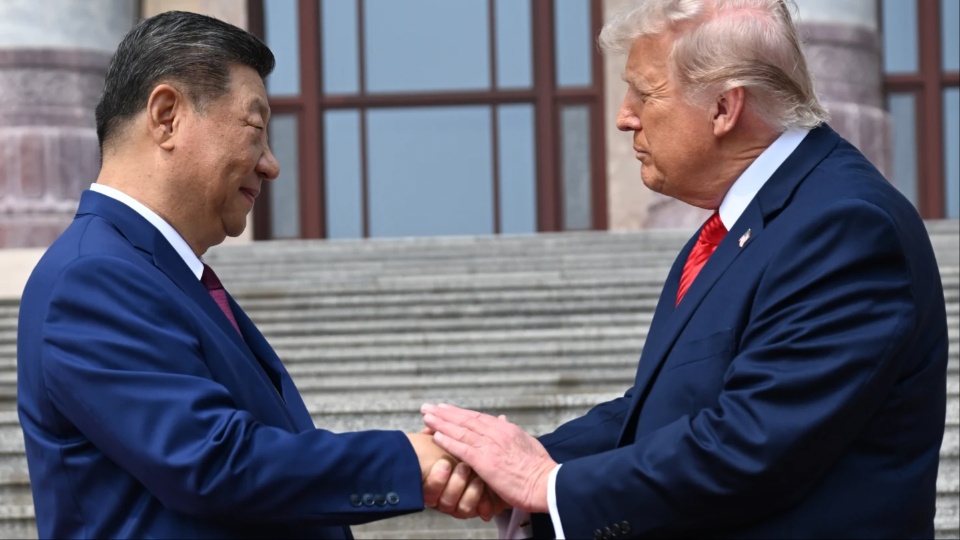
As U.S. President Donald Trump and Chinese President Xi Jinping sit across from one another at the Great Hall of the People in Beijing, the eyes of working people around the world are fixed on this two-day summit with both urgency and hope.
The relationship between the United States and China has deteriorated badly in recent years. Reckless tariff wars have disrupted global supply chains and squeezed workers and consumers in both countries with inflation and layoffs. Military posturing in the Asia-Pacific and the signing of new war pacts like the AUKUS nuclear submarine scheme have raised the specter of catastrophic conflict.
A “new Cold War” framework—driven by Washington’s bipartisan foreign policy establishment—has pushed the two largest economies on earth toward confrontation rather than cooperation. That path leads nowhere good. This summit is an opportunity to step back from the brink and push the reset button.
President Xi, in his opening remarks, posed the right question: Can the United States and China avoid the “Thucydides Trap,” the historical pattern in which a rising power and an established one blunder into war? That question deserves a serious answer, and it demands more than diplomatic pleasantries. It demands concrete commitments.
On trade, the two sides must move beyond the destructive cycle of tariffs and retaliation launched by Trump that has benefited no one but arms dealers and certain sectors of big capital. Working people in Detroit and Shenzhen alike pay the price when commerce becomes a weapon. Expanding fairly negotiated market access, stabilizing supply chains, and building genuine mutual benefit—not zero-sum competition—must be the goal.
On technology, the potential of artificial intelligence and other emerging fields is too great, and too consequential for humanity, to be squandered on a race for military and economic dominance. With the jobs of millions at stake, dialogue about how each country addresses questions of a just transition would be to the benefit of all. The same goes for the environmental impacts of data center construction. Frameworks for cooperation, not walls of restriction, are what workers and communities need.
On Taiwan, Xi was direct: Mishandling this issue risks “clashes and even conflicts.” This publication has long held that military adventurism in the Taiwan Strait would be a catastrophe for the peoples of the entire region. Dialogue, restraint, and respect for the One China principle are the only responsible course.
On the Middle East, both powers have agreed that energy waterways must remain open and that nuclear weapons proliferation is undesirable. These points of agreement should be the foundation for broader diplomatic engagement, not new pretexts for confrontation.
As People’s World regularly said during the last Cold War: Détente is not surrender, peace is not weakness. The people of both the U.S. and China—and the world—have everything to gain from leaders who choose cooperation over conflict.
We hope you appreciated this article. At People’s World, we believe news and information should be free and accessible to all, but we need your help. Our journalism is free of corporate influence and paywalls because we are totally reader-supported. Only you, our readers and supporters, make this possible. If you enjoy reading People’s World and the stories we bring you, please support our work by donating or becoming a monthly sustainer today. Thank you!
CONTRIBUTOR