

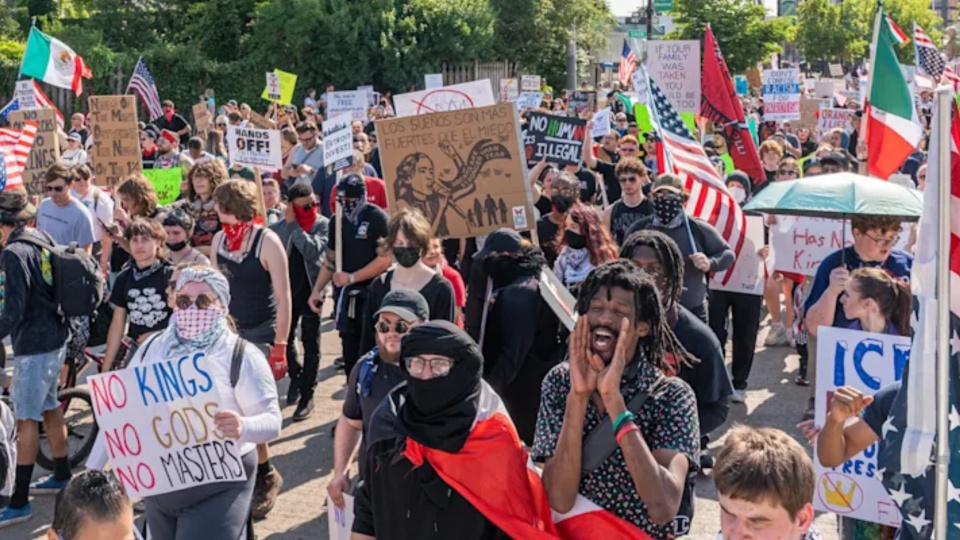
An estimated eight million people turned out to protest at over 3,000 U.S. destinations on No Kings Day III, on March 28, 2026. It’s described as the largest protest in U.S. history and the largest rebuke of Trump’s presidency. As many as 200,000 turned out for the “flagship” protest in Minneapolis, site of the videotaped ICE murders of human rights supporters Renee Good and Alex Pretti.
The anger expressed in the streets is a response to masked ICE aggression against immigrants and people wrongly identified as immigrants, and their defenders. Minneapolis was particularly targeted for occupation by 3,000 ICE and Border Patrol agents in retribution against the public display of resistance during the protests of the killing of George Floyd in 2020. It was also targeted for its large Somali population, described by Trump as “garbage.”
The No Kings protesters were also expressing anger over the military attacks against Iran at the hands of the U.S. and Israel and the ongoing genocide in Gaza, in tandem with the deteriorating living conditions for the broad masses across the country. The overwhelming messaging in the many creative signs held by the demonstrators was in opposition to the billionaire class, Trump’s threats to illegally thwart voting rights come the midterm elections in November, and fascism.
In Detroit and the surrounding region, there were over 25 demonstrations—downtown, in the suburbs, and even the rural sectors where Trump enjoyed electoral support in 2024. At Woodward Ave., just north of Detroit, site of the internationally-renowned classic car and hotrod event, “Woodward Dream Cruise,” thousands took over the sidewalks and the median of the four-lane boulevard. Many thousands in cars, trucks, and even semi-truck trailers cruised by with blaring horns and holding their own signs or displaying fists in solidarity. The overwhelming number of participants were white and ranged considerably by age. LGBTQ contingents were present. While union members were among the attendees, unions were not formally represented. Pro-Trump or MAGA counter-protesters were extremely scarce.
The inspiration behind the outpouring of support for No Kings Day was set by the organized protests in St. Paul and Minneapolis, Minnesota, especially with the organized 70,000-strong community-labor coalition calling for “no work, no school, no shopping” during a day of protest in sub-zero wintry weather two months before. The coalition incorporated unions representing service, hotel, communications, transportation, and electrical workers, and included the federated leadership of most of the unions in Minneapolis.
The No Kings Day protest was criticized by some on the left for its lack of a single list of “demands.” This may have been its strength. The organizers, the core of which is Indivisible, a grassroots group, instead offered a broad umbrella by which people could come together fighting on my fronts as part of one movement. What the No Kings Day mobilization has contributed is drawing millions into the streets, out of their isolation, many for the first time.
While the labor movement in any organized capacity has largely been absent from the No Kings Day demonstrations, that’s about to change. Prior to the first No Kings protest in June 2025—but after the similar “Hands Off” protest in April, two months before—workers and some unions mobilized for International Workers Day, May Day. Demonstrations were organized in over 1,500 locations, the broadest ever, and maybe the largest in turnout on the heels of the 2006 May Day protests under the banner of “No Immigrant Day,” when millions marched. A nationwide “May Day Strong” coalition was birthed during the lead up and is now mobilizing for this year’s May Day protests under the banner of “workers over billionaires.”
No Kings organizers have already endorsed the May Day events as the next step, going one step further by calling for a nationwide day, on Friday, May 1, of “no work, no school, no shopping.”
Several labor organizations participated in Detroit’s 2025 iteration of May Day (all for the first time), but this year the Metro Detroit Central Labor Council (AFL-CIO) will lead it. This represents a radical departure from decades of U.S. trade union leaders recognizing only Labor Day in September. One of the Executive Board members said that “members are demanding that we do something, and we are.” The ongoing reactionary attacks on workers and their unions, in tandem with the very visible No Kings Day mobilizations, have brought the mass movement knocking on labor’s door, and labor is responding.
As with all op-eds published by People’s World, the views reflected above are those of the author.
We hope you appreciated this article. At People’s World, we believe news and information should be free and accessible to all, but we need your help. Our journalism is free of corporate influence and paywalls because we are totally reader-supported. Only you, our readers and supporters, make this possible. If you enjoy reading People’s World and the stories we bring you, please support our work by donating or becoming a monthly sustainer today. Thank you!
CONTRIBUTOR

MOST POPULAR TODAY

Credible sources say Trump readies to steal the midterm elections

Leonard Peltier, longest serving U.S. political prisoner, should be free

Dark day for Hollywood labor: Paramount-Warner Bros. mega merger approved

How the bad science of AI doomerism is good for big business

Controversial ‘God made Trump’ campaign ad produces bipartisan uproar