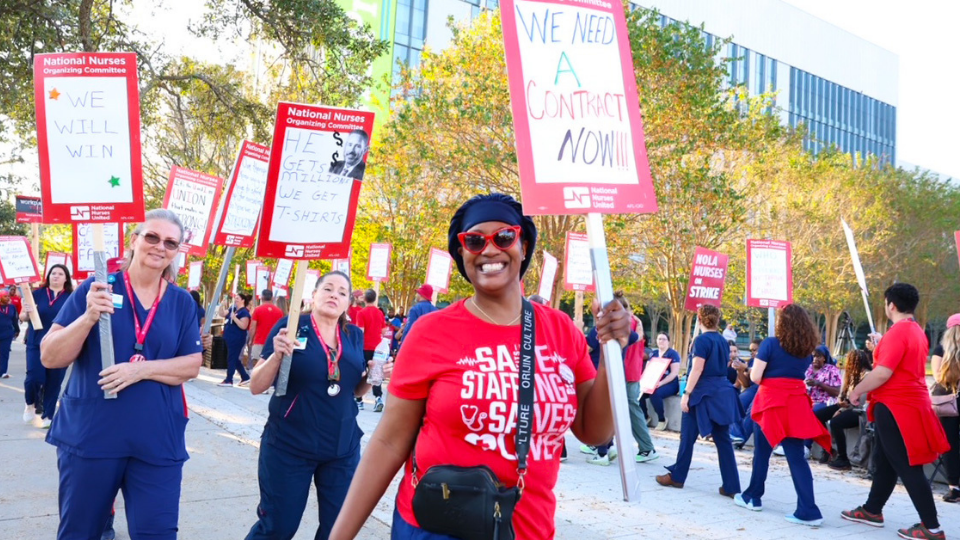
NEW ORLEANS—More than 600 registered nurses at New Orleans’ and Louisiana’s first unionized hospital concluded a planned five-day strike at 6:59 a.m. on May 6 after starting it the morning of the mass May Day protests nationwide.
Key issues for the nurses, members of National Nurses United/National Nurses Organizing Committee, are short-staffing at the patients’ bedsides at the University Medical Center-New Orleans and management’s surface bargaining in the negotiations.
The New Orleans nurses strike was one workers’ action discussed at a “debriefing” call the evening of May 5 on the impact of the massive demonstrations nationwide on May 1.
One of the newest of the UMCNO nurses, Juliette Etienne, RN, was impressed by the solidarity of her colleagues and the community against the bosses of the medical center and its owner, UCMC Health.
“We started our strike on May Day,” Etienne said, just as millions of workers and their allies hit the streets in 5,000 marches in every state, plus Puerto Rico. “It’s been a perfect example of the spirit of the day.
“We had an election in November 2023,” and unionized, Etienne explained. “We’ve been in negotiations for over two years without a contract. Management engages in surface bargaining, or cancels sessions,” and doesn’t reschedule them. The union has been forced to file unfair labor practices charges—the formal name for labor law violations—against the hospital.
“Management thinks they can wait us out, and we’ll get discouraged, but we are proving them wrong.”
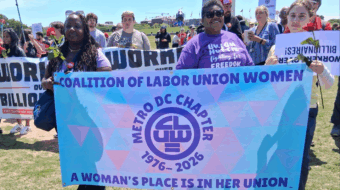
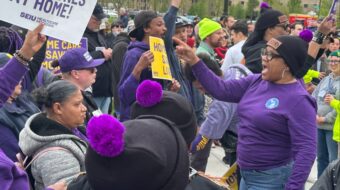
The May Day demonstrations, joined by the striking nurses, involved many other workers, students, immigrants, and others in a show of political and economic strength against the billionaires and oligarchs and their allies.
The debriefing on the May Day Zoom call, chaired by Tennessee-born activist Ash Lee Henderson, had only a few specifics for follow-up to the massive May Day marches. Nevertheless, Henderson promised there would be further marches, but set no dates. And she urged participants to check out actions they can undertake between now and Election Day and beyond by going to the May Day Strong website.
The actions, she said, would expand worker rights, civil rights, immigrants’ rights, and political rights. And “we will have to have even more solidarity to fight this tyrannical regime and its illegal war, and to go after the bad billionaire bosses and this madman in the White House,” Donald Trump.
Henderson, plus other speakers, led by Chicago Teachers Union/AFT Local 1 President Stacy Davis Gates, also warned that the enemies of workers did not sit still during May Day but continue to plot, scheme, and act against workers.
Gates singled out “terrorism by ICE,” Donald Trump’s violent and vicious Immigration and Customs Enforcement agents who invaded Chicago for months and are still there, though in fewer numbers. “But we have the power to change it,” by creating a mass movement of resistance, Gates declared.
Which is, though Gates didn’t toot Chicago’s own horn, precisely what the entire city–parents, students, teachers, business owners, Black, brown, and white—did and has kept doing.
Other speakers on the conference call specifically referred to one of the latest repressive tactics, the GOP-run Florida’s new congressional redistricting plan.
It eliminates four of the eight Democratic-held districts in a 28-seat delegation, while similar schemes are now beginning in Tennessee and Alabama. Three organizations have already filed federal court suits against Florida, charging that the plan is an unconstitutional racial gerrymander, rather than a constitutional political one.
None of this came up in New Orleans, but short-staffing at the hospital, and a contract as the solution, did. Short-staffing can get worse as a result of Trump’s so-called “Big Beautiful Bill” of last year, which cuts Medicaid payments to health care providers by $800 billion-$900 billion over a decade.
Hospitals get half of their revenue from Medicare and Medicaid. So cuts will hurt the New Orleans hospital, which is a Level 1 trauma center, a burn center, and a stroke center, Etienne said.
“Having a union contract lets us fight back” against short-staffing and cuts in care, she explained. “Hospital management wants to funnel dollars to the top [management] instead of to nurses who are taking care of patients. Our only option is to strike in order to get them to talk to us.”
In a video NNU posted, nurses told of conditions at the hospital—the same conditions that led them, like so many other exploited workers and overstressed hospital workers in particular, to organize. And organizing was the point of the Zoom debriefing conference call, too.
“When you’re short-staffed, you work harder, and you give less care to your patients,” nurse practitioner Lauren Waddell said in the video. Added Robyn Woodard, RN: “When you’re overworked, you’re stressed, and it increases errors when you’re stressed. It increases injuries, it increases falls, and sometimes it increases deaths.”
Other nurses reported patients had to wait 20 hours in the emergency room for care. “I would always go home feeling very guilty that I couldn’t take care of patients the way I wanted to,” said Dana Judkins, RN. The point of getting a union contract is to tackle such problems, all the nurses—including Etienne—said.
We hope you appreciated this article. At People’s World, we believe news and information should be free and accessible to all, but we need your help. Our journalism is free of corporate influence and paywalls because we are totally reader-supported. Only you, our readers and supporters, make this possible. If you enjoy reading People’s World and the stories we bring you, please support our work by donating or becoming a monthly sustainer today. Thank you!
CONTRIBUTOR