WASHINGTON—As the BlueGreen Alliance, a coalition of unions and environmental groups, celebrates its 20th anniversary this spring, it can look back on acceptance of the principle it pushed ever since Steelworkers President Leo Gerard and Sierra Club Executive Director Carl Pope founded it: That green jobs are good jobs, that green jobs should be union jobs, and that green jobs can restore the U.S. manufacturing base.
With the help of sympathetic legislators and other advocates, the alliance, which now includes several green groups and even more unions, won not just that acceptance, but implementation of a lot of its specifics during Democratic President Joe Biden’s administration.
But now the alliance and its allies must constantly tackle a new and ominous threat, the anti-union, anti- green economy regime of President Donald Trump, aided and abetted by the very fossil fuel interests the alliance tries to turn the nation away from. Those interests reap the profits, too.
Given the corporate clout and the campaign cash of the oil, coal, natural gas, and other fossil fuel-oriented firms and their magnates, that’s going to be a constant battle, BlueGreen Executive Director Jason Walsh told Peoples World in an exclusive interview. Which doesn’t prevent him from tooting the alliance’s horn—and the need to adjust the U.S. economy away from carbon-causing pollution, which leads to global warming.
“It all boils down to a belief that we shouldn’t have to choose between good jobs and a green environment,” he says. “We can have both.”
And those green jobs must be union jobs, Walsh declares. This was one of the alliance’s greatest achievements during Biden’s administration. And which Trump’s legislation has undone.
Since its founding, the Alliance has grown, though the Laborers withdrew several years ago. The union felt the alliance was too green-oriented at the expense of construction workers and their jobs.
And while individual unions—the Steelworkers, the Communications Workers, the Service Employees, the Plumbers, the Painters, the Bricklayers, and the Auto Workers—are members, the labor movement as a whole is not, yet. Which doesn’t mean other unions are hostile.
Even Sean McGarvey, president of North America’s Building Trades Unions, vigorously endorsed green jobs as good union jobs in his recent keynote address to NABTU’s legislative conference. But for McGarvey, they’re part of the all-of-the-above sources of energy for the U.S., including green sources such as solar, wind, and hydropower, and traditional ones such as oil and natural gas.
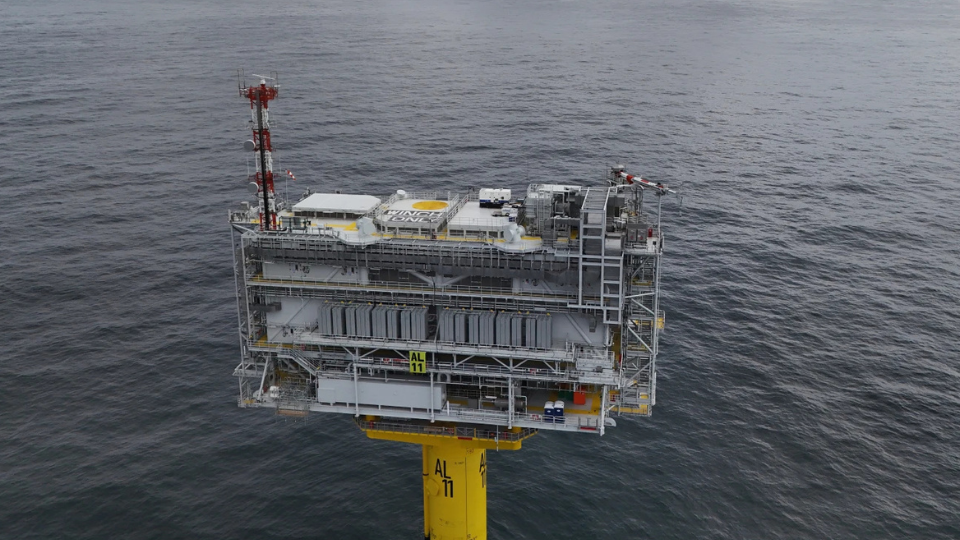
So McGarvey blasted Trump for wiping out thousands of current and potential building trades jobs by shutting down leases for offshore wind farms and for paying a virtual $928 million bribe to their main European sponsor, the French petrochemical firm Total, to never build them again in the U.S. market.
That deal symbolizes what Walsh and the alliance are now up against.
Before that, there were successes under Biden, with the Infrastructure Investment and Jobs Act and the law that emphasized green jobs but also deficit reduction. Walsh and the alliance take pride in convincing then-Sen. Joe Manchin, D-W. Va., a longtime recipient of fossil fuel company campaign cash, to remove his blockade on that latter bill–even if Manchin exacted concessions.
Manchin “was the 50th vote” in the Senate for both bills, Walsh explains. Get 50 votes, then Vice President Kamala Harris breaks the tie. Manchin also chaired the Senate Environment and Public Works Committee, which writes both environmental and job-creation laws. “It gave him a lot of leverage,” says Walsh.
“But when we focused on how important the laws would be for economic development and jobs,” Manchin agreed to the measure. His state, West Virginia, suffers from the long-term decline of its dominant coal industry. It’s now one of the poorest in the U.S.
“We worked intensively to get wage replacement and benefit support for those dedicated fossil fuel workers,” notably the now-unemployed coal miners, Walsh says. The alliance is still working on that issue, even as Trump, the supposed fossil-fuel champion, tries to cut such aid.
It’s also keeping its goal of aiding communities of disadvantaged workers, most of them workers of color, who are most impacted by both the continuing operation of fossil fuel plants–due to the pollution—or their closure, which costs jobs, and which fuels the “green” versus “jobs” debate.
“People from Appalachia had experienced economic strain, not economic gain,” Walsh comments.
Both laws encouraged unionization, Walsh noted. In Biden’s Build Back Better law, after the alliance and its allies presented their policies and lobbied, Biden and lawmakers inserted requirements for Project Labor Agreements in all but the smallest federally funded construction projects. “There were many people,” including the alliance, “who helped shape that.”
The second law mandated “green” rules for federal spending. “We got a comprehensive policy agenda” through Congress, after arguing for it since 2006. And the Auto Workers adopted the same goals in their successful bargaining with the Detroit 3 automakers. They achieved one big alliance goal: That auto plants for electric vehicles be wall-to-wall union, even in the labor-hostile South.
“We at the policy level have a consensus-based coalition” for green jobs are good union jobs, says Walsh. “It’s essential to our identity.” But the alliance also tackled the problems of displaced fossil fuel workers and how to retrain them for jobs of the future, in and out of the clean energy industries.
“We were very fortunate with the Biden administration,” said Walsh, who served in Democratic President Barack Obama’s White House before becoming the alliance’s executive director.
But now times are different, with Donald Trump in the White House and fossil fuel barons in ascendance. They started accumulating such clout, Walsh says, 13 years ago–after the financial industry-caused crash during the George W. Bush administration.
“In 2013, there was [Great] Depression-era joblessness in Appalachia—and the coal industry turned that into a culture war, telling miners that green groups ‘were forcing them to give up their way of life.’”
That drumbeat hasn’t ceased. Under Trump, “It’s on steroids.”
So how does the BlueGreen Alliance combat it? By providing factual data and arguments that the transition, properly managed, could leave those hurting regions better than before.
And by shifting much of its focus to the states where it is strong: Illinois, Minnesota, California, Colorado, Connecticut, Maine, Massachusetts, Michigan, Nevada, New Hampshire, Ohio, Oregon, Pennsylvania, Washington state, West Virginia, and Wisconsin.
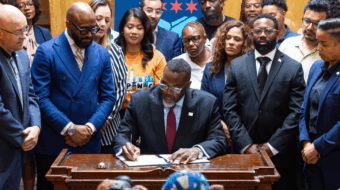
As one example of its work in the states, the BlueGreen Alliance cites work with the Oregon legislature and Gov. Tina Kotek (D) to set environmental and labor standards for planned windfarms off the state’s Pacific Coast. That bill became law in 2024. It’s “a blueprint on what is possible when you move at the pace of partnership rather than a race to be first,” BlueGreen Alliance Oregon State Policy Manager Ranfis Giannettino Villatoro said then.
“Bringing offshore wind to Oregon’s coast must be done correctly, including strong workforce equity provisions, robust labor standards, and ensuring that labor, conservationists, tribal leaders, and a diverse community of stakeholders are engaged to explore the impacts and benefits of offshore wind development. Today’s framework moves Oregon forward through careful planning and partnership.”
The new law told the state Department of Land Conservation and Development “to develop an Offshore Wind Roadmap to support Oregon’s goals and policies related to communities, economic opportunity, protection of Tribal resources, offshore wind workforce development, environmental protection, and state energy and climate objectives.”
It also mandated strong labor standards for any proposed wind projects and gave coastal communities and current ocean users “a seat at the table” where wind project decisions are made.
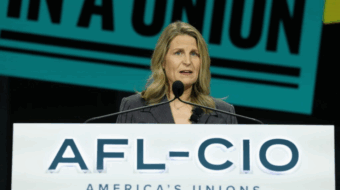
“As the Oregon economy shifts toward greener energy sources, it is essential workers are protected every step of the way,” state AFL-CIO President Graham Trainor said then. The new wind project law “ensures strong labor standards for construction, operations, maintenance, and manufacturing jobs, including the highest level of worker training and earn-as-you-learn apprenticeships, living wages, and family-supporting healthcare.”
But that success, which Walsh cites, also shows the limits of working state by state. Wind farms depend on federal tax credits and federally approved leases and permits. And Trump hates wind farms, because they aren’t powered by the fossil fuel firms, who are big GOP campaign contributors.
Trump and his Interior Secretary, Doug Burgum, canceled all wind farm permits. The Trump-GOP “Big Beautiful Bill” removed the tax credits. And Trump and Burgum push for more oil and gas drilling on federal lands. The federal government owns 28% of all U.S. land, with the highest shares in Nevada (80%), Utah (63%), Idaho (62%), Alaska (61%), and Oregon (53%).
Trump “presents the false choice of ‘Do you want to have a job or do you want a clean environment?’
Social movements are the most powerful forces against that dichotomy. But we have to develop successes” they can cite, says Walsh. “So we’ll develop our own platform next year and make the case that it’s good politics, too.”
“We fight like hell, and it’s hard, because it’s not just Trump and his cronies, but a Republican-controlled Congress that has become supine and a personality cult for Trump,” Walsh explains. “We’re trying to hold them accountable.”
We hope you appreciated this article. At People’s World, we believe news and information should be free and accessible to all, but we need your help. Our journalism is free of corporate influence and paywalls because we are totally reader-supported. Only you, our readers and supporters, make this possible. If you enjoy reading People’s World and the stories we bring you, please support our work by donating or becoming a monthly sustainer today. Thank you!
CONTRIBUTOR