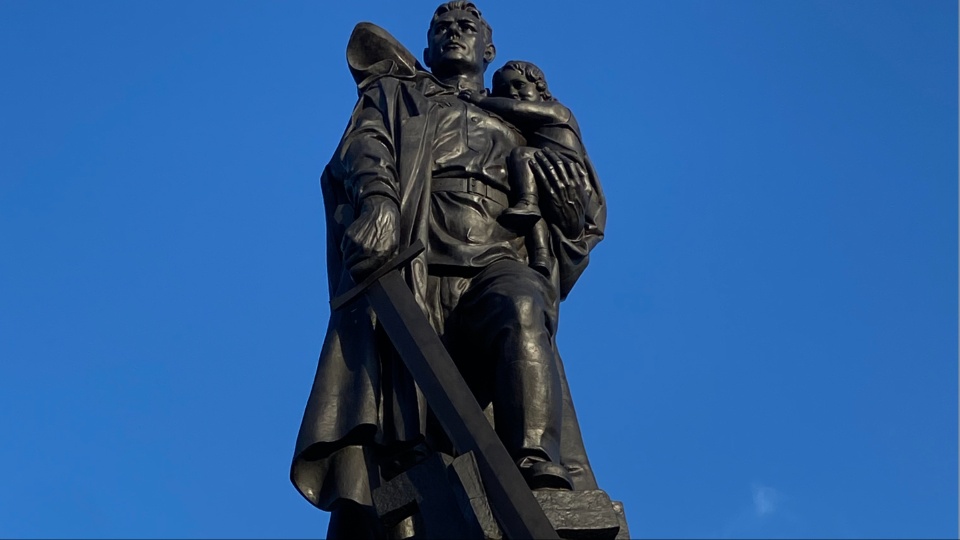
BERLIN—On the night of April 7, 2022, the world-famous Soviet War Memorial in Treptower Park, the final resting place of some 7,000 Red Army soldiers who lost their lives in the fighting for Berlin in April and May 1945, was desecrated.
Graffiti—swastikas and slogans in English such as “Death to all Russians,” “Russia kills,” and “Russians = Rapists”—was found throughout the extensive grounds, from the Motherland Calls sculpture to the hill with the monumental statue of a soldier holding a child. At the time, an employee of a cleaning company tasked with removing the damage told the Junge Welt newspaper that the graffiti was so extensive that it seemed as if “an entire school class” had been at work—apparently professionals at leaving no trace, as the perpetrators were never caught.
Although Ukrainian historian Yevheniia Moliar recently called for the “sacred status” of the memorials to be “broken,” an incident of this magnitude has not been repeated since. The impetus behind the desecration of the memorial—the attack on Soviet commemorative symbolism and its connection to the war in Ukraine—has become professionalized.

What seemed hasty in 2022—such as the demand by Stefanie Bung, then the CDU parliamentary group spokesperson for urban development in the Berlin House of Representatives, to remove the two T-34 tanks in front of the memorial in the Tiergarten as “symbols of aggression”—is now being approached cautiously, step by step.
The three Soviet war memorials in Berlin—in Treptower Park, Schonholzer Heide, and Tiergarten—have become battlegrounds in the debate surrounding the interpretation of the Russian attack on Ukraine.
A coalition of political, historical-political, and “civil society” actors is working to reinterpret, “contextualize,” and alter these sites, ultimately aiming to “de-Sovietize” them. The anti-Soviet iconoclasm that has swept through eastern Europe with renewed vigor since 2022 is thus also reaching Germany, where, after 1990, initially “only” the various layers of the anti-fascist and communist culture of remembrance left behind by the German Democratic Republic were attacked, erased, and overwritten. Much of that continues today.

The statue of Ernst Thälmann, leader of the historic Communist Party of Germany, in a park in what was East Berlin is regularly vandalized in the same fashion as the Treptower Park Memorial. During the Nazi period, Thälmann was imprisoned in the notorious Buchenwald Concentration Camp, where he was executed and communists later led the only movement inside a concentration camp that resulted in that camp’s liberation.
After World War II, the GDR constructed the Memorial to the Victims of Fascism and Militarism in Berlin, which featured a constant guard and an eternal flame burning at the site. After the GDR was annexed to West Germany, that flame was extinguished. Authorities never touched the huge monument to monarchy, the statue of Frederick the Great on horseback, just opposite that memorial, however.
Nearby, the enormously popular Palace of the Republic, a cultural and recreational venue popular in the GDR, was torn down and replaced with a hollow empty facade of the Kaiser’s Palace. Frequent mass demonstrations against the destruction of the beloved center by the population were ignored.
The TV Tower constructed in Berlin during the GDR days was always a sore spot for right-wingers in the Federal Republic of Germany, as it could be seen all over West Berlin as well as East Berlin, the capital of the GDR. It was for a while the fourth-tallest building in the world. Now, in the area where it stands, new construction blocks the view of the tower when you are in the area around it. Elsewhere in the city, of course, it can be seen from almost everywhere. What was a low-cost public facility is now an expensive restaurant and tourist attraction. Similarly, hotels all over the former GDR that were vacation spots for workers are now luxury hotels for businessmen.
For a long time, though, the memorial sites with a direct connection to the Soviet military’s defeat of Nazi Germany remained untouched. The central argument against the memorials in their current form is inherently contradictory: On the one hand, Russia is accused of instrumentalizing the memorials; on the other hand, it is claimed that the memorials, with their Soviet character, are as such an authentic expression of an “imperial” policy that continues in the war in Ukraine.
Since 2022, this contradiction has been translated into political action with the annual ban on displaying Soviet flags and other symbols at the memorials on May 8 and 9. The fact that it can be normalized to prohibit the display of the liberators’ flag at their graves on the day of liberation from fascism in the former capital of Nazi Germany has whetted the appetite for more.

Since 2025, there has been an increase in attempts to alter the appearance of war memorials. Eastern European actors play a significant role in this, indirectly introducing a line of inquiry into the mainstream of the German debate on the politics of remembrance, derived from the programmatic declaration of the so-called “Platform of European Memory and Conscience,” which equates Nazism and Communism.
Organizations and individuals of the Ukrainian nationalist diaspora—such as the Vitsche association and the Berlin-based Ukrainian Institute (arguing along the lines of a “decolonization” of the memorials, based on the claim that the relationship between Russia and Ukraine in the USSR was a colonial one); the anti-Soviet Memorial association; the Pilecki Institute, which has been operating in Berlin as an outpost of Polish anti-communist historical policy since 2019; institutions of belligerent ideology production such as the Konrad Adenauer Foundation-sponsored “Cafe Kyiv”; Ukrainian and German historians (who, since 2022, have largely acted as maximalist amplifiers of the state’s position, much like the discredited “eastern studies” of the past)—and increasingly also parts of Berlin state politics are active in the debate about the memorials.
The main argument here is for a more or less invasive “contextualization” of individual elements of the memorials. This method has a certain tradition—one need only think of the handling of the memorial erected in 1981 in Berlin’s Lustgarten for the resistance group around the communist Herbert Baum.

Since simply removing the memorial seemed too risky, but it was also inconceivable that a communist monument bearing the inscription “Forever bound in friendship with the Soviet Union” could remain in the heart of Berlin, the idea arose to cover the memorial stone with glass plates on which the monument would be commented on according to the dictates of German historical policy.
Similar preparations are now under way for the war memorials. Since 2025, two Social Democrat (SPD) members of parliament, Andreas Geisel and Alexander Freier-Winterwerb, have been particularly active. Both have recognized (or been told) that a redesign of the memorials can best be presented as a measure against “Stalinist bombast.” In October 2025, they called, among other things, for commentary on the Stalin quotes engraved on some of the stones and a stronger emphasis on the memorial’s character as cemeteries. The Berliner Zeitung newspaper thundered: “Away with the Stalin propaganda at the Treptow War Memorial!”
This opens a path to ultimately deeming the entire memorial “Stalinist” (or, depending on the context, “imperial”) and calling it into question. This was evident from the program of a conference held on March 26 at the Berlin-Karlshorst Museum—a joint event organized by the museum, the Ukrainian Institute, and the “Federal Foundation for the Study of the SED [Socialist Unity Party] Dictatorship” (in East Germany).
Under the telling title “Foreign Remembrance—Our Own Responsibility?” discussion focused on “Soviet Memorials and German Culture of Remembrance,” with the opening panel tellingly addressing “Coming to Terms with Communism in Germany.”
Only afterwards was the discussion turned to “Dealing with Memorials and Cemeteries.” At the site where Nazi Germany’s unconditional surrender was signed on May 8, 1945, the structurally and primarily anti-communist “German culture of remembrance” comes into its own. It could not be demonstrated more clearly that the intended new approach to the war memorials is understood as a kind of conclusion to the political debate surrounding “Communism in Germany.”
The conference caused quite a stir after an RT report referred to it as a “secret conference,” especially since Jorg Morre, the museum’s director, subsequently told the Berliner Zeitung: “We were not interested in public reporting on March 26. That was the selection criterion for our guests.”
Just before the anniversary of the liberation this past weekend, Berlin’s state politicians took action. A motion from the Green Party, which the Left Party (Die Linke) supported at the committee level, proposes entering into dialogue not with Russia, but with the 14 other successor states of the USSR—several of which, as is well known, pursue a policy of rigorously removing Soviet monuments—about what the future of the memorials could look like. SPD representative Freier-Winterwerb reiterates in his motion the demand to “contextualize” the Stalin quotes. The SPD’s coalition partner, CDU, will now form an opinion on the matter.

Undoubtedly, the (foreign) policy costs associated with intervening in the design of the war memorials are also being considered. In the agreement between the Federal Republic of Germany and the Russian Federation on the “care of war graves” of December 1992, the Federal Republic committed itself to maintaining and caring for the Soviet war cemeteries in Germany, guaranteeing access and dignified conditions for commemorative events, and informing the Russian side about restoration and maintenance work.
However, the 1992 agreement only guarantees the existence of the war cemeteries, not the architectural design and political symbolism. A greater obstacle appears to be the historic preservation regulations, which make it difficult to simply remove or overwrite individual design elements.
One factor, however, cannot be factored into the equation: political opposition. In the Berlin House of Representatives, only Rep. Alexander King of Sahra Wagenknecht’s party has so far spoken out against the redesign of the war memorials.
He told Junge Welt last Thursday that the plan to reinterpret the Treptow War Memorial is “clearly in line with the logic of anti-Russian propaganda.” In his view, “neither German politicians nor Memorial EV [the German wing of the anti-Soviet Memorial organization], which is collaborating with Berlin SPD representatives on this matter,” are authorized to “develop or even implement changes to the memorial” without the consent of the Russian embassy.
Republished from Junge Welt (www.jungewelt.de). John Wojcik contributed to this article.
We hope you appreciated this article. At People’s World, we believe news and information should be free and accessible to all, but we need your help. Our journalism is free of corporate influence and paywalls because we are totally reader-supported. Only you, our readers and supporters, make this possible. If you enjoy reading People’s World and the stories we bring you, please support our work by donating or becoming a monthly sustainer today. Thank you!
CONTRIBUTOR