WASHINGTON—In dealing with the impact of artificial intelligence on their lives, and particularly their jobs, more voters—though not a majority—trust unions for accurate information, and nobody else.
They most certainly distrust corporate chieftains who rush to embrace AI as a way to save time and money, and in many cases are rushing to use it to replace human beings. They also show no love for politicians who cater to the abusers of AI.
The survey by the independent pollster David Binder Research, released May 12 by the AFL-CIO, comes as tumult over AI grows. Moguls such as Jeff Bezos at Amazon view it as a cost-saver and work saver.
Unions have been warning of the threat of AI to millions of blue, white, and pink-collar jobs and trying to come up with ways to deal with it on workers’ behalf. The AFL-CIO has set up an entire institute whose mission concentrates on AI, its impact, and how to curb it or turn it to workers’ advantage.
SAG-AFTRA again dealt with AI and its impact in its second consecutive tentative agreement with the Association of Motion Picture and Television Producers, reached the week of May 10.
This time, the union sought and won even tougher guardrails on AI. It also didn’t have to go on strike to do so. AMTMP members—the big studios, streaming video firms, and similar enterprises—forced a long SAG-AFTRA strike during the contract talks. And AI was the big and final snag in that pact.
Media moguls were determined to use AI to replicate a performer’s image, voice, mannerisms, and even clothes, and then use them over and over and over again without compensating her. The union finally won curbs on such copycatting and royalties for repeat usage. This time, studios agreed not to use AI-generated “synthetic characters” unless “they bring unique value to a production,” Variety reported.
In the survey, 91% sided with SAG-AFTRA on ordering bosses to get permission from workers before such uses. And 78% said there must be curbs on all bosses’ harmful uses of AI against workers.
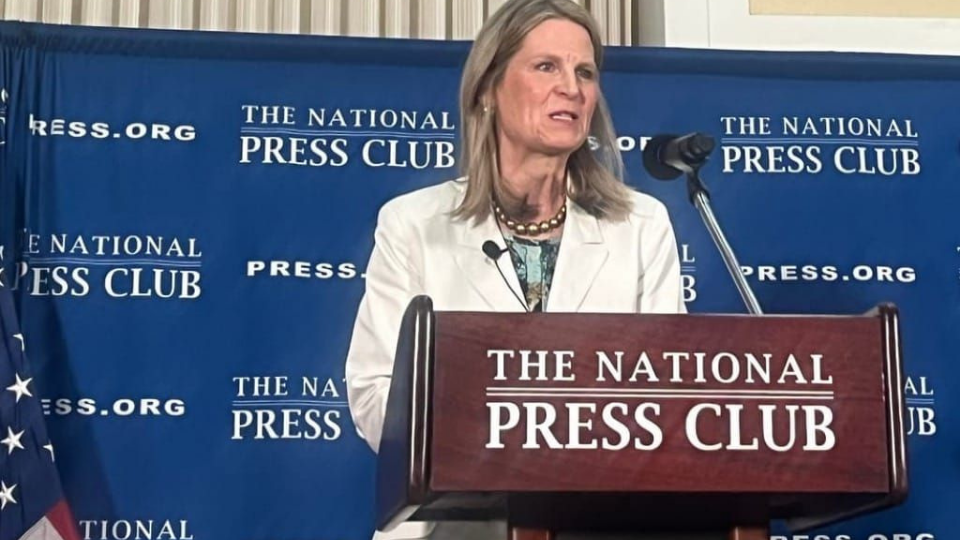
Still, the threat looms ever larger, warns AFL-CIO President Liz Shuler, who set up that institute. “We are at the most important fork in the road our economy has faced in the last 100 years,” Shuler told a National Press Club newsmaker session in late April.
“Last month, one of the big banks put out its projections on the state of the economy. This bank said, on the conservative side, seven percent of workers would be displaced by AI over the next few years.
“We have some 163 million workers in America. Does anyone want to do some back-of-the-envelope math for me on what’s seven percent of 163 million workers? A lot. That’s 12 million Americans–a group of people the size of Pennsylvania losing their jobs.”
Her voice rising, Shuler asked the crowd: ”Does anyone think that calls for business as usual?!”
“Are we just going to sit around and let that happen?… Does anyone want to continue this race to the bottom…where workers are being fired, discriminated against, surveilled, without our consent? Where this handful of billionaires…gets to play God with our economy and our lives? Hell, no.”
By contrast, and as a symbol of AI’s threat to jobs, Republican President Trump, catering to the corporate CEOs who fund his party’s campaigns, and who always seek to either exploit or fire workers in the style of unbridled capitalism, staunchly opposes curbs on AI by either the federal government or states. His party, by and large, agrees with his stand.
The poll results are from a scientifically selected and weighted sample of 1,164 registered voters in mid-April, including an oversample of 364 unionists. It shows the U.S. apparently doesn’t agree with Trump—and doesn’t trust the Republicans, the Democrats, or the corporations to deal with the threat.
The poll has an error of plus or minus 2.9 percentage points, compared to the results if the entire nation were surveyed. Specific findings included:
- Overall, 92% of those surveyed say society must confront the threat to jobs from AI. Unions get a 38% positive score (12% negative) from all voters–43% positive from independents–on that front, especially on the need for human control of key decisions such as evaluating resumes, hiring, firing, promotions, and discipline.
That pro-union score may not sound impressive, but it is more favorable than evaluations of AI stands by the Democratic Party (17% positive), the Republicans (10%), and the employers (6%)—combined.
- Every pro-worker, pro-privacy protection tested by the pollsters garnered at least 75% approval. Ironically, strengthening union contracts overall, not just against AI, had that figure.
- The leading figure, at 95%, was to “require a human to be the final decision-maker on any issues that affect individual workers and their employment.” Second, at 94%, was “fight back against misinformation,” which AI generates.
- Some 94% of respondents say the boss should inform them, in advance, that AI is being used to monitor their work. But only seven percent say the boss actually does so.
That 7% doesn’t include Amazon. The huge anti-labor rights retailer and warehouse giant uses the badges it mandates workers wear to track them, sending radio signals to a central command post. When workers step away from their assigned positions–even if it’s to go to the restroom—the badges signal they’re taking “time off task.” Too much “TOT” gets you an AI algorithm-generated pink slip.
- Other findings showed 92% supported “advance guardrails against misuse of AI in the workplace,” and “holding governments accountable for responsible use of AI” in that sector. Some 85% want to “ensure workers have a say in how technology is designed and developed” for their work.
The federation also commissioned some focus groups on AI from a different firm. Those participants voiced doubts, too. One union member put it in labor law terms:
“An algorithm can’t be held accountable for unfair labor practices. So these companies can just defer and say, ‘Oh, well, nobody made that decision. It was the AI,” that worker said.
We hope you appreciated this article. At People’s World, we believe news and information should be free and accessible to all, but we need your help. Our journalism is free of corporate influence and paywalls because we are totally reader-supported. Only you, our readers and supporters, make this possible. If you enjoy reading People’s World and the stories we bring you, please support our work by donating or becoming a monthly sustainer today. Thank you!
CONTRIBUTOR