DENVER—“A Truth in art is that whose contradictory is also true,” writes Oscar Wilde in his 1885 essay “The Truth of Masks.” There are strains of Marxist thought that have taken note of this remark, both as a reminder to think dialectically and as a way to explore the overlap between aesthetics and politics. An exhibit that has been running this Spring at the Redline Contemporary Arts Center in Denver, Colorado, exemplifies this dialectic in revolutionary—but not always obvious—ways.
The exhibit is entitled UNSEEN: Frames of Quiet Witnesses. It brings together seven Colorado Photographers with members of Colorado’s Palestinian diasporic community into various artist-subject relationships. It was produced at the Redline Center—after a considerable struggle lasting more than a year—by the Sumud Artistic Collective, a group of artists and activists who seek to amplify and celebrate Palestinian life in Colorado, throughout the diaspora, and of course in historic Palestine.
The seven photographers are: Malek Asfeer, Amanda Villarosa, Armando Geneyro, Blake Jackson, Elly Michaels, Molly Olwig Solorzano, and Sierra Jeter. The Sumud Artistic Collective consists of Malek Asfeer (Creative Director), Meera Alul (Creative Lead), Abdullah Elagha (Community and Education Lead), Josie Angel (Project Manager), and Joie Ha (Creative Operations). According to Sumud’s Exhibit Statement:
UNSEEN disrupts flattened representations that limit Palestinians to tropes of victimhood or threat. The show features intimate portraits that uncover the lives of Palestinians beyond the headlines, where daily routines unfold alongside grief, memory, and an unbreakable connection to home.
In other words, these Palestinians living in Colorado, and the tokens, small and great, of their lives here and in their homeland, evoke at once the glorious ordinariness of day-to-day living and the momentous struggle for survival and liberation that they also embody. The very design of the exhibit itself displays this paradox, with a comfy living room setting (including a wide-screen TV playing a continuous loop of children in genocide-torn Gaza) in one corner of the room (“Life at Home”); and a pile of wreckage in the center just a few feet away, in which food wrappers, dolls, shoes, a backpack and other artefacts lie semi-buried (“Life in Rubble”). On the standing beams of this re-creation of smashed lives are Arabic graffiti of revolutionary slogans. Also included are four works of ceramic art by Meera Alul. All of this gives context to the featured photographs without ever overwhelming them.
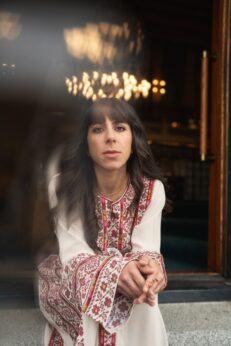
Among these many works of nuance, precision, exploration, and multiple dimensions (though few are collage or otherwise overtly multiform), this article can only include and discuss a precious few by Creative Director Malek Asfeer. “Nimbus” shows subject Natalie Baddour, in traditional embroidered thobe, framed by a large, open rectangular window from which she appears to emerge (at the Colorado State Capitol building, as it happened). A light fixture inside the room behind her provides the halo, or “nimbus” of the title, in ironic contrast to Natalie’s ghost of a smile, which bespeaks an inspiring combination of wit and iron determination.
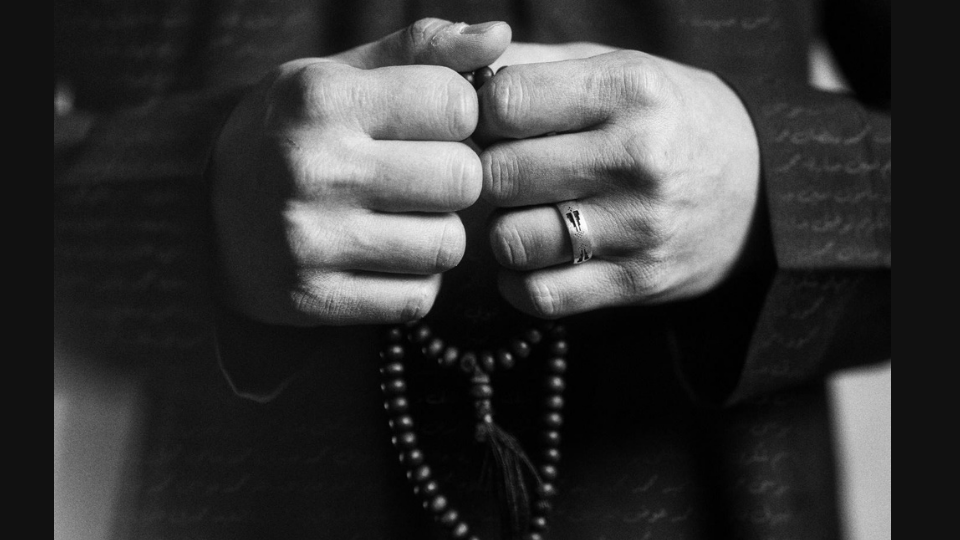
Another of Asfeer’s works is “Standing Witness,” a black and white detail of a man holding prayer beads. The sharper focus is on the man’s hands, and the beads they hold, but the wedding ring on the left hand’s finger conveys kindred, though of such whose fate we can’t know. So, though we do not see his face, the picture is one of a person calling on faith, family, and heritage to carry him and those dear to him through challenges quotidian and world-historical. Only seeing the subject’s torso and hands, the viewer is left to decide if the work is Standing Witness to hope, anguish, or both.
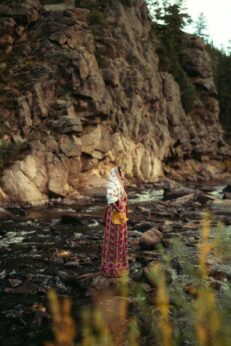
“A Carried Home” is in one sense a variation on a time-honored Colorado theme: A lone figure stands on a rock in the middle of a bucolic stream in the mountains. But this is Sara Shawish, born in Jordan, her grandparents married in Bethlehem, a family heritage so rich in learning, love, and fulfillment; yet Sara and her family have overcome the “otherness” of language and culture and imposed stereotypes here and genocidal violence at home. The stream and the mountain landscape in which she stands seem to perfectly accept, even celebrate, her ornately embroidered dress, which is yet redolent of an identity that might have gotten her arrested on an American university campus in these times. Sara is so at home in this natural setting, and she brings with her the gift of a home from half a world away.
Perhaps the most provocative work in the collection is the title one. “UNSEEN” is Asfeer’s extreme close-up of the pupil and iris of one of Abdullah Elagha’s eyes. In the exhibit’s own description, “the circle holds the names of Abdulla Elagha’s martyred family members, all children under 18.”
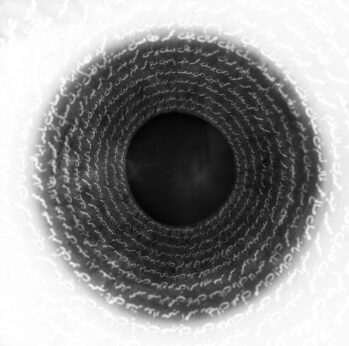
“They do not present themselves all at once. From a distance, they appear as texture, almost inconsequential. From far away, suffering and pain become merely a shape, a pattern, and therefore easy to pass over. As one approaches, the names appear gradually, each pressed against the other as a woven thread with no beginning and no end. Without Hierarchy and without punctuation.”
Capitalism and imperialism work together to render their structural violence invisible. The inspection of the body’s organ of seeing invites the viewer to eventually see the names of the martyrs in Abdullah’s family, just as close inspection of the global conditions we live under reveals the heroism of the day-to-day, the ordinariness of withstanding suffering, and the quiet violence of our complicity in genocide, whose glaring and howling slaughter becomes more impossible to deny from minute to minute. UNSEEN: Frames of Quiet Witnesses, however, does not accomplish this in the usual ways.
Even the subtle, gentle, and unimposing qualities of this exhibit faced a protracted uphill struggle to be shown at Redline, an institution that prides itself on being one “that fosters education and engagement between artists and communities to provide creative opportunities for positive social change.” Yet the Redline’s own website identifies Laura Merage as a Board member and as the Founder of Redline—and also as on the Board of Directors of the Mountain States and National Anti-Defamation League, thought by some to be a notoriously Zionist organization. What it doesn’t say is that the Merage family are heirs to the HotPocket fortune. She thus unites capitalist class hegemony, Zionist hasbara in the U.S., and “philanthropic” gatekeeping in the arts. Merage was the primary obstacle to the UNSEEN exhibit, finally overcome this year.
Much leftist thought on the role of the arts in our struggles insists on stridency, strict dogmatism, and loud confrontation. The oppressors seek to make their inhuman conditions seem second nature, the “will of God,” or simply the “way things are.” UNSEEN reveals the revolutionary in the everyday, and the resistance of quiet witness. May the Sumud Artistic Collective bring us more work of this subtle and nuanced kind of power!
We hope you appreciated this article. At People’s World, we believe news and information should be free and accessible to all, but we need your help. Our journalism is free of corporate influence and paywalls because we are totally reader-supported. Only you, our readers and supporters, make this possible. If you enjoy reading People’s World and the stories we bring you, please support our work by donating or becoming a monthly sustainer today. Thank you!
CONTRIBUTOR